AUSTRALIAN EYES ON AMERICA
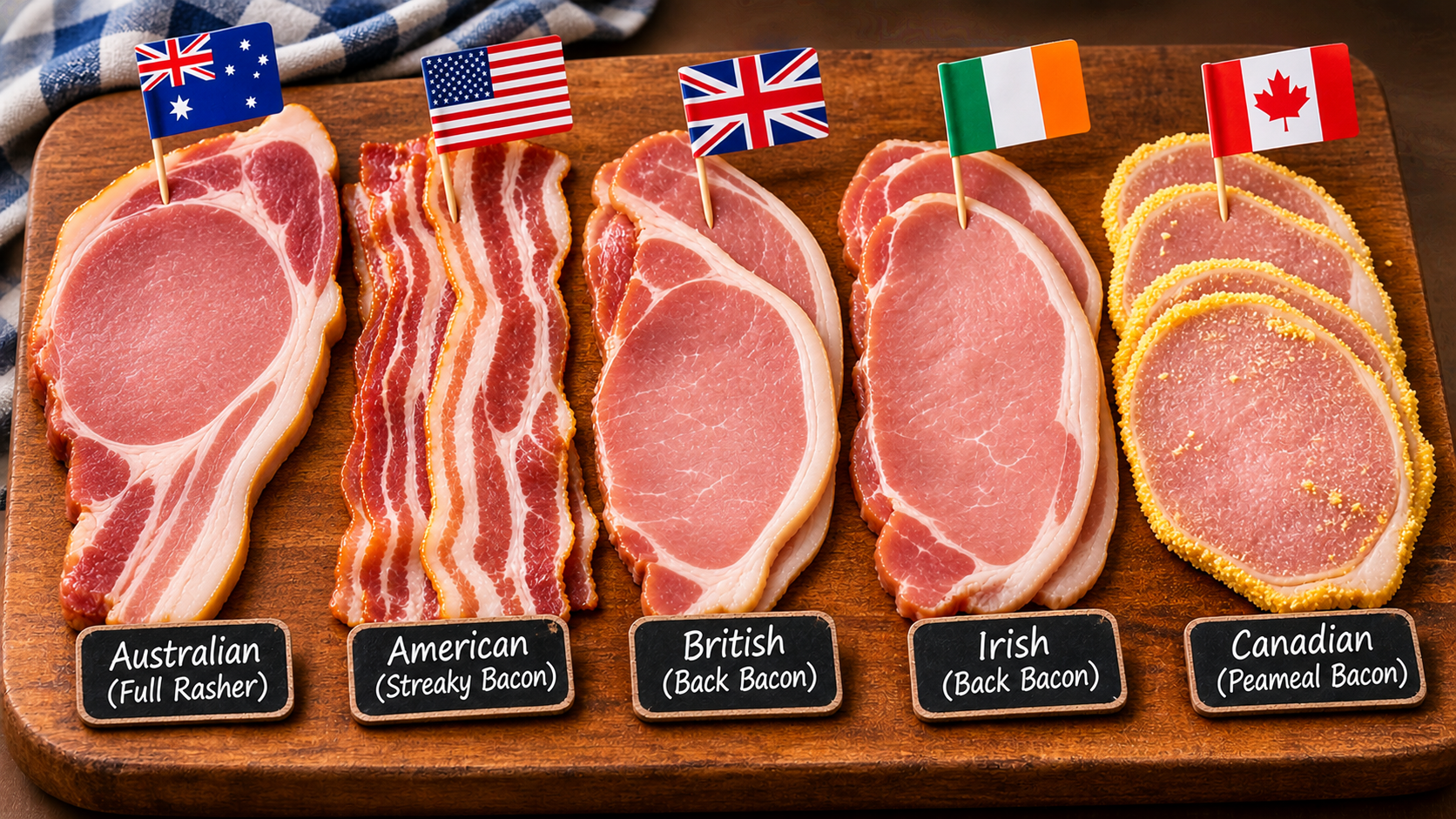
Five countries. One animal. And apparently five different ideas about what bacon should look like.
Australia, The United States, Great Britain, Ireland and Canada all love bacon. We fry it, grill it, put it in sandwiches and serve it alongside eggs. But ask someone from each country to describe a proper rasher, and you might be surprised by the answers.
I’m Australian, and I’ve lived in America for over eight years. I’ve adapted to plenty of things here, but American bacon is one battle I haven’t surrendered.
It’s thin, it’s small and it’s fatty. And when I cook it, I sometimes wonder whether I’m preparing breakfast or extracting crude oil.
So how did five countries end up with such different bacon traditions? And more importantly, can anyone explain why America decided the best bacon should be so crispy it falls apart when you drop it?
Australian Bacon: Give Me a Proper Rasher
Growing up in Australia, bacon meant a proper, full rasher.
You had the large, round, meaty eye at one end, with a narrower, fattier tail attached. It was a decent piece of meat, not something you needed a magnifying glass to locate on your plate.
I always preferred the meaty part. A little fat was fine, but the meat was the main attraction.
And there was nothing better than a good old-fashioned Australian bacon and egg roll.

Just bacon, egg and tomato sauce. That’s it.
No avocado or fancy cheese. No elaborate selection of sauces. Just a decent rasher of bacon, an egg and enough tomato sauce to make the whole thing slightly messy.
It’s funny how the simplest Australian foods become the things you miss overseas. I’ve noticed the same thing with Australian chicken salt, another everyday staple that’s surprisingly difficult to replace in America.
Growing up, bacon and eggs were also a regular Sunday night dinner in our house. If nobody felt like cooking anything elaborate, out came the frying pan.
It was simple, filling and delicious.
The Australian full rasher is generally made from what’s called middle bacon, which includes both the loin and belly portions of the pig. The loin provides that big, meaty eye, while the belly creates the streaky tail.
Not all Australian bacon is sold this way. You’ll also find shortcut bacon, which is mostly the lean loin, and streaky bacon, which comes from the belly. But the traditional full rasher was what I always bought.

American Bacon: Where Did All the Meat Go?
When I first moved to America, I was genuinely surprised by the bacon.
I opened the packet and wondered where the rest of it was.
Instead of the substantial rashers I was used to, I found these long, narrow strips with what appeared to be considerably more fat than meat.

I didn’t like it then, and eight years later, I still don’t.
The standard American bacon is made from pork belly. That’s why it’s so streaky, with layers of fat running through the meat.
It’s also why cooking it can be an adventure.
Try cooking American bacon on the barbecue, and the dripping fat can cause flare-ups. I’ve found myself wondering whether breakfast is worth setting the barbecue on fire. Thankfully I’ve had fire blankets at the ready!
Cook it in a frying pan, and by the time you’re finished, you’ve got enough grease left over to make you question where the bacon went.
Apparently, there’s even a market for bacon grease containers with strainers. I never imagined needing a dedicated storage facility for bacon fat, but after eight years in America, I can see why they exist.
I’ve tried thick-cut American bacon too. I thought maybe that would solve the problem.
It didn’t.
It’s essentially the same fatty bacon, just thicker.
And American bacon isn’t exactly cheap, either. I’m regularly surprised by what it costs at the supermarket, especially when so much of it seems to disappear during cooking.
The other thing I’ve never understood is the American enthusiasm for extremely crispy bacon.
Now, I like bacon with a little browning. It should be properly cooked, with a bit of colour around the edges.
But I don’t want it so crispy that if I drop it, I need a dustpan and brush to collect breakfast.
Plenty of Americans love that crunch. It’s part of the appeal. For me, though, bacon should still have some softness and substance.


British Bacon: Closer, But Not Quite There
Britain is where things start looking a little more familiar to an Aussie.
British bacon commonly comes in the form of back bacon, cut primarily from the pork loin. It has a large meaty portion, sometimes with a smaller strip of belly attached.
That makes it considerably closer to the bacon I grew up eating than standard American streaky bacon.

In the UK, bacon is central to the traditional cooked breakfast, but it’s equally at home in a bacon butty, a straightforward bacon sandwich that doesn’t need much dressing up.
British supermarkets sell both smoked and unsmoked bacon, along with different curing styles.
The distinction between back bacon, middle bacon and streaky bacon matters because these aren’t just different names for the same product. They’re different cuts of pork.
The British pork industry’s Love Pork guide explains the differences between back, middle and streaky bacon.
Recently, I decided to try ordering some British bacon here in the US.
After years of putting up with American bacon, I thought maybe I’d finally found the answer.
And it was better.
Definitely better.
But it still wasn’t quite the Australian bacon I remembered.
That doesn’t mean British bacon is inferior to Australian bacon. In fact, the two can be very similar, depending on the cut and how they’re cured.
The British bacon I ordered simply wasn’t the full Australian rasher I was hoping for.
So the search continues.

Irish Bacon: Another Country That Understands a Proper Rasher
Ireland deserves a place in this discussion because Irish bacon is another close relative of the Australian rasher.
A traditional Irish breakfast often includes back bacon rashers alongside eggs, sausages, black pudding, white pudding and other cooked breakfast favourites.
Irish back bacon is made primarily from pork loin, although the amount of attached fat and belly can vary.
Like Britain, Ireland has smoked and unsmoked varieties, as well as different curing methods.
Dry curing, for example, involves applying a curing mixture directly to the meat rather than relying on a liquid brine. It can produce a firmer texture and a different flavour, depending on the recipe and processing.
Irish bacon isn’t universally different from British bacon. The two countries share a great deal of culinary tradition, and their back bacon can be fairly similar.
The distinctions often come down to the producer, the particular cut, the curing process and individual preferences.
But from my perspective, Ireland is at least starting with the right idea: a decent piece of meat.
I haven’t conducted an exhaustive taste test of Irish bacon, so I’m not going to declare it better or worse than the Australian version.
Although if somebody wants to arrange an international bacon tasting, I’m prepared to make myself available.

Canadian Bacon: Now I’m Completely Confused
Then we come to Canada.
And this is where the international bacon discussion gets a tad strange.
Because what Americans call Canadian bacon isn’t necessarily what Canadians themselves mean when they talk about bacon.
In America, Canadian bacon is usually sold as round slices of cured pork loin. It’s lean, often smoked and frequently sold fully cooked.
To me, it looks and tastes much more like ham than the bacon I grew up with.
I’ve tried it, and I’m still not entirely sure what to make of it.
It’s not really similar to American streaky bacon, and it doesn’t resemble the Australian full rasher either.
Yet somehow, it’s bacon.
Meanwhile, in Canada itself, ordinary everyday bacon is often the same pork belly-based streaky bacon commonly sold in America.
But Canada also has another bacon tradition worth knowing about: peameal bacon.

Peameal bacon is made from cured, lean pork loin, usually rolled in cornmeal. It’s commonly associated with Ontario and Toronto.
Historically, ground yellow peas were used for the coating, which explains the name. Cornmeal eventually became more common, but the original name stuck.
Unlike the round, frequently precooked Canadian bacon sold in American supermarkets, traditional peameal bacon is usually sold uncooked and then sliced and fried.
It’s also popular in sandwiches.
Now that sounds considerably more appealing to me.
A substantial piece of cured pork loin in a roll? We’re finally getting somewhere.
And the naming confusion is genuine. The Dictionary of Canadianisms on Historical Principles, published by the University of British Columbia, explains that the American term Canadian bacon commonly refers to what Canadians call back bacon.
So Canada and America don’t even agree on what Canadian bacon should be called.
We’ve somehow managed to turn breakfast into an international diplomatic incident.

So What’s Actually Different About These Five Types of Bacon?
Despite the national arguments, the biggest differences aren’t really about geography. They’re about which part of the pig is used, how the meat is cured and how people prefer to cook it.
Here’s a simplified comparison of the main styles we’ve discussed.
| Country | Typical bacon style | Main characteristics |
|---|---|---|
| Australia | Full rasher or middle bacon | Loin eye with an attached streaky belly tail |
| United States | Streaky bacon | Pork belly, with alternating layers of fat and meat |
| Britain | Back bacon | Primarily loin, sometimes with a fatty tail |
| Ireland | Back bacon rashers | Primarily loin, with various curing styles |
| Canada | Streaky, back and peameal bacon | Everyday streaky bacon plus distinctive loin-based varieties |
Of course, these aren’t exclusive national products.
Australians can buy streaky bacon. British supermarkets sell it too. Americans can find back bacon through specialty suppliers, and Canadian shoppers have more than one option.
But the default expectations are different.
If an Australian asks for a full rasher, they’re generally expecting something quite different from the strips served with breakfast at an American diner.
Why does American bacon have so much fat?
It comes down primarily to the cut.
Pork belly naturally contains substantial layers of fat. As it cooks, some of that fat renders out, producing the grease I’ve become so familiar with.
Back bacon, made mainly from the loin, is generally leaner.
Middle bacon combines the two, giving you both the meaty eye and the streaky tail.
You can even buy a bacon press to keep the strips flat while they cook. Clearly, Americans have put considerably more engineering into bacon than I ever thought necessary.
Then there’s curing, smoking and seasoning. Bacon can be wet-cured or dry-cured, smoked or unsmoked, and prepared using different seasoning mixtures.
Those differences affect flavour, texture, saltiness and how the bacon behaves in the pan.
The point is that there’s no single universal definition of the perfect rasher.
Although I do have a fairly strong opinion.
The Bacon and Egg Roll Test
For me, the ultimate test of bacon is simple.
Can you make a proper Australian bacon and egg roll with it?
And this is where American bacon consistently lets me down.
I’ve tried.
But the strips are too narrow, too fatty and simply don’t provide the substantial meaty bite I want in a bacon and egg roll.
I’ve actually found that frying up some ham makes a better substitute.
Bacon isn’t the only familiar food I’ve struggled to replace. I had a similar experience discovering why American Chinese food tastes so different from the takeaway I grew up eating in Australia.
But think about bacon for a sec.
I’ve been living in America for eight years, and when I want something resembling an Australian bacon and egg roll, I’m better off using ham than American bacon.
I realise that’s probably sacrilege to some American readers, but it’s where I’ve ended up.
Back in Australia, I could get a decent bacon and egg roll from a takeaway shop without giving it a second thought.
Here, I’ve yet to find one that really comes close.
It’s one of those small everyday differences that reminds me how much can change when you move from Australia to America.
And I don’t want anything complicated.
Bacon. Egg. Tomato sauce.
That’s all I’m asking.

My American Daughter Thinks This Bacon Is Perfectly Normal
There’s another interesting side to all of this.
My wife, Nikki, is Australian too, so we both grew up with Australian bacon.
Our daughters, however, have had a very different experience.
Georgia was born in Australia, but she doesn’t remember Australian bacon.
Brianna was born here in America, and American bacon is all she’s ever known.
And Brianna likes it.
She has no problem with those skinny, crispy strips that I’ve spent eight years complaining about.
To her, that’s simply what bacon is.
Which makes sense when you think about it.
We tend to judge food against what we grew up eating. What seems perfectly normal in one country can look strange to somebody from somewhere else.
For Brianna, American bacon is normal.
For me, it’s still missing half the pig.
I’m not suggesting one country is objectively right and the others are wrong. Plenty of people genuinely prefer American bacon, particularly the crisp texture and smoky flavour.
I just happen to be an Australian who misses the bacon he grew up with.

Eight Years Later, Australia Still Wins
After eight years in America, I’ve become accustomed to plenty of American foods.
But bacon?
I’ve written before about loving two countries without loving either one less. Apparently, that principle doesn’t extend to bacon.
I’ll eat American bacon if it’s served to me. I’m not going to make a fuss about it.
I’d just rather have something else.
Give me a choice between Australian and American bacon, and I’m choosing Australian every single time.
The full rasher, the meaty eye, the little bit of fat around the edges, and bacon cooked until it’s lightly browned without turning into something that could double as a roofing tile.
British bacon has come close. Irish bacon looks promising. Canadian peameal bacon is something I’d be interested in trying.
But nothing I’ve found here has quite replaced the Australian bacon I remember.
And I still miss a proper bacon and egg roll.
Enjoyed this little international bacon dispute? If you’d like to support more stories about Australian life in America, you can buy me a coffee and help keep From Down Under to Down South going.