AUSTRALIA EXPLAINED
Growing up in Australia, I thought I knew a thing or two about barbecues.
I’d spent years working as a chef, cooked plenty of meat in my time, and enjoyed more backyard barbies than I could possibly remember.
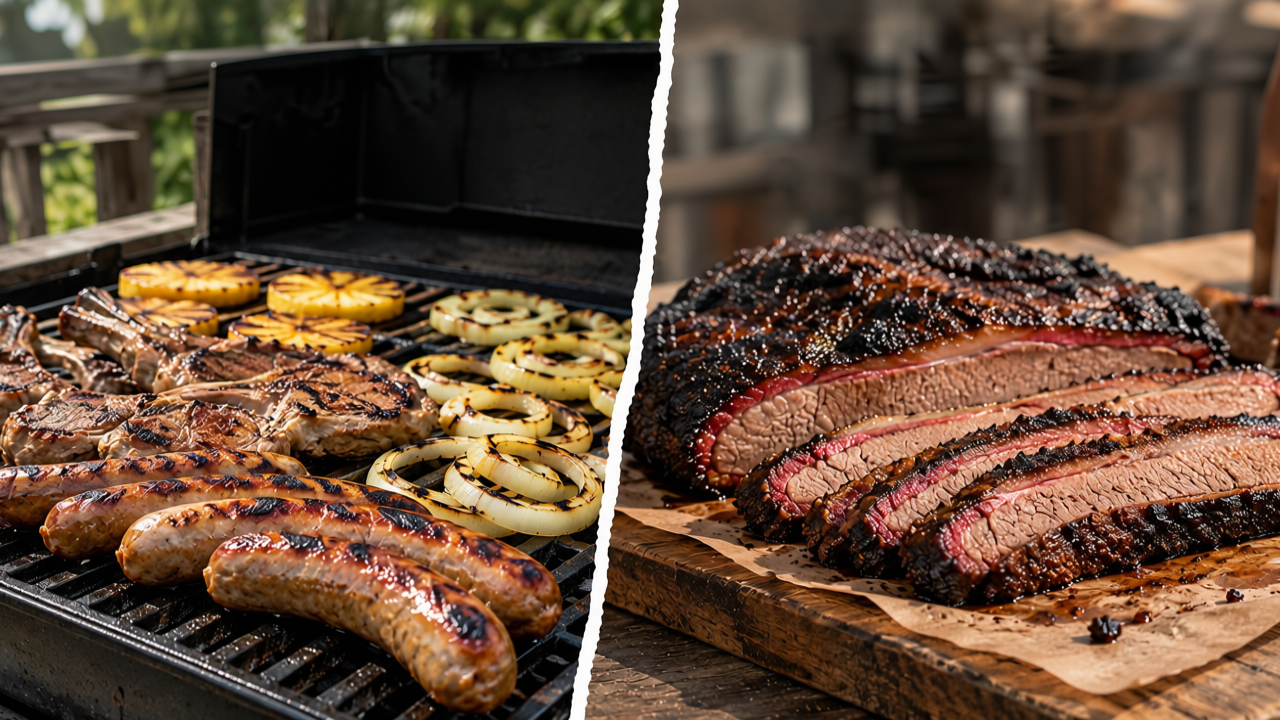
Sausages, steaks, lamb chops, a pile of onions on the hotplate. Nothing particularly complicated about it.
Then I moved to America.
I’d eaten pulled pork back in Australia, so American barbecue wasn’t completely unfamiliar territory. But there was one thing I hadn’t properly appreciated.
Brisket.
I had absolutely no idea how good brisket could be until I moved to Tennessee.

That dark, smoky bark on the outside. The juicy meat underneath. The flavour you get when somebody knows what they’re doing with a smoker and has the patience to let it do its job.
It’s now, by a country mile, my favourite American barbecue food.
And it got me thinking about something.
Australians and Americans both love a barbecue, but we don’t necessarily mean the same thing when we use the word. In fact, depending on where you are, the difference can be enormous.
It’s funny how moving to another country can change your appreciation of familiar foods. I’ve discovered that with American Chinese food too. Sometimes you think you know what to expect, only to discover something quite different.
What’s the Difference Between Australian BBQ and American BBQ?
The simplest explanation is that an Australian barbecue usually describes cooking food outdoors on a grill or hotplate, while traditional American barbecue often refers to meat cooked slowly using indirect heat and smoke.
Australians tend to associate a barbie with sausages, steaks, lamb chops and a casual gathering in the backyard.
In the American South, barbecue can mean brisket, pulled pork, ribs and other meats that have spent hours in a smoker.
But there’s an important distinction.
Americans also have backyard cookouts where they grill burgers, hot dogs and steaks, just as Australians do. And Australians certainly aren’t strangers to smoking meat.
The difference is more about the traditions and expectations surrounding the word.
| Australian BBQ | Traditional American BBQ |
| Often grilled over direct heat | Often slow cooked using indirect heat and smoke |
| Sausages, steaks, lamb chops and chicken | Brisket, pulled pork, ribs and smoked chicken |
| Gas barbecues, charcoal grills and hotplates | Smokers, barbecue pits and offset smokers |
| Tomato sauce, BBQ sauce and marinades | Dry rubs and regional barbecue sauces |
| Salads, bread rolls and grilled onions | Coleslaw, baked beans, mac and cheese and cornbread |
| Often centred on a casual gathering | A cooking tradition as well as a social occasion |
Neither description covers every barbecue in either country. But it gives you a pretty good idea of why an Australian and an American might have very different expectations when somebody announces they’re putting on a BBQ.
What Does an Australian Barbie Actually Look Like?
In Australia, you don’t need a special occasion to fire up the barbie.
A birthday, a family gathering, a Saturday afternoon, Christmas lunch, or simply a few mates coming around.
Sometimes the barbecue is the entire reason for getting together. Other times, somebody decides they’re hungry and the next thing you know, the gas bottle is being checked.
The food is usually straightforward.
Sausages are almost compulsory. Steaks and lamb chops are popular, along with chicken, burgers and whatever else somebody has brought along.
You’ll often find onions cooking on the hotplate, a bowl of potato salad somewhere nearby, and enough bread rolls to feed twice as many people as actually turned up.

Of course, Australian barbecues vary enormously. Seafood, kebabs, vegetarian food and all sorts of other dishes can find their way onto the grill.
But the basic backyard barbie I grew up with was rarely an elaborate production.
Someone cooked the meat. Everyone else stood around talking.
Occasionally, somebody would wander over and offer unsolicited advice.
There’s always one. Usually a bloke who hasn’t touched the tongs all afternoon but suddenly becomes an expert when somebody else starts cooking the steaks.
The Hotplate Is Part of the Story
One difference that doesn’t always get mentioned is the Australian love of a flat barbecue hotplate.
Many Australian barbecues combine an open grill with a solid cooking surface.
The grill handles steaks, chops and sausages. The hotplate is brilliant for onions, eggs, bacon and anything else you don’t particularly want disappearing through the gaps.
It’s a practical arrangement, especially when you’re cooking for a crowd.
And it means you can have several things going at once without needing an entire collection of cooking equipment.
I’ve always liked that about Australian barbecues.
They’re generally designed to get the food cooked, get everyone fed and get back to enjoying the afternoon.
Nobody needs to be standing beside the barbecue for twelve hours. Unless they’ve had a particularly bad week and are trying to avoid talking to the relatives.

The Sausage Sizzle: Australia’s Most Uncomplicated Meal
If you really want to understand Australian barbecue culture, you need to understand the sausage sizzle.
It’s a wonderfully simple concept.
Cook a sausage, put it diagonally across a slice of white bread, add some onions and tomato sauce, and hand it to somebody.
Done.
No brioche bun or artisan mustard. No complicated toppings.
Just a snag in bread.
Australians have a habit of putting their own stamp on food, whether it’s the humble sausage sizzle or what we call McDonald’s back home. Although I reckon a sausage sandwich from Bunnings is harder to beat.

You’ll find sausage sizzles at school fundraisers, sporting clubs, community events and, perhaps most famously, outside Bunnings hardware stores.
For Americans unfamiliar with Bunnings, imagine heading to a Home Depot on Saturday morning to buy a few things for the house and finding a community group outside selling freshly cooked sausages.
There’s a good chance you’d end up buying one whether you were hungry or not.
The Bunnings sausage sizzle has become such a familiar part of Australian life that many people associate a weekend hardware-store trip with the smell of onions cooking outside. The money raised goes towards local community groups, which makes the whole thing even better.
The Great Onion Controversy
Australians can be fairly relaxed about a lot of things.
Apparently, the correct position of onions on a sausage sandwich isn’t one of them.
In 2018, Bunnings recommended putting the onions underneath the sausage rather than on top.
The reason?
Loose onions could fall onto the ground and create a slipping hazard.
Yes, we managed to turn the humble sausage sandwich into a workplace health and safety discussion.
And naturally, people had opinions.
Personally, I think the important thing is getting the sausage into your mouth without losing half the onions down the front of your shirt. Although I’m sure somebody will disagree with me about that too.

American Barbecue Taught Me That Good Things Take Time
Moving to Tennessee introduced me to a different side of barbecue.
Here in the South, barbecue isn’t just a way of cooking dinner outdoors.
It’s a craft.
People spend years perfecting their techniques. They experiment with different woods, temperatures, rubs, sauces and cooking times.
Some have enormous smokers parked in their backyards. Others take their barbecue seriously enough to enter competitions.
And depending on what they’re cooking, they might start preparing dinner long before the guests have even thought about getting out of bed.
As a former chef, I appreciate the skill involved.
Cooking a steak over direct heat is one thing.
Taking a tough cut of meat, cooking it slowly for hours and turning it into something beautifully tender is another.
There’s a lot more happening than simply leaving a piece of meat in a smoker and hoping for the best.
Temperature control matters. So does the cut of meat, the amount of smoke, the seasoning and knowing when it’s actually ready.
And brisket can be particularly unforgiving.
Get it wrong and you’ve spent most of the day producing something that needs a fair bit of chewing. Get it right, though, and it’s magnificent.
Why Brisket Became My Favourite American BBQ Food
I genuinely didn’t know what I was missing.
Brisket was hardly an unknown cut of beef in Australia. But the slow-smoked American version wasn’t something I’d grown up eating at backyard barbecues.
Here, I’ve discovered how good it can be.
That smoky flavour, the seasoning, the bark and the tenderness all come together in a way that makes it one of my favourite things to eat.
I’ve had some wonderful pulled pork and ribs in America too.
But given the choice, I’m going for brisket.
I’ve actually thought about buying myself a smoker and learning how to do it properly.
I haven’t got one yet.
I suspect once I start experimenting, I’ll end up spending an unhealthy amount of time trying to get everything exactly right.
I’ll probably be standing in the backyard at two in the morning, staring at a thermometer and wondering why I couldn’t just cook a few sausages like a normal person. But I’d still love to give it a go.

My Go-To Barbecue Spot in Tennessee
One of the places I regularly visit is The Candied Rib Company in Mount Juliet, Tennessee.
It’s become my go-to when I’m in the mood for American barbecue.
Sometimes I’ll have brisket. Other times I’ll go for ribs.
Quite often, I’ll see what special they’re offering.
Recently, they had pork belly tacos with pineapple.
Now, that’s not something I remember seeing at too many Australian backyard barbies.
And it’s another thing I enjoy about American barbecue.
There’s the traditional side, with its regional cooking methods and recipes, but there’s also plenty of room for people to experiment.
Smoked meats can find their way into sandwiches, tacos and all sorts of dishes that go well beyond the standard barbecue platter.
I’m certainly not complaining.
For now, I’m happy letting the people who know what they’re doing handle the smoker while I enjoy the results. Although I still reckon there’s one in my future.

Why Americans Talk About Grilling, Smoking and Barbecue
Here’s where the language gets interesting.
In Australia, if I put a steak on the barbecue, I’m having a barbecue.
If I cook sausages on it, I’m still having a barbecue.
And if I invite friends around to eat the results, that’s a barbecue too.
Simple enough.
In America, particularly in regions with strong barbecue traditions, people often distinguish between grilling and barbecue.
Grilling generally involves cooking food over relatively high, direct heat.
Burgers, steaks, hot dogs and chicken are familiar examples.
Smoking uses smoke to flavour food, often while it cooks slowly at lower temperatures.
Traditional American barbecue commonly involves slow cooking meat using indirect heat, with smoke playing an important role in many regional styles.
Of course, not everybody in America uses the terminology in exactly the same way.
In some places, people happily invite their friends over for a barbecue and cook burgers on the grill.
Elsewhere, the gathering might be called a cookout.
But in places like Texas or Tennessee, where barbecue has deep culinary traditions, the distinction can mean quite a lot.
An Australian might say they’re barbecuing a steak.
An American barbecue enthusiast might insist they’re grilling it.
Both people are getting dinner. One of them is just a little more particular about the vocabulary
America Doesn’t Have Just One Style of Barbecue
Another thing I’ve come to appreciate is how much American barbecue changes depending on where you are.
When people talk about American BBQ, it’s tempting to imagine one national style.
But that’s not really how it works.
Texas is particularly associated with beef brisket, often seasoned simply and smoked over wood.
The Carolinas have strong pork barbecue traditions, including whole-hog cooking in some areas, and sauces that can vary dramatically between regions.
Memphis is famous for pork ribs and pulled pork, including dry-rubbed ribs that don’t necessarily need to be covered in sauce.
Kansas City is known for a broad range of smoked meats and its association with thick, sweet, tomato-based barbecue sauces.
And those are only a few examples.
There are regional differences within states, individual pitmaster traditions and plenty of arguments about what constitutes the real thing.
I find that fascinating.
Australia has regional food traditions too, of course, but the backyard barbie I grew up with didn’t involve quite the same range of established smoking styles.
We were more likely to argue about whether the sausages were burnt. Or whether somebody had brought enough beer.
The Side Dishes Are a Whole Different Experience
The meat gets most of the attention, but the side dishes deserve a mention too.
You can’t have a proper Aussie backyard barbie without a few salads on the table. Potato salad, pasta salad and a good creamy coleslaw are all familiar favourites.
If you fancy making your own, I’ve put together a traditional Australian-style creamy coleslaw recipe that you can print out and keep.
[Download the Free Australian Coleslaw Recipe Card (PDF)]
Sadly, somebody would inevitably bring a bowl of something they’d spent half the morning preparing, only for everyone to concentrate on the sausages.
American barbecue restaurants introduced me to a different collection of sides.
Mac and cheese, baked beans, coleslaw, cornbread, collard greens and all sorts of regional favourites.
Some are familiar. Others are a little different from what I grew up eating.
And they’re not merely extras thrown onto the plate.
A good side dish can be part of what makes a particular barbecue restaurant worth visiting.
I also enjoy the variety of sauces.
Some are sweet and sticky. Others are sharp and vinegary, mustard-based or spicy.
Of course, a good piece of brisket doesn’t necessarily need any sauce at all. But it’s nice to have the choice.

The One Thing Australian and American Barbecues Have in Common
For all the differences in food and cooking techniques, there’s something about barbecues that feels familiar on both sides of the Pacific.
They bring people together.
An Australian backyard barbie might involve a few friends standing around a hotplate, talking while the sausages cook.
An American cookout might have somebody tending the grill while everyone else sits around the backyard.
And a Southern barbecue gathering might involve meat that’s been smoking since the early hours of the morning.
Different menus. Different equipment. Different levels of preparation.
But much of the appeal is the same.
Good food, good company and an excuse to spend some time together.
I’ve been in America for eight years now, and there are plenty of things I’ve come to appreciate about living here.
American barbecue is definitely one of them.
But I haven’t lost my affection for the Australian barbie either.
There’s still something satisfying about a sausage sandwich with grilled onions and tomato sauce. It doesn’t need to be complicated.
So, Which Barbecue Would I Choose?
That depends on what I’m in the mood for.
If I’m having a few friends around for a relaxed afternoon, I’m perfectly happy firing up the grill and cooking some steaks, sausages and lamb chops.
I don’t need a twelve-hour cooking schedule to enjoy a barbecue.
But if we’re talking about sitting down to a plate of beautifully smoked meat, American barbecue has certainly won me over.
Especially brisket.
I never imagined when I left Australia that a cut of beef would become one of my favourite discoveries about living in Tennessee.
But here we are.
I still don’t own a smoker, although I suspect it’s only a matter of time.
And knowing me, once I buy one, I’ll probably spend months trying to work out why my brisket doesn’t taste quite as good as the stuff I get at my favourite barbecue restaurant.
In the meantime, I’ll keep enjoying both traditions.
Because there’s absolutely no reason a bloke can’t appreciate a good Australian sausage sizzle and a plate of American smoked brisket.
Just don’t ask me to choose between them when I’m hungry.
If you enjoy these stories about Australian language, culture, and the little things that make us who we are, you can support From Down Under to Down South through Buy Me a Coffee . Every bit of support helps keep the stories coming.