AUSTRALIAN EYES ON AMERICA
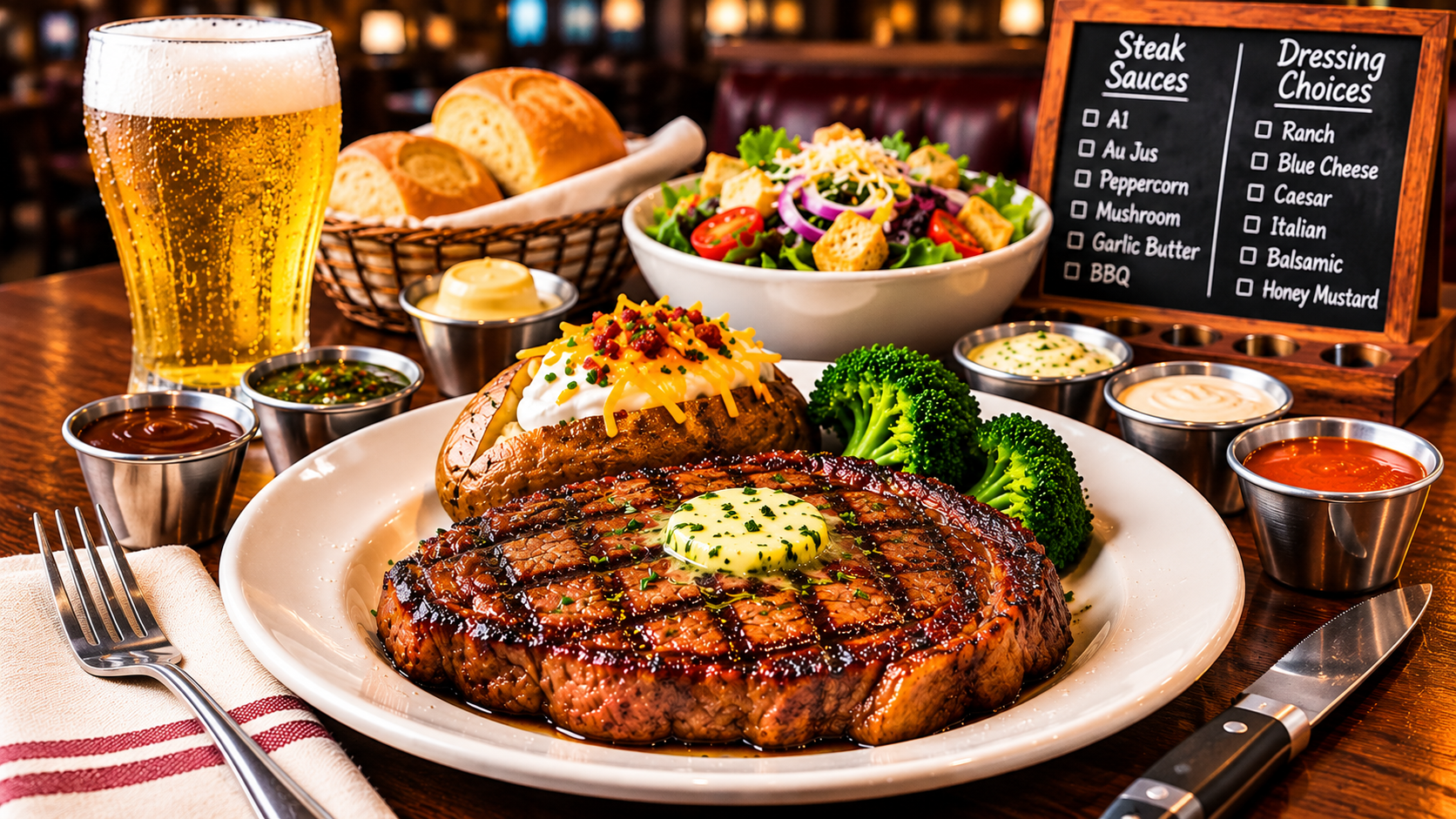
The first time I went to a steakhouse in America, I thought I was ordering dinner.
Apparently, I was taking part in an interview.
“How would you like your steak cooked?”
Fair enough. Perfectly normal question.
“What sides would you like?”
No worries.

“What dressing would you like on your salad?”
Righto.
“What sauce would you like?”
“Can I get you an appetizer to start?”
“What size would you like your beer?”
“Would you like some more bread?”
By this stage, I was beginning to wonder what else the waitress could possibly ask me.
I was half expecting her to ask what colour plate I’d like my dinner served on.
All I wanted was a steak and a beer. Somehow, I’d ended up making more decisions than I had all week. Welcome to dining out in America, where the menu is apparently just the beginning of negotiations.
In America, Everything Comes With Options
Now, Australians aren’t unfamiliar with making choices when ordering food.
We choose how our steak is cooked and what sides we would like.
We have restaurants where you can build your own burger or sandwich.
But there’s something about the sheer number of questions in an American restaurant that takes a bit of getting used to.
Even ordering a coffee can become a minor interrogation.
I’ll walk into a coffee shop and order my usual latte.
“What size?”
Large.
“Hot or iced?”
Hot.
“Would you like a flavour?”
No.
I just want a large, hot latte. No vanilla, no caramel, no pumpkin spice, no additional personality.

To be fair, I’ve become used to it after nearly a decade of living in America. These days, I know the questions are coming, and I can usually get through them without breaking into a sweat.
But there’s another American habit I’ve never quite embraced.
Changing what’s actually on the menu.
For many Americans, ordering a meal seems to be an opportunity to create something entirely new.
Hold the onions. Add extra cheese. Substitute the potatoes. Dressing on the side. Different sauce. No tomatoes. Extra bacon.
By the time they’ve finished, the original dish is barely recognizable.
Meanwhile, I’m sitting there thinking, why didn’t you just order something else?
My Wife Has Turned Menu Customization Into an Art Form
A while back, we were in Daytona Beach, Florida, and went out for dinner at a Ukrainian restaurant.
Now, I should explain something about my wife, Nikki.

She’s one of those people who sees a restaurant menu as a starting point rather than a finished product.
She’ll find something she likes, then immediately begin making adjustments.
On this particular evening, she was in fine form.
She wanted this added, that removed, something else substituted, and another ingredient changed.
I was sitting there watching the whole performance, wondering whether the chef would recognize the dish when the order eventually reached the kitchen.
Then it was Georgia’s turn.
Our ten-year-old daughter has clearly been paying attention to her mother, because she started doing exactly the same thing.
Something removed. Something substituted. Another change.
I could feel myself getting increasingly embarrassed.
“Just order what’s on the menu, guys!” I mumbled.
There’s even a book called Picky: How American Children Became the Fussiest Eaters in History, which explores how American children developed such particular eating habits. Perhaps I should buy Nikki and Georgia a copy. Although they’d probably want a few chapters changed.
I looked at the waitress, expecting at least a flicker of irritation.
Nothing.
She was smiling, happily taking notes, completely unfazed by the entire production.
Apparently, this was a perfectly ordinary evening for her.
Then she turned to me.
I ordered exactly what was on the menu.
No changes or substitutions. No special instructions.
I suspect I was the most straightforward customer she’d had all night.
And quite possibly the strangest.

Apparently, Seven in Ten Americans Do This
It turns out my wife and daughter are hardly alone.
According to a 2025 report from restaurant research company Datassential, approximately 70% of American consumers modify their restaurant orders in some way.
Even more interestingly, 69% say the ability to customize their orders is very important to them. With Guardrails

Seven in ten!
Having watched Nikki and Georgia order dinner in Daytona, I’m surprised the figure isn’t higher.
The research also revealed a fascinating generational difference.
Only 20% of Gen Z consumers order items exactly as they’re listed on the menu. Among Baby Boomers, roughly half typically order meals as listed.
So younger Americans are particularly enthusiastic about putting their personal stamp on dinner.
That certainly explains what I’m witnessing at home.
Georgia is already developing the habit, and she’s only ten.
At this rate, by the time she’s eighteen, she’ll be arriving at restaurants with architectural drawings of the meal she’d like prepared.
Interestingly, Datassential also found that about 40% of consumers prefer meal bundles that are mostly fixed, with only one or two choices.
Even Americans, it seems, occasionally reach the point where they’d rather somebody else make a decision.
Would Australians Do the Same Thing?
This is where the cultural difference becomes interesting.
Growing up in Australia, I don’t remember people routinely making so many changes to restaurant meals.
You looked at the menu, found something you liked, and ordered it.
Of course, people had dietary requirements, allergies, or particular preferences. Restaurants accommodated those where they could.

But completely redesigning a dish wasn’t something I remember being especially common.
In fact, I’ve been to plenty of Australian restaurants where substitutions simply weren’t permitted.
The menu told you what was available, and that was largely what you got.
And there’s some interesting Australian evidence that supports this difference.
In a 2018 Australian government review of fast-food menu-labelling schemes, restaurant industry representatives acknowledged that customization was growing, but described it as a relatively small niche in terms of quick-service restaurant order volumes. Consultation summary report
Compare that with the American research showing around seven in ten consumers modify their orders.
They’re different types of research, conducted in different years, so they don’t establish an exact percentage gap between the countries.
But the contrast is striking.
In America, customization is an established part of the restaurant experience. In Australia, it has traditionally been much more of a special request.
And I think there’s a cultural reason for that.
Australians, like the British in many respects, tend to have a bit of a reluctance to make a fuss.
We don’t necessarily want to be seen as difficult customers.
If something isn’t quite to our liking, we’re often more inclined to put up with it than start negotiating.
Americans, on the other hand, seem perfectly comfortable asking.
And when I’ve discussed this with Americans, the response is remarkably consistent.
“Why not? It’s my money. Why shouldn’t I have it my way?”
Which, when you think about it, is a pretty reasonable argument.
But it also raises another question.
What about the poor bugger in the kitchen?
I Used to Be a Chef. I Know What Happens Behind Those Doors.
Before my banking career, I worked as a chef in Australia.
And that experience probably explains why I get so uncomfortable when people start making endless changes to their orders.
I’ve been on the other side of the kitchen door.
I know what it’s like when a restaurant is busy, orders are coming in, and you’re trying to get meals out quickly.

You’ve got several dishes on the go, everything is timed, and you’re working with a menu designed around ingredients and preparation methods that the kitchen knows well.
Then an order arrives with half the ingredients removed, three substitutions and something added that isn’t normally part of the dish.
Suddenly, you’ve got to stop and work out how you’re going to prepare it.
Now, I wasn’t one of those chefs who refused to make changes.
Quite the opposite.
I was fairly accommodating, and I actually enjoyed getting creative when customers had special requests.
Vegetarian meals were a good example.
Back when I was cooking, we didn’t have much in the way of vegetarian options on the menu. So if someone wanted something different, I’d often come up with a dish specifically for them.
I quite enjoyed that.
But it took time.
On a quiet evening, no problem.
On a busy Saturday night, when the kitchen was already flat out, that special request might mean the customer had to wait a little longer.
That’s the part I still think about when Nikki and Georgia start redesigning their dinners.
I’m not necessarily embarrassed because they’re doing anything wrong.
I’m embarrassed because I know somebody in the kitchen has to make it happen.
Of course, American restaurants are generally well accustomed to dealing with modifications, and many have systems designed to handle them.
But I still can’t help imagining the chef reading the order and wondering what happened to the original dish.

Have It Your Way. It’s the American Philosophy.
There’s something distinctly American about the belief that customers should be able to get exactly what they want.
Burger King’s famous “Have It Your Way” advertising slogan captured that attitude decades ago.
The idea was simple.
You’re paying for the food. You should be able to decide how you want it.
And that philosophy seems to extend well beyond burgers.
In a 2021 McKinsey survey of American consumers, 71% said they expected companies to provide personalized interactions, while 76% said they became frustrated when that personalization wasn’t provided. McKinsey & Company+1
That research wasn’t specifically about restaurants, but it does help explain the broader expectation.
American customers often see personalization as part of the service they’re paying for.
And, to be fair, there’s a lot to admire about that.
Why shouldn’t someone be able to leave the onions off a burger if they don’t like onions?
Why shouldn’t a customer be able to substitute a side dish or request a different sauce?
If the restaurant can accommodate the request, and everybody’s happy, what’s the problem?
I don’t think there is one.
But surely there has to be a limit somewhere.
You can’t walk into a Chinese restaurant and expect them to make you Greek food.
At some point, the menu has to mean something.
Otherwise, why bother having one?

The One Time I Tried to Have It My Way
Now, before anyone accuses me of being completely inflexible, I have actually tried requesting something different at an American restaurant.
A couple of times, in fact.
One of my favourite meals back in Australia was steak, eggs and chips.
A nice steak, a fried egg on top, and a generous serving of hot chips.
Beautiful.
Nothing particularly complicated.
So one day, I was eating at Outback Steakhouse.
Yes, Outback Steakhouse. The American restaurant chain supposedly inspired by Australia.
I ordered my steak and decided I’d ask for a fried egg to go with it.
Seemed reasonable enough.
After all, I was in America, the land of endless customization, sitting in a restaurant that was meant to be Australian.
If there was anywhere I could get steak and eggs, surely this was it.
“No, sorry. We don’t have eggs.”
They didn’t have eggs.
And while we’re talking about proper Australian chips, there’s one thing Americans really ought to try: Australian chicken salt. If you’ve never had it, you’re missing out on one of life’s simple pleasures.
At Outback Steakhouse.
In America.
The country where you can apparently change every ingredient in a meal, but I couldn’t get one bloody fried egg.
I don’t think I’ve asked again since.

Perhaps I’m the Strange One Now
After nearly a decade living in America, there are plenty of things I’ve become accustomed to.
The enormous portion sizes. The endless choices. The waitress returning to check whether everything is alright when I’ve barely taken my second bite.
Even the coffee questions don’t bother me anymore.
Large. Hot. No flavour.
I’ve got that down to a fine art.

But when it comes to ordering food, I’m still very much Australian.
I look at the menu, find something I like, and order it.
If I don’t like the ingredients, I choose something else.
Nikki and Georgia, meanwhile, have fully embraced the American approach.
They’re paying for dinner, and they’re going to have it exactly the way they want it.
Perhaps they’re right.
Perhaps I’m just an old-fashioned Australian who spent too many years working in restaurant kitchens.
Or perhaps I’ve simply developed an unreasonable attachment to the idea that the meal described on the menu should bear some resemblance to the meal that arrives at the table.
Either way, next time we go out for dinner, I know exactly what’s going to happen.
Nikki will make her changes.
Georgia will make hers.
I’ll quietly mumble, “Just order what’s on the menu, guys!”
Then I’ll order whatever the chef intended.
Unless, of course, they’ve got a fried egg.
I’m still willing to negotiate on that one.
If you enjoy these stories about Australian language, culture, and the little things that make us who we are, you can support From Down Under to Down South through Buy Me a Coffee . Every bit of support helps keep the stories coming.
This article contains affiliate links. If you purchase through them, I may earn a small commission at no additional cost to you.