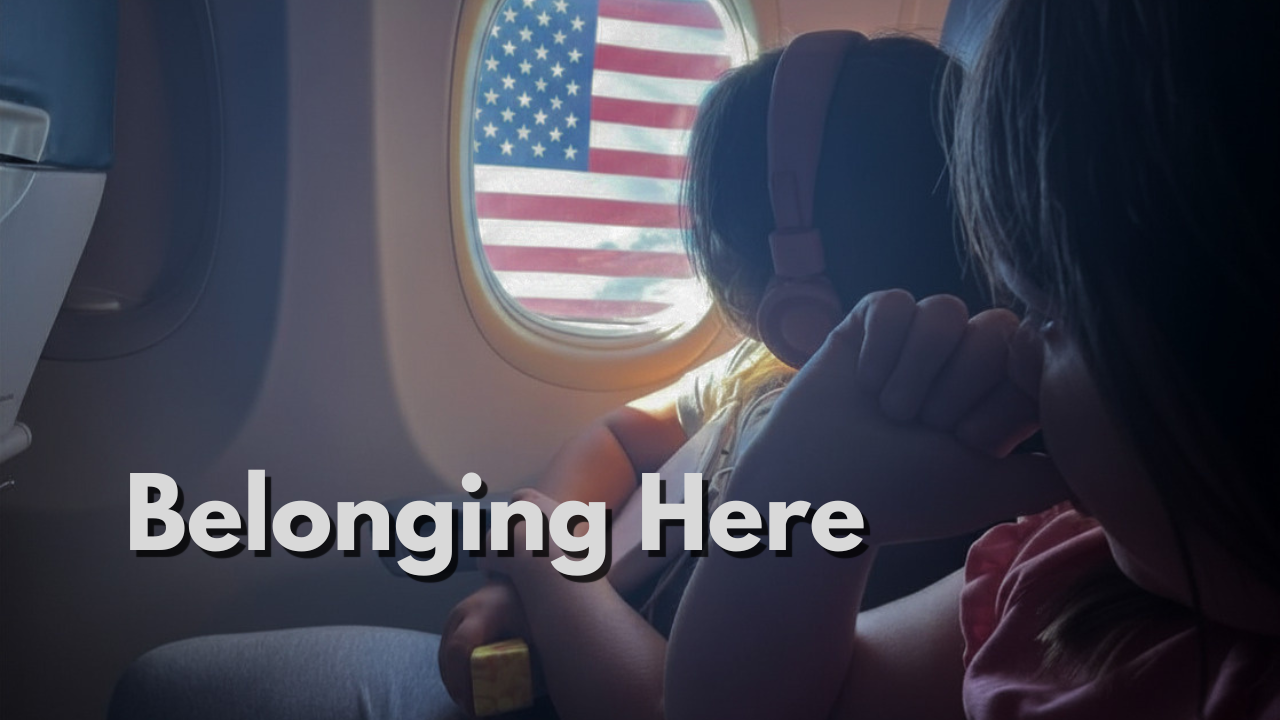
AUSTRALIAN EYES ON AMERICA
There is a strange assumption that sometimes follows you when you move to another country.
At some point, apparently, you are supposed to choose.
If you say too many nice things about the country you left, someone wonders why you left it.
If you say too many nice things about the country you moved to, someone wonders whether you’ve forgotten where you came from.
I’ve come across versions of both.
After eight years living in the United States, I’ve become very comfortable saying that I love America.
I chose to live here. I became an American citizen. I’m raising my children here. I’ve built a life here. There are things about American culture that I’ve genuinely come to admire, and many of them have become the subjects of the videos and articles I make.
None of that has made me less Australian.
That’s the part I think people sometimes misunderstand. Loving one country doesn’t mean you have to love the other one less.
I Didn’t Exchange Australia for America
When you immigrate, there is a tendency for people to think about the move as a replacement.
Old country out. New country in.
But that isn’t how it has felt to me.
Australia is still there in so much of who I am.
It’s in my accent, despite whatever America has been doing to it lately. My sense of humour, the food I occasionally find myself desperately searching for. The expressions that come out of my mouth without me even noticing them.
The experiences that shaped me long before I ever imagined living in Tennessee.
America didn’t erase any of that.
It added to it. I think that distinction matters.

Psychologists actually have language for this.
In research on immigration, assimilation generally means adopting the new culture while gradually letting go of your attachment to the culture you came from.
Integration is different. It means becoming part of your new culture while still maintaining your connection to the old one.
Research from the American Psychological Association suggests the two identities don’t have to compete. Immigrants can adapt to life in a new country while maintaining a strong connection to their heritage, and research has found benefits to being able to maintain both.
In other words, the science doesn’t require me to hand in my Vegemite before I’m allowed to enjoy biscuits and gravy. Which is quietly reassuring.
Somewhere Along the Way, America Became Home Too
This is where things become more complicated than simply saying, “I’m an Australian who lives in America.”
Because America isn’t just where I live anymore.
It’s home.
That’s a surprisingly significant word for an immigrant.
Home used to have a very obvious answer. Australia was home because Australia was where I came from.
Then you spend years somewhere else. You work there. Make friends there. Raise your kids there.
You stop having to think about where things are or how things work. The supermarket becomes your supermarket. The roads become familiar. Places that once felt foreign become completely ordinary.
Eventually you return from a trip, walk through your own front door and think:
It’s good to be home.
Except you’re not in the country you once meant when you used that word.
You’re in the other one.
That has been one of the strangest changes for me.
I don’t feel 50 percent Australian and 50 percent American.
Identity isn’t a pie chart.
I feel Australian.
I also feel American. Those statements stopped contradicting each other a long time ago.
Becoming American Didn’t Feel Like Rejecting Australia
I remember standing in the courthouse on the day I became an American citizen.
There were about 40 of us, from all over the world, standing together and taking the Oath of Allegiance to the United States.
It was a proud moment for me.
But there was one part of the oath that felt strange.
I had to declare that I “absolutely and entirely renounce and abjure all allegiance and fidelity” to any foreign state of which I had previously been a citizen.
In my case, Australia.
I understood what the oath meant. I was choosing to become an American citizen and accepting the responsibilities that came with that.
But standing there saying those words, I didn’t feel as though I was renouncing Australia.
I certainly didn’t feel any less Australian when I walked out of the courthouse than I had when I walked in.

If anything, becoming an American citizen felt like formal recognition of something that had already happened.
America had become part of my life.
I had a stake in this country.
Its future mattered to me because my future was here too.
So was my family’s.
None of that required Australia to become less important.
There is an interesting contradiction in the language of citizenship itself. For much of history, dual nationality was viewed with suspicion because governments worried about divided loyalties. Today, dual citizenship is far more widely accepted around the world, and both Australia and the United States allow people to hold more than one nationality.
So I walked into that courthouse as an Australian.
I walked out as an American.
But I also walked out as an Australian.
Maybe that’s the point. Becoming one didn’t require me to stop being the other.
Sometimes Other People Want the Choice More Than You Do
One of the interesting things about living between countries is how often identity gets defined from the outside.
People like neat categories.
Australian.
American.
Immigrant.
Expat.
Pick one.
But people don’t necessarily work that way.
Research into immigrant belonging suggests that the way newcomers are treated by the society around them can have a significant effect on whether they feel accepted as part of their new country. Research summarized by the Migration Policy Institute has found that public attitudes and political rhetoric can influence an immigrant’s sense of national belonging.
That makes sense to me.
Belonging isn’t only about deciding that a country is yours.
Sometimes it is also about feeling that the country has decided you are one of its people.
I’ve noticed something interesting when Americans meet me.
Obviously, the accent usually gives me away pretty quickly. People ask where I’m from, how long I’ve been here and, occasionally, something involving kangaroos.
But when they learn that I’m also an American citizen, something subtly changes.
It’s difficult to describe because nobody announces it.
The conversation just feels slightly different.
There’s a sense of, Oh, you’re one of us.
Maybe I’m imagining some of it. Human interactions aren’t exactly easy things to measure while you’re standing in the supermarket talking to a stranger.
But I’ve noticed it enough times to believe there’s something there.
My Australian accent still makes me interestingly foreign.
My American citizenship seems to make me belong.
The funny thing is, I don’t need one of those things to cancel out the other. I can be the Australian in the conversation and still be one of the Americans in the room.
Loving America Doesn’t Require Pretending It’s Perfect
There is another part of this that I think is important.
Loving your adopted country doesn’t mean pretending everything about it is sunshine, roses and butterflies.
I don’t believe that about America.
I didn’t believe it about Australia either.
No country gets everything right.
You can love a country and still criticize it.
Admire another country without declaring it superior in every possible way.
You can even prefer different things about different places.
There are things Australia does that I wish America would copy tomorrow. There are things about American life that I now genuinely prefer.
That isn’t betrayal.
It’s perspective.
In fact, one of the unexpected gifts of immigration is that you begin seeing both countries differently.
Distance makes you notice things about the country you left that you once took for granted.
Living somewhere new makes you question things you once assumed were universal.
Then you go back to the country you came from and discover that you’re looking at that differently too.
I’ve experienced that with Australia.
Things that were completely unremarkable to me when I lived there suddenly stand out. Some make me appreciate Australia more. Others make me wonder how I never noticed them before.
You haven’t stopped being an insider.
But you’re not entirely looking at it through an insider’s eyes anymore either.
Somehow, you become both.
It’s occasionally confusing.
But it’s also fascinating.
Maybe Belonging Doesn’t Have to Be Exclusive
In some ways, none of this should be particularly unusual in America.
Americans have been combining identities for generations.
Irish American. Italian American. Mexican American. German American.
For some people, the connection to the first country goes back generations. They may never have lived there, or perhaps never even visited, but their heritage can still be an important part of how they understand who they are.
My version is obviously a little different.
Australia isn’t where my ancestors came from several generations ago.
It’s where I came from.
It’s where I grew up and spent most of my life before moving to the United States.
But maybe the principle isn’t so different.
Becoming American doesn’t require everything that came before it to disappear.
Researchers studying bicultural identity have found that people can identify strongly with both their heritage culture and their national culture. Research also suggests that seeing those identities as compatible, rather than in conflict with each other, can help people feel more connected to the society around them.
That feels much closer to my experience than the idea that I must gradually become less Australian in order to become more American. America didn’t replace Australia.

It joined it.
I Still Know Where I Came From
There are moments when the distance from Australia hits harder than others.
One of the biggest for me came during the Black Summer bushfires of 2019 and 2020.
I was thousands of miles away in America while fires burned up and down the New South Wales coast and surrounded the area where I grew up.
Glued to Australian news reports. I listened to Australian radio from America trying to find out what was happening.
These weren’t just names of towns appearing on a news report.
I knew these places.
Knew the roads.
I knew the countryside.
I was watching places I knew like the back of my hand burn. At one point, I watched as fire roared across paddocks towards a house I had once lived in and came frighteningly close to engulfing it.

Being in America didn’t make any of that feel distant.
If anything, being unable to physically be there made the distance feel enormous. The COVID years brought a different version of the same feeling. Australia suddenly seemed much further away than the number of miles between us.
Those experiences reminded me that moving overseas doesn’t sever your connection to the place you came from.
But neither does missing Australia mean I’m secretly waiting to leave America.
That’s the false choice.
I can miss one place while being happy in another.
Be proud of where I came from while being grateful for where I ended up.
Care about what happens to Australia and care deeply about what happens to America.
I can watch Australia play sport and know exactly which side I’m supporting.
Okay, some loyalties apparently do have limits.
But for everything else, I’ve stopped feeling any need to choose.
I’ve lived in America long enough now to understand that moving countries didn’t divide my identity.
It expanded it.
Australia gave me the foundations of who I am.
America has shaped who I’ve become since.
One doesn’t diminish the other.
So can you love your new country without loving your old one less?
After eight years of trying it, I think the answer is pretty simple.
Yes. You just end up with more than one place in the world that feels like yours.
Enjoyed this article?
From Down Under to Down South is independently created and supported by readers like you. If you’d like to help me keep making articles, videos and podcasts about life between Australia and America, you can support the work through Buy Me a Coffee.
You can make a one off contribution or become a monthly supporter for $5 a month. Either way, it helps me keep building the brand and creating more of the stories you enjoy.

Sources and further reading
The American Psychological Association’s work on immigration and acculturation explains the distinction between assimilation and integration, including the ability to participate in a new culture while maintaining attachment to one’s heritage culture.
The APA’s more recent review of immigration research discusses evidence supporting bicultural integration and the psychological and sociocultural benefits associated with maintaining connections to both heritage and destination cultures.
The Migration Policy Institute has examined both dual citizenship and immigrant belonging, including the historical shift away from treating dual nationality as inherently incompatible with integration. Research published in Cultural Diversity and Ethnic Minority Psychology has also examined dual identity among immigrants and the relationship between identification with both heritage and national cultures, belonging and psychological outcomes.