Tag: australian expat in usa

  • Representing Australia in Tennessee Felt Like Home

    Representing Australia in Tennessee Felt Like Home

    Some weeks don’t arrive with one big headline.

    They come as a collection of smaller moments. Things that seem ordinary while they’re happening, then linger afterward. A conversation here. A surprise there. Something familiar appearing in an unexpected place.

    That was this week for me.

    Not dramatic. Not life-changing.

    Just quietly revealing what it actually feels like to live in America as an Australian.


    The School Night That Brought Australia to Tennessee

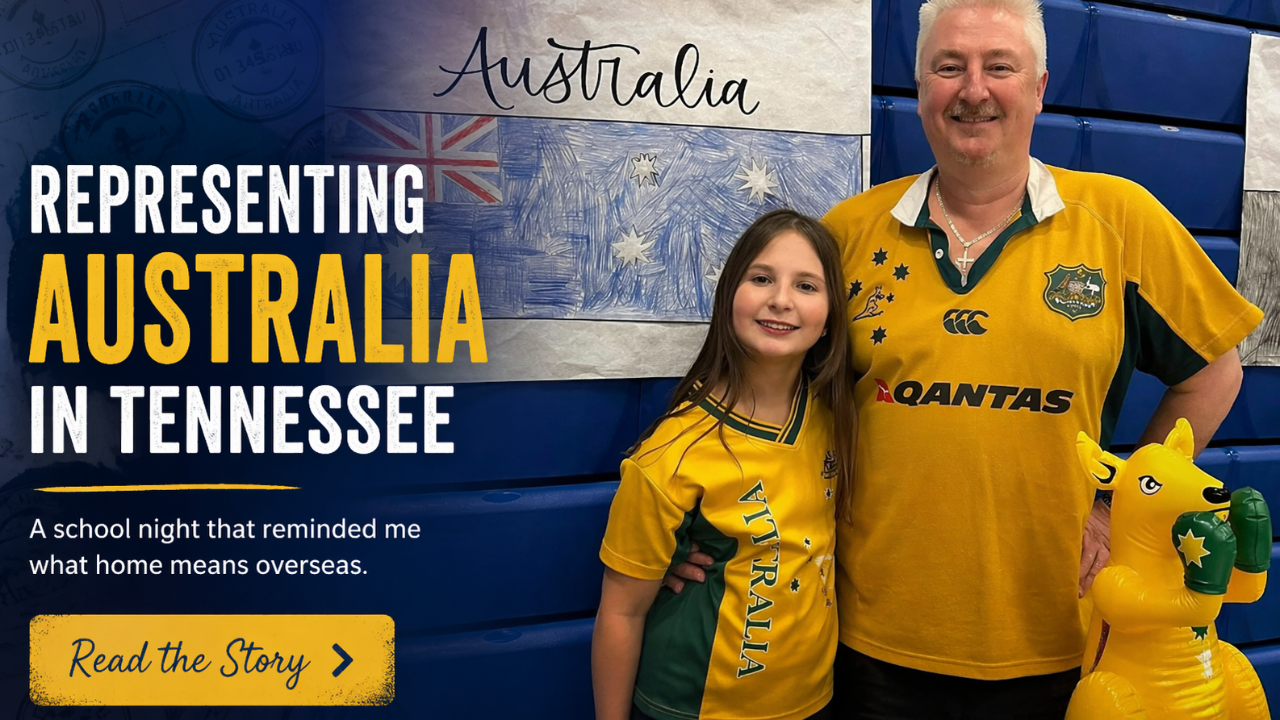
    Recently, Georgia and I took part in her school’s very first international night.

    Around fifteen countries were represented. Booths from places like Uzbekistan, Samoa, Guatemala, India… and there we were for Australia.

    It felt a little surreal standing in a Tennessee school gym representing home.

    What We Brought to the Australian Booth

    We tried to keep it properly Australian:

    • Sausage rolls
    • Vegemite sandwiches
    • Fairy bread
    • Tim Tams
    • Violet Crumble

    Amazon has a great assortment of Aussie items these days in the US:

    Each child had a small passport and moved from country to country collecting stamps.

    It was a simple idea, but a brilliant one.

    They were learning about the world without it feeling like learning.

    That’s usually when education works best.


    Tim Tams Were the Stars of the Night

    The hall started off quiet.

    Then, almost without warning, it filled up.

    Families everywhere. Kids racing around with passports. Parents chatting. Music and movement in every direction.

    We ran out of food halfway through, which I took as a fairly strong sign we’d done alright.

    And yes — the Tim Tams disappeared at alarming speed.

    I may need to contact Arnott’s next year regarding sponsorship opportunities.


    Talking About Australia in the Middle of Tennessee

    What I enjoyed most wasn’t the food.

    It was simply standing there and talking about Australia.

    Some people had visited.
    Many wanted to go.
    Some wanted to discuss cricket.

    And that always catches me off guard a bit.

    You don’t expect to be having a cricket conversation in Tennessee.

    Yet there I was.

    That’s one of the lovely things about living overseas — home appears in strange places.


    The Unexpected Samoan Moment

    At one point I ended up speaking some Samoan with the neighbouring booth.

    That took me back instantly to the years I lived there.

    Funny how language works like that.

    You can go years without using something… then suddenly it returns as if it had only been waiting quietly in the corner.

    They were so excited they called their father over because there was “this guy here” who had lived there and could speak the language.

    For a moment, Tennessee disappeared.

    I was somewhere else entirely.


    Identity Carries Weight

    Our booth sat next to Belgium.

    The couple running it weren’t actually Belgian.

    She was from Belarus, but with everything happening in the world, she didn’t feel comfortable representing that nationality publicly right now.

    So they chose Belgium.

    That stayed with me.

    Because where you’re from can carry more emotional weight than people realise. Sometimes pride. Sometimes pain. Even complexity.

    Identity isn’t always simple.


    Bluey, Bingo and Vegemite Reactions

    Georgia disappeared quickly once her friends arrived, which felt extremely on-brand for a child whose father was left doing passport duties for hundreds of children.

    We also had Bluey and Bingo there.

    That may have been the most popular part of the entire booth.

    And surprisingly, plenty of people liked the Vegemite.

    Though not everyone.

    There were still a few faces that suggested immediate regret, followed by a quiet search for the nearest bin.


    What It Felt Like

    I walked away thinking how much I enjoyed representing Australia.

    Not just missing it.

    Not just talking about it.

    But sharing it.

    There’s something grounding about that when you live overseas.


    Georgia’s Sleepover and a New Normal

    Not long after that, Georgia had a sleepover.

    There was:

    • an American girl
    • a Polish girl
    • a Spanish girl
    • and our Aussie girl

    All just hanging out together as if it were the most normal thing in the world.

    Because to them, it is.

    No labels. No special meaning.

    Just friends.

    When I was growing up in Australia, you noticed where people were from more. Not negatively — it was simply more visible.

    For this generation, diversity often isn’t something they comment on.

    They’re just growing up inside it.

    And there’s something genuinely beautiful about that.


    Easter in America Still Feels Different

    Another reminder of cultural difference came through Easter.

    Back home in Australia, Easter often feels like the country collectively slows down.

    Good Friday. Easter Monday. Shops closed. A pause in rhythm.

    Here in America, much of life keeps moving.

    Banks open. Businesses open. Things rolling on.

    For a place where faith can be very visible publicly, that contrast still feels interesting to me.

    Sometimes what stands out most in another country is what doesn’t happen.


    The Ice-in-Drinks Theory

    A podcast listener messaged me after I mentioned how much ice Americans use in drinks.

    They said:

    “It’s basically a scam.”

    And once that idea enters your mind, it’s hard to ignore.

    You take a few sips. Look down.

    And realise you’re mostly holding frozen optimism.


    The America You See vs The America You Live

    People back home sometimes ask how we can live here.

    Because the America shown in the news can feel intense, loud and relentless.

    But day-to-day life is mostly school runs, groceries, dance classes, errands, dinner, routines.

    Normal life.

    That’s probably the hardest thing to explain from a distance.

    Not that difficult things never happen.

    Just that everyday life rarely looks like headlines.


    Final Thought

    Living overseas has taught me that countries are never fully understood through headlines, stereotypes, or internet arguments.

    They’re understood through ordinary moments.

    School nights. Snack tables. Children laughing. Unexpected conversations. Shared routines.

    Quiet things.

    And often, those quiet things mean the most.


    Related Reads

    Why Are Americans So Polite? An Australian Explains the Cultural Difference
    Why American Goodbyes Feel Faster Than Australian Goodbyes


    Thanks for reading. Hoo roo maties.


  • What America Gets Right, After Living Here for 8 Years

    What America Gets Right, After Living Here for 8 Years

    I’ve lived in America for eight years now.
    Long enough to stop reacting.
    Long enough to stop constantly comparing.

    And long enough to admit something Australians don’t always say out loud:

    America does some things extremely well.

    That might sound obvious. But if you’ve ever lived overseas, you’ll know it’s not always where your mind goes first.


    Living Overseas Changes the Way You See Culture

    When you first move to another country, everything feels different.

    You compare constantly.
    Everything gets measured against home.
    You notice what’s missing.
    What feels louder.
    What doesn’t sit quite right.

    And if you’re not careful, that becomes your whole lens.

    Living overseas changes how you see things — not just the place you’re in, but where you came from as well. I wrote more about that shift here. -> An Aussie Expat’s Take on Culture Shock, Identity & Life in America

    You become the person who only sees what’s wrong.

    But over time, something shifts.

    The comparison softens.
    You stop reacting.
    You start observing.

    And when that happens, you begin to notice something else:

    Strength.

    Not surface-level clichés.
    Not patriotic slogans.

    But deeper, structural strengths—
    the kinds of things you only recognise when you’ve lived inside a culture long enough to stop defending your own.

    After eight years in the United States, here are four things I’ve come to genuinely respect.


    1. Confidence and Self-Promotion

    This is the one that stretched me the most personally.

    Because I didn’t grow up in a culture that rewards self-declaration.

    In Australia, humility is social currency.

    • If you do well, you downplay it
    • If someone compliments you, you deflect it
    • If you’re capable, you wait to be noticed

    There’s a natural instinct toward understatement. Tall poppy syndrome is part of that wiring.

    So when I arrived in America, the confidence felt… confronting.

    People spoke clearly about what they were good at.
    They outlined their experience without apology.
    They applied for roles before they felt fully ready.

    At first, I mistook that for ego.

    But over time, I realised something important:

    Confidence in America isn’t automatically seen as arrogance. It’s seen as clarity.

    Take this coffee mug for instance, I had two employees with the same ones!

    It’s a subtle shift, but once you notice it, you start seeing these differences everywhere — even in something as simple as how we hear each other. -> Why Living Overseas Changes How You Hear Accents

    It’s not: “I’m better than you.”
    But more like: “This is what I bring.”

    And that difference matters.

    Especially in a country of over 330 million people, where waiting quietly often means being overlooked.

    In Australia, you often wait to be invited forward.
    In America, you’re expected to step forward.

    That expectation changes behaviour.

    I’ve watched people create opportunities simply because they were willing to speak up—not because they had everything figured out, but because they didn’t assume they needed permission to try.

    As an introvert, that’s still a stretch for me.

    But I’ve come to respect a culture that doesn’t automatically punish visibility.

    Because when visibility is normalised,
    possibility expands.


    2. Customer Service and Hospitality

    This one didn’t fully hit me until I went back to Australia for a visit.

    We walked into a café in Canberra for breakfast.

    The service was fine.
    Efficient. Professional. Straightforward.

    But something felt… different.

    No greeting at the door.
    No eye contact on entry.
    Proactive warmth was missing.

    We ordered. Paid. Sat down.

    And it hit me:

    I’d gotten used to American hospitality.

    I didn’t fully understand it at first, but over time I realised there’s a deeper cultural layer behind that kind of interaction. -> Why Are Americans So Polite? An Australian Explains the Cultural Difference

    Especially living in Tennessee, there’s a consistent pattern:

    • You’re acknowledged when you walk in
    • There’s eye contact
    • There’s a greeting—often immediate
    • There’s an effort to make you feel welcome

    “How y’all doing today?” isn’t just a phrase—it’s a social signal.

    Now, Australians are friendly. No question.

    But the timing is different.

    • In Australia, friendliness often unfolds after interaction begins
    • In America, friendliness often starts the interaction

    That small difference changes the atmosphere of everyday life.

    It lowers social barriers.
    Creates ease between strangers.
    It makes public spaces feel more open.

    And when you live inside that long enough, you stop noticing it—until it’s gone.

    Then you realise how much emotional energy proactive warmth actually saves.

    It quietly says:

    “You’re welcome here.”

    And that matters more than we tend to admit.


    3. Ambition and Scale Thinking

    This is where America really separates itself.

    If you’ve ever been to Buc-ee’s, you’ll know exactly what I mean.

    The first time I pulled into one, I thought I’d accidentally arrived at an airport.

    • Dozens and dozens of fuel pumps
    • A store the size of a supermarket
    • Walls of snacks (the jerky is a must!)
    • Fresh food counters
    • Merchandise everywhere
    • A beaver mascot somehow tying it all together

    It’s almost theatrical in scale.

    But it works.

    Because it reflects a broader mindset.

    In Australia, we tend to build what’s needed:
    functional, practical, proportional.

    In America, there’s a tendency to ask:

    “How far can this go?”

    That difference shows up everywhere:

    • Business growth
    • Education systems
    • Sports structures
    • Infrastructure
    • Entrepreneurship

    There’s an assumption of expansion.

    An expectation that something good should multiply.

    Sometimes that creates excess.
    Sometimes it creates inefficiency.

    But it also creates something powerful:

    Momentum.

    Australia’s strength is grounded practicality.
    America’s strength is expansive ambition.

    And when you live inside that mindset, you start to see how many doors it can open.

    Because scale doesn’t just grow businesses—
    it creates pathways.


    4. Encouragement Culture

    This might be the most underrated difference of all.

    Encouragement in America is visible.

    You see this play out most clearly in environments built around performance and participation. -> Dance Competitions in America: When the Show Becomes the Focus
    It’s expressed.
    It’s often loud.

    You see it everywhere:

    • School assemblies
    • Local sports games
    • Dance competitions
    • Community events

    Parents cheering.
    Teachers praising publicly.
    Strangers saying, “You’ve got this.”

    At first, the volume surprised me.

    It felt big. Almost over the top.

    Because in Australia, encouragement exists—but it’s often quieter.

    • “Good on ya”
    • A nod
    • A private comment

    In America, encouragement is often public and frequent.

    And that has an impact.

    When effort is acknowledged openly:

    • Trying becomes normal
    • Failing becomes survivable
    • Risk feels safer

    There’s something powerful about growing up in an environment where people regularly say:

    “We’re proud of you.”

    That reinforcement builds confidence over time—almost by default.

    And when you combine:

    • Confidence
    • Hospitality
    • Ambition
    • Encouragement

    You get forward movement.

    You get people willing to try.
    Willing to step up.
    Willing to back themselves.

    Because culturally, they’ve been taught to.


    What Living Between Australia and America Teaches You

    Living overseas has taught me something I didn’t expect:

    You don’t lose your identity by recognising someone else’s strengths.

    You don’t become less Australian by respecting America.

    It expands you.

    Australia gave me:

    • Humility
    • Directness
    • Perspective

    America has given me:

    • Confidence
    • Hospitality
    • Scale
    • Encouragement

    And then there’s another layer again.

    The time I spent in the Pacific—places like Samoa, Fiji, Tuvalu, and Tonga—that shaped me too.

    Not as a comparison.
    But as a foundation.

    So when people ask me which place I prefer,
    it’s not really a question I can answer.

    Because both places are home.

    And holding all of that at once…

    that feels like maturity.

    Not competition.
    Just clarity.


    Final Thought

    If there’s one thing living in America has taught me, it’s this:

    Every culture has strengths.
    You just have to stay long enough to see them.

    Hoo roo maties.


    You can find audio versions of this article and more on the Listen page.

    ☕ Support my work by Buying Me a Coffee from the below link.
    https://buymeacoffee.com/fromdownundertodownsouth