AUSTRALIA EXPLAINED
I’ve lived in America for eight years now, but there are some Australian habits I simply cannot shake.
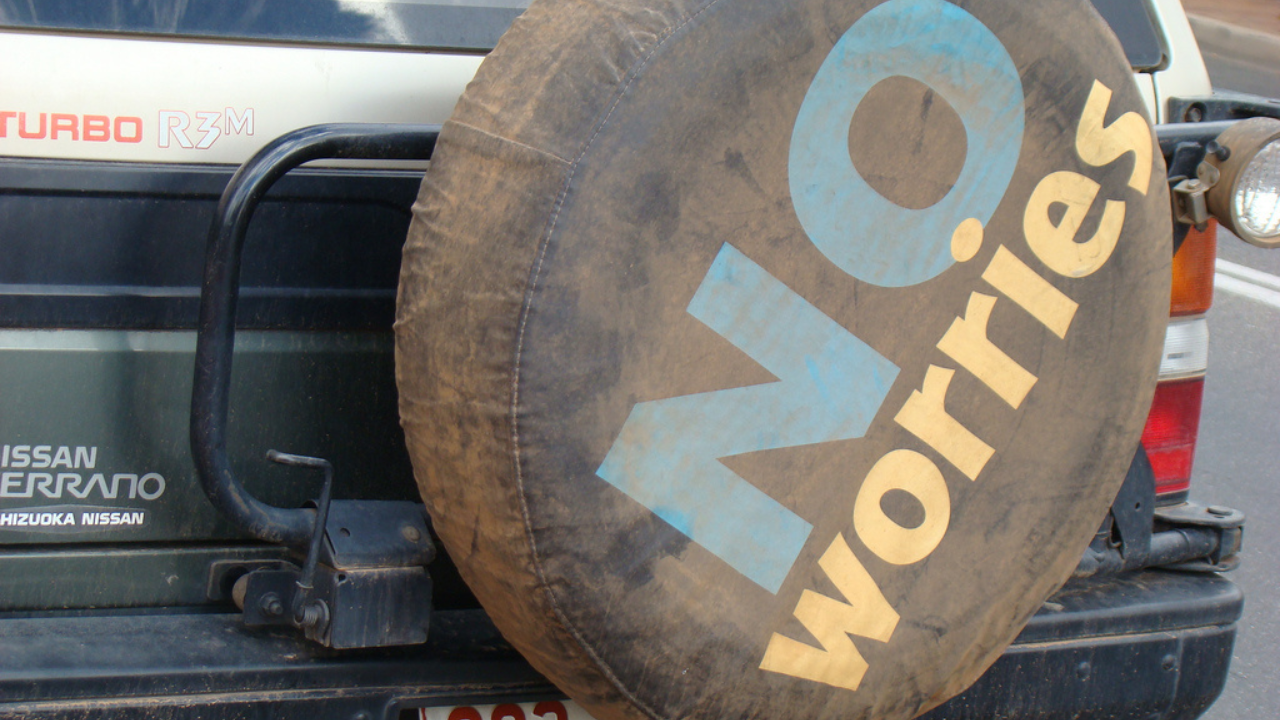
One of them is saying “no worries.”
I was at work here in Tennessee recently when I said it to a customer. Nothing unusual about that. Just another conversation, another “no worries,” and on with my day.
About ten minutes later, I was talking to a different bloke and out it came again.
“No worries.”

Unfortunately, the woman from earlier was still standing nearby.
That’s when I realised she’d heard me say exactly the same thing to two different people within ten minutes.
She must think I’m the No Worries Guy.
The funny thing is, I don’t even notice I’m saying it. It’s practically automatic. Someone thanks me? No worries. Someone apologises? No worries. Someone asks for help? No worries.
Someone creates an enormous problem that is absolutely going to ruin my afternoon?
Still no worries.
It’s one of those expressions that comes so naturally to Australians that we rarely stop to think about what we’re actually saying.
But why do Australians say “no worries” so much, and what do those two little words really mean?

What Does “No Worries” Mean in Australia?
The simplest explanation is that “no worries” means “it’s okay,” “no problem,” “don’t mention it,” or “you’re welcome.”
But that doesn’t quite capture how Australians use it.
It’s one of the most versatile expressions in Australian English. Depending on the situation, it can be an acknowledgement, reassurance, acceptance, or simply a polite way of ending a conversation.
For example:
Someone says thank you.
“Thanks for giving me a hand.”
“No worries.”
Someone apologises.
“Sorry I’m running late.”
“No worries.”
Someone asks you to do something.
“Can you grab that for me?”
“No worries.”
Someone changes their mind.
“Actually, I don’t need it anymore.”
“No worries.”
Four completely different situations. Exactly the same response.
You could probably get through an entire working day in Australia using “no worries” as your primary form of communication.
I reckon i’m making a reasonable attempt at doing exactly that here in Tennessee.
The important thing is that “no worries” doesn’t necessarily mean there was never a problem. More often, it means the other person doesn’t need to feel bad about it.
It’s a way of saying that whatever happened, we’re fine.
It’s a bit like the Australian habit of calling people mate. The words sound simple, but their meaning depends on the situation.
Where Did the Expression “No Worries” Come From?
Although “no worries” feels as though it’s been part of Australian life forever, its documented history is actually fairly recent.
The expression appears to have become common during the 1960s.
By 1967, it had even made its way into a television advertisement for the State Savings Bank of Victoria.
The advertisement promoted the bank as a place where customers could manage their finances without unnecessary worry.
Which is rather amusing, considering that banking and worrying about money tend to go together rather nicely.
By the late 1970s, “no worries” was already being described as something resembling a national motto.

Its popularity overseas received another boost during the 1980s, particularly through Australian films and television.
Paul Hogan’s Crocodile Dundee introduced international audiences to a particular version of Australian life, complete with broad accents, bush humour and a rather relaxed approach to almost everything.
Later, personalities such as Steve Irwin helped make Australian expressions familiar to audiences around the world.
But “no worries” was never just a line from a film.
It was something Australians were already saying to each other in shops, workplaces, pubs, schools and homes.
And unlike a few other Australian expressions that have gradually fallen out of everyday use, this one has shown remarkable staying power.

Why Australians Say It So Much
I think part of the appeal of “no worries” is that it removes unnecessary formality from everyday interactions.
Australians generally aren’t fond of making a big production out of small things.
If someone asks for a hand carrying something, you help them.
If someone thanks you, you acknowledge it.
Nobody needs to deliver a speech.
“No worries” does the job beautifully.
There’s also something uniquely Australian about the idea that helping someone shouldn’t automatically be treated as an inconvenience.
When I say “no worries” to someone who thanks me, what I’m really saying is that they haven’t put me out.
It wasn’t a burden. There’s no debt to repay. We’re all good, mate.
Don’t get me wrong, that doesn’t mean all Australians are relaxed, helpful or easygoing.
Anyone who has spent time in Sydney traffic during the morning peak hour can confirm that the national commitment to remaining calm has certain limitations.
But as a social expression, “no worries” creates a sense of ease between people.
It makes an interaction feel less formal and more equal.
It doesn’t matter whether you’re speaking to a customer, a neighbour, a friend or someone you’ve never met.
The words work just as well.
And maybe that’s why I still use them so naturally after eight years in America.
They’re not something I consciously choose to say.
They’re simply part of how I speak to people.

Is “No Worries” the Same as “You’re Welcome”?
This is where things get interesting, particularly when you move from Australia to the United States.
In America, “you’re welcome” is a familiar response when someone says thank you.
You’ll also hear “no problem,” “of course,” “you bet,” and, sometimes in customer service, “my pleasure.”
Australians use some of those expressions too, but “no worries” has a slightly different flavour.
“You’re welcome” acknowledges the person’s thanks.
“No worries” reassures them that whatever you did wasn’t an inconvenience.
It’s a subtle distinction, but an interesting one.
Researchers studying Australian English have examined how “no worries” works as a form of politeness, helping reduce the sense of obligation or inconvenience between people.
In plain language, we’re telling the other person not to make a fuss.
I find that really interesting because I’ve noticed how much Americans value friendly, enthusiastic customer service.
People here can be very warm and welcoming, often in ways that surprised me when I first arrived.
Another expression that caught my attention after moving here was “I appreciate you,” which still sounds surprisingly personal to my Aussie ears.
But the language of politeness can be different.
An American might say “It’s my pleasure.”
An Australian might say “No worries, mate.”
Both can be equally sincere.
One places emphasis on the pleasure of helping. The other places emphasis on the fact that helping wasn’t a problem.
Different words, similar intentions.
Personally, I like both approaches.
Although I reckon I’ll be saying “no worries” long after I’ve forgotten where I left my car keys.
When “No Worries” Actually Means There Are Plenty of Worries
Here’s where Australian English becomes a tad entertaining.
Sometimes “no worries” means exactly what it says.
Other times, it means something closer to “this is an absolute disaster, but I don’t wanna discuss it.”
Imagine someone has just informed you that a job you thought would take twenty minutes is actually going to take three hours.
“No worries.”
There are worries.
Several of them.
Or a mate has borrowed something and returned it in considerably worse condition.
“No worries.”
You might be furious, but apparently we’re all maintaining diplomatic relations for the moment.
Then there’s the classic situation where someone asks whether you can manage a task that you have absolutely no idea how to do.
“No worries.”
You’ve now committed yourself to something you may deeply regret, forever.
I think there’s an element of Australian understatement involved.
We don’t always feel the need to announce every inconvenience, irritation or difficulty.
Sometimes we just get on with it.
That can be admirable, but it can also be ridiculous.
There are times when we probably should admit that something is a worry instead of pretending everything is under control.
Still, there’s something reassuring about hearing those two words when a situation becomes tough.
Even if the person saying them is quietly wondering how on earth they’re going to sort things out.

No Wuckers, No Dramas and Other Aussie Variations
Australians have never been content to leave a perfectly good expression alone.
Once we’ve found something that works, we tend to shorten it, rearrange it or make it slightly more ridiculous.
“No worries” is no exception.
There’s “no probs,” which is simply a shorter version of “no problems.”
There’s “no dramas,” which suggests that whatever has happened doesn’t need to become a major production.
Then there’s “no wuckers.”
This is a distinctly Aussie slang variation, derived from the rather less polite expression “no wucking furries,” reverse that one and you’ll catch my drift.
It’s not something I’d recommend using at a formal job interview, although it would no doubt make you unforgettable.
That sort of wordplay is also part of why Australians can sound so casual about swearing, even when nobody’s particularly upset.
If you’re planning a trip to Australia and want to understand what the locals are saying, an Australian slang dictionary is worth a look. Although I should warn you, learning the words is one thing. Working out when we’re being sarcastic is an entirely different challenge.
You’ll also hear “she’ll be right,” another famous Australian expression.
The two are related, but they aren’t quite interchangeable.
“No worries” often reassures someone that a request, apology or situation is fine.
“She’ll be right” expresses confidence that something will work out.
Sometimes that confidence is justified.
Sometimes it’s based on absolutely nothing.
And occasionally it’s being expressed by a bloke standing beside a broken lawnmower with a screwdriver and no particular plan.
Australian optimism can be a special thing.
Of course, we’ve also managed to turn “yeah nah” into a perfectly understandable answer, so maybe none of this should come as a shock.
Has “No Worries” Become an American Expression?
One of the interesting things about living in America is hearing Aussie expressions that have crossed the Pacific.
“No worries” is one of them.
Although it became associated with Australia, it has also found a place in American English.
You might hear it in a coffee shop, at work or during an ordinary conversation between two Americans.
For some people, it’s simply another way of saying “no problem.”
Not everyone is enthusiastic about its popularity, though.
In 2022, Lake Superior State University in Michigan included “no worries” on its annual Banished Words List, which collects expressions people nominate for overuse or misuse.
If you’re curious about where some of Australia’s stranger expressions came from, there’s a whole history behind the way we speak. Kel Richards’ dictionary of Australian phrase and fable explores the origins of hundreds of Australian sayings, including some that might leave visitors completely bewildered.
Apparently, some Americans were becoming tired of hearing it used in place of “you’re welcome.”
As an Australian, I find that quite funny.
We exported a perfectly harmless expression, and somehow it ended up on a list of words people wanted banished.
That’s a fairly impressive achievement for two words that are supposed to make everyone feel more relaxed.
But language changes, and expressions travel.
Americans have influenced the way Australians speak for generations through television, films, music and popular culture.
It’s not surprising that the traffic occasionally moves the other way.
What I find amusing is that after eight years in America, I’m still saying “no worries” without thinking, while Americans use it themselves.
So maybe I’m not the only No Worries Guy after all.
Two Little Words That Say Quite a Lot
I’ve spent over eight years living in the United States, and in that time I’ve adapted to plenty of American habits.
I drive on the other side of the road, use American terms when I need to, and have become used to the everyday differences that come with living in another country.
But some things remain stubbornly Australian.
“No worries” is one of them.
It’s not something I deliberately hold on to as a reminder of home. I don’t wake up each morning determined to preserve Australian English one yarn at a time.
It just happens.
Because underneath those two words is a simple idea that I think is worth keeping.
Don’t make someone feel like a burden when they haven’t been one.
Don’t turn every little inconvenience into a major event.
And when you can help someone, just help them.
Of course, none of this guarantees that life will be free of worries.
It hasn’t worked that way for me.
But maybe that’s the whole point.
Sometimes “no worries” isn’t a description of how life is.
It’s how we’d like to approach it.
So if you happen to visit Tennessee and encounter an Australian bloke who says “no worries” three times in five minutes, there’s a decent chance you’ve found me.
Don’t worry about it.
Apparently, I can’t help myself.
Enjoying these little explanations of Australian life? You can support From Down Under to Down South through Buy Me a Coffee. It helps keep the stories, articles and podcast going. No worries if you can’t, of course!