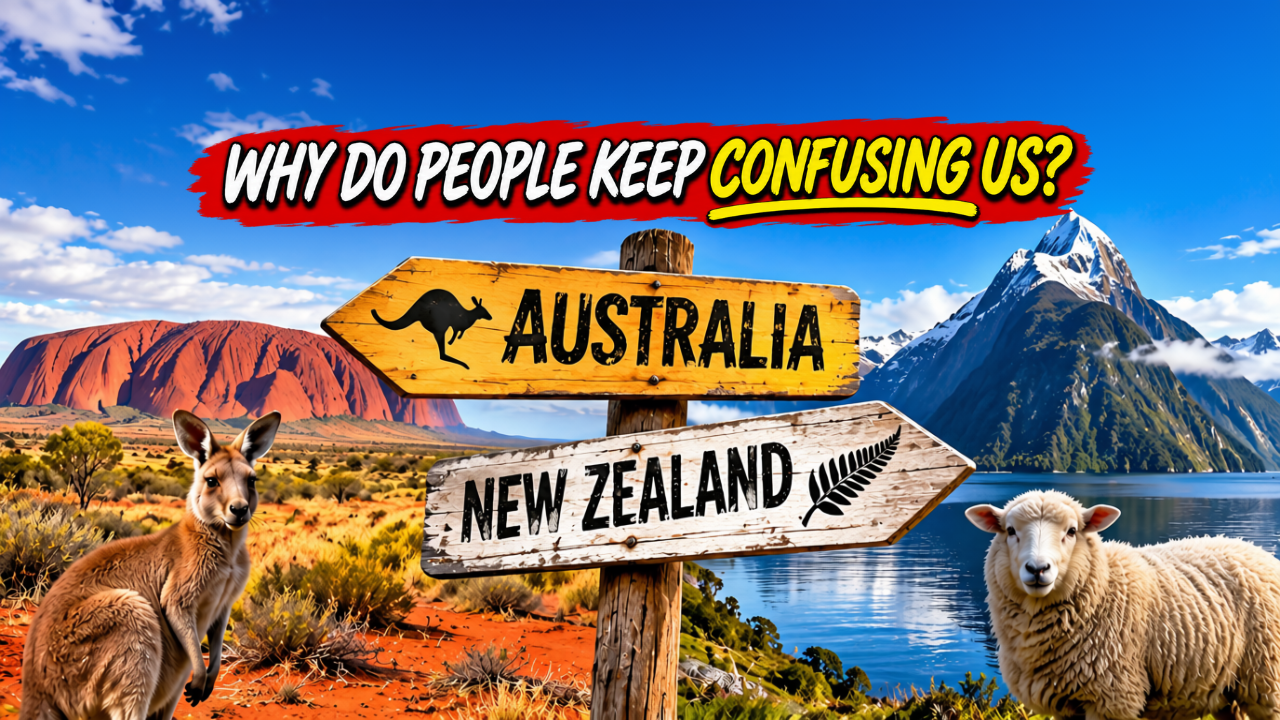
AUSTRALIA EXPLAINED
I’ve lived in America for eight years, and there’s one conversation that still catches me off guard.
Someone hears my accent, smiles, and asks, “Are you from New Zealand?”
“No, Australia,” I reply.
“Oh, right. Same sort of place, though?”

And there it is. Two countries, separated by the Tasman Sea, reduced to one enormous patch of the Southern Hemisphere where everyone apparently sounds alike, plays rugby and has an unhealthy relationship with sheep.
I don’t take offence. In fact, I’ve spent enough time in New Zealand to understand why people make the connection. I love the country, I love its people, and I could happily live there.
But Australia and New Zealand are not the same place.
We have different histories, different landscapes, different national identities and, despite what American ears might suggest, different accents.
So why do people keep confusing us?
The answer is more interesting than you might think.
Why Do Americans Confuse Australia and New Zealand?
From the other side of the Pacific, Australia and New Zealand have plenty in common.
Both are English-speaking countries in the Southern Hemisphere. Both have strong historical ties to Britain, parliamentary democracies, sporting traditions and reputations for spectacular scenery.
We share a long history of migration, trade and military cooperation. Australians and New Zealanders can also live and work in each other’s countries under special arrangements, although the immigration rules aren’t entirely identical.
Then there are the accents.
To someone who has grown up in Australia or New Zealand, the difference can be immediately obvious. But to an American who rarely hears either accent, we can sound remarkably similar.
And that’s before someone starts talking about rugby, cricket or the strange collection of vowels we both seem determined to rearrange.
I suspect there’s another reason, too.
Geography.

When you live thousands of miles away, neighbouring countries can become mentally grouped together. We do it ourselves with other parts of the world.
But proximity doesn’t make two countries interchangeable.
Ask an Australian and a New Zealander whether they’re basically the same, and you might discover just how passionate people can become about a seemingly innocent question.
Australia and New Zealand: Two Very Different Countries
The first thing worth understanding is just how different these countries are geographically.
Australia is enormous. At approximately 7.7 million square kilometres, it’s the sixth-largest country in the world.
New Zealand covers around 268,000 square kilometres.

That makes Australia nearly 29 times larger.
But size isn’t the only difference.
Australia is famous for its deserts, vast cattle stations, tropical rainforests, eucalyptus forests, beaches and enormous stretches of relatively dry interior.
New Zealand is renowned for its dramatic mountains, glaciers, volcanic landscapes, fjords and lush green countryside.
Of course, neither country can be reduced to a postcard.
Australia has snowfields, temperate forests and green farming regions. New Zealand has cities, beaches, geothermal areas and landscapes that look nothing like the mountains featured in tourism advertisements.
Still, the contrast can be striking.
Drive across parts of inland Australia, and you can spend hours looking at an apparently endless horizon.
Drive through parts of New Zealand, and you might find yourself surrounded by mountains that look as though somebody borrowed them from a fantasy film.
Which, of course, somebody did.
New Zealand provided many of the spectacular landscapes used in The Lord of the Rings films.

Australia, meanwhile, seems to have developed an international reputation for being a place where practically everything is trying to kill you.
Both are exaggerations, but they do make for effective tourism marketing.

Can Australians and New Zealanders Really Hear the Difference in Our Accents?
Absolutely.
And this is probably where I have the most fun with Americans.
Australian and New Zealand English share historical roots, which explains many of their similarities. Both developed through the influence of British and Irish settlers, although their linguistic histories and subsequent development differ.
But the vowel sounds aren’t identical.
One of the classic jokes involves the way New Zealanders pronounce the word “fish.”
Australians often imitate it as “fush.”

New Zealanders, naturally, have their own opinions about how Australians pronounce things.
And neither imitation is particularly accurate.
The differences involve genuine vowel shifts, not simply one country pronouncing words incorrectly.
Australian English also has its own regional and social variations, while New Zealand English has been shaped by influences including te reo Māori.
After years living in America, I’ve become more conscious of my own accent.
Americans sometimes hear things in my speech that Australians wouldn’t think twice about. And I’ve occasionally caught myself adjusting the way I pronounce something simply to make myself understood.
It’s one of the curious things about living overseas.
You start noticing aspects of your own culture that were once completely invisible to you.
And apparently, you also become the unofficial Australian representative responsible for explaining why you aren’t from Auckland.
Australia and New Zealand Share History, but Not the Same Identity
Our two countries have a relationship that goes well beyond accents and sporting rivalries.
Australia and New Zealand share significant historical connections, including their experiences of British colonisation and cooperation during major conflicts.
The ANZAC tradition is perhaps the most recognisable example.

ANZAC stands for Australian and New Zealand Army Corps, a name closely associated with the First World War and the Gallipoli campaign of 1915.
Every year, both countries commemorate ANZAC Day on April 25.
It’s an important part of our shared history, but it doesn’t mean our national stories are identical.
Australia’s First Nations peoples include Aboriginal and Torres Strait Islander peoples, with diverse cultures and histories extending back tens of thousands of years.
New Zealand’s Indigenous Māori people have their own histories, language, traditions and relationship with the land.
The Treaty of Waitangi, signed in 1840 between representatives of the British Crown and many Māori chiefs, remains central to New Zealand’s political and constitutional life.
Australia has a different constitutional history and different ongoing debates about Indigenous recognition, rights and reconciliation.
These distinctions matter.
They shape how each country understands its past, its institutions and its national identity.
It’s easy to overlook these differences when you’re looking at the region from thousands of miles away.
But spend time in either country, and they become impossible to ignore.
The Great Australia vs New Zealand Sporting Rivalry
Now, if you really want to see Australians and New Zealanders become competitive, mention sport.
Especially rugby.

New Zealand’s All Blacks are one of the most famous rugby union teams in the world.
Australia’s Wallabies have their own proud history, although I suspect a few Australian rugby supporters would prefer not to discuss certain recent results.
The rivalry extends beyond rugby union.
Cricket, netball and numerous other sports have provided generations of opportunities for Australians and New Zealanders to remind each other who supposedly does things better.
There’s a wonderful contradiction in the relationship.
We can spend an entire afternoon making fun of each other, yet there’s also considerable mutual respect.
The rivalry is real, but so is the connection.
It’s rather like having a sibling.
You might give them an absolute hiding over a game of backyard cricket, but you’re still likely to stand beside them when it matters.
And that’s part of what makes the relationship interesting.
We can be fiercely competitive without pretending our shared history and friendships don’t exist.
What I Learned Spending Time in New Zealand and the Pacific
My perspective isn’t based solely on growing up in Australia.
I’ve spent significant time in New Zealand, and I could genuinely see myself living there.
I’ve also lived in Fiji and Samoa and travelled extensively around the Pacific.
Those experiences changed how I think about the region.
From a distance, people sometimes imagine the Pacific as a collection of beautiful islands with broadly similar cultures.
But that overlooks enormous differences in language, history, customs, geography and identity.
Samoa is not Fiji. Tonga is not Tahiti. New Zealand is not Australia.

And while these places have connections, those connections shouldn’t erase what makes each one distinctive.
Living in Samoa also gave me a greater appreciation for the diversity of Pacific cultures and the importance of understanding places on their own terms.
It’s something I think about when Americans confuse Australia and New Zealand.
I don’t automatically assume they’re being disrespectful.
Most are simply making connections based on what they know.
And when you think about it, that’s how all of us understand unfamiliar places.
We start with similarities.
The interesting part comes when we become curious enough to discover the differences.
Do Australians and New Zealanders Actually Like Each Other?
Yes.
Despite the jokes, sporting rivalries and occasional arguments about who invented what, Australia and New Zealand have a remarkably close relationship.
Families move between the two countries. People travel back and forth for work, holidays and education. Businesses operate across the Tasman, and friendships regularly span both sides.
There are plenty of New Zealanders living in Australia and Australians living in New Zealand.
Of course, not everyone feels the same way, and the relationship isn’t without its disagreements.
But the idea that Australians and Kiwis genuinely dislike one another because of a few rugby matches is rather silly.
We simply enjoy giving each other a hard time.
And to be fair, both countries are quite good at it.
There is, however, one thing worth understanding.
New Zealanders generally don’t appreciate having their country treated as an extension of Australia.
And why should they?
New Zealand has its own identity, culture, achievements and history.
Australians wouldn’t appreciate being told we’re simply a larger version of New Zealand, either.
Although I suspect the Kiwis might enjoy that description considerably more than we would.

Why Living in America Has Changed How I See Australia
Before moving to the United States, I rarely had to explain the difference between Australia and New Zealand.
It was simply something everybody around me understood.
Now I find myself explaining all sorts of things that once seemed obvious.
Why Australians shorten words.
Why we say “no worries” so often.
Why our sense of humour can sound insulting to people who don’t know us.
And why an Australian accent isn’t automatically a New Zealand accent.
It’s one of the unexpected consequences of living overseas.
You become more conscious of the country you came from because you’re constantly seeing it through somebody else’s eyes.
Sometimes that produces genuinely interesting conversations.
Other times, you find yourself explaining for the third time that Sydney is not the capital of Australia.

I’m from Canberra, so that particular misunderstanding is one I take rather personally.
But I enjoy these conversations.
They remind me that things we consider common knowledge are often simply the things we grew up knowing.
And there’s nothing wrong with asking questions.
I’d much rather someone ask me about Australia than pretend to know everything already.
So, Are Australia and New Zealand Really That Different?
Yes. And no.
We share language, history, traditions, values and an extraordinary number of cultural connections.
But we’re also distinct countries with our own identities, landscapes, Indigenous histories, accents and national experiences.
The similarities help explain why people confuse us.
The differences explain why that confusion can be so entertaining.
After eight years in America, I’ve come to appreciate both sides of the conversation.
I understand why someone hearing my accent might immediately think of New Zealand.
And I understand why an Australian or Kiwi might want to correct them.
But I don’t see it as something worth getting upset about.
If anything, it’s an opportunity to talk about two countries that have far more to offer than kangaroos, sheep, rugby and spectacular scenery.
Although, if you ever find yourself at a barbecue with an Australian and a New Zealander, here’s a little advice.
Ask them which country makes the better pavlova.
Then stand back.
You might learn more about the Australia–New Zealand relationship in five minutes than you would from an entire geography lesson.
Hoo roo, maties.