Category: Australia Explained

  • What Is a Tradie in Australia? More Than Just a Bloke With a Toolbox

    What Is a Tradie in Australia? More Than Just a Bloke With a Toolbox

    If you’ve spent any time in Australia, you’ve probably heard someone mention a tradie.

    Maybe the plumber is coming around to fix the hot water. Perhaps the sparky has been called because half the house has lost power. Or someone has announced that the tradies next door have started work at seven in the morning, which is lovely if you happen to be a rooster.

    For Australians, the word barely requires an explanation. It’s simply part of everyday conversation.

    For anyone unfamiliar with Australian English, though, it can sound like an entirely different occupation.

    So what exactly is a tradie?

    The short answer is that a tradie is an Australian slang term for a tradesperson, particularly someone working in a skilled manual trade such as plumbing, electrical work, carpentry or bricklaying.

    But that simple definition doesn’t quite capture the whole picture.

    Because in Australia, tradies have developed a recognisable identity of their own, complete with distinctive clothing, workplace traditions, a vocabulary that occasionally requires translation, and an almost legendary relationship with the local bakery.


    What jobs do tradies actually do?

    A tradie isn’t one particular type of worker. It’s an umbrella term covering a wide range of skilled trades.

    The word comes from tradesperson, shortened and given the familiar Australian ending that has also produced words such as brekkie, barbie and mozzie.

    Some of the occupations commonly described as tradies include:

    Australian termWhat they do
    SparkyElectrician
    ChippyCarpenter
    BrickieBricklayer
    Dunny diverPlumbing and pipework
    RoofieInstalls roof tiles
    PlastererPlastering and wall finishing
    PainterPainting and decorating
    ConcreterConcrete work

    Not every tradesperson necessarily calls themselves a tradie, and the term is mainly associated with construction and related industries.

    A mechanic, for example, might also be described as a tradie, although Australians are just as likely to call them a mechanic.

    The important distinction is that a tradie is generally someone with practical trade skills, often developed through formal training and experience on the job.

    It isn’t simply another word for anyone who works with their hands.

    Australian electrician working on an electrical installation.
    From sparkies to chippies, the word tradie covers a wide range of skilled occupations

    Why do Australians call them tradies?

    Australians have a longstanding habit of shortening words and adding an informal ending.

    Breakfast becomes brekkie. A barbecue becomes a barbie. A mosquito becomes a mozzie.

    A tradesperson becomes a tradie.

    There’s no complicated secret behind it, although the broader Australian habit of shortening words is worth exploring in its own right.

    What makes tradie interesting is how naturally the shortened word has become part of everyday language.

    You might hear someone say:

    “The tradie’s coming around tomorrow.”

    “The tradies are working on the house next door.”

    “We need to get a tradie in to have a look at that.”

    Nobody needs to specify which trade unless it’s relevant to the conversation.

    It’s also a useful example of how Australian English can sound informal without necessarily being disrespectful.

    Calling someone a tradie is generally a perfectly ordinary way of referring to their occupation.

    You can be talking about a highly experienced, licensed electrician running a substantial business and still call them a tradie.

    The nickname doesn’t erase the skill involved.

    In fact, if your hot water system has stopped working in the middle of a Canberra winter, that tradie might suddenly become the most important person in your life.


    The apprenticeship: how someone becomes a tradie

    One of the things worth understanding about Australian trades is that many involve structured training.

    A common pathway is an apprenticeship, where someone combines paid employment with formal vocational education.

    Depending on the trade, that training might involve a registered training organisation such as TAFE, which stands for Technical and Further Education.

    An apprentice learns practical skills while working alongside experienced tradespeople and completing the relevant training requirements.

    Many traditional trade apprenticeships take around three to four years, although the exact duration and qualification requirements vary.

    Some trades also require licensing or registration before a person can carry out certain work independently.

    An electrician, for example, cannot simply buy a toolbox, watch a few YouTube videos and start rewiring houses.

    There are training and licensing requirements.

    The same principle applies to various aspects of plumbing and other regulated work, with requirements differing between Australian states and territories.

    So while tradie sounds wonderfully casual, the occupations behind it can involve substantial technical knowledge, qualifications and legal responsibilities.

    And that brings me to something I understand rather well.


    I was an apprentice myself

    I completed a four-year chef apprenticeship in Australia, went to culinary school and eventually worked as both a sous chef and an executive chef.

    Now, chefs aren’t usually the first people Australians picture when someone says tradie. Most people immediately imagine someone on a building site.

    But the apprenticeship system is familiar territory to me.

    You learn the theory, work alongside experienced people and discover fairly quickly that knowing how something should be done and actually doing it under pressure are two very different things.

    In a kitchen, that might mean learning to prepare a complicated dish while someone is shouting that table twelve has been waiting twenty minutes.

    On a building site, I imagine the pressure comes in slightly different forms.

    Either way, practical skills aren’t something you acquire simply by buying the equipment.

    I own a toolbox.

    That doesn’t mean you should let me anywhere near your electrical wiring.

    Apprentice learning practical trade skills during vocational training.
    Apprenticeships combine practical experience with formal training. I went through the system myself as a chef.

    The unofficial tradie uniform

    If you want to spot a tradie in Australia, the clothing can be a fairly useful clue.

    High-visibility shirts, work shorts, steel-capped boots and a ute parked somewhere nearby are all familiar parts of the picture.

    Of course, not every tradesperson dresses like this. Workwear depends on the job, employer, weather and safety requirements.

    But the combination is recognisable enough that Australian workwear has become something of a cultural identity.

    What’s a ute?

    For American readers, a ute is short for utility vehicle.

    Think of something in the general family of a pickup truck, although the Australian ute has its own history and has included both car-based vehicles and larger pickup-style vehicles.

    A tradie’s ute might contain tools, materials, ladders, equipment and several objects that look suspiciously like they haven’t moved since 2017.

    Some are immaculately organised.

    Others look as though a hardware store has exploded in the back.

    I’m not judging. You should see my garage.

    Australian tradie's utility vehicle carrying tools and building equipment.
    The ute is a familiar sight on Australian building sites, although the contents of the tray are another matter entirely

    The tradie breakfast: Australia’s unofficial construction-site cuisine

    Now we arrive at an important subject.

    Food.

    If you’ve ever visited an Australian bakery early in the morning, you might have noticed workers in high-visibility clothing lining up for breakfast.

    A meat pie, sausage roll or bacon and egg roll can make a convenient meal when you’ve got a long day ahead of you.

    Naturally, not every tradie eats this way. Some bring lunch from home, some stop at cafรฉs, and some probably eat something sensible involving fruit.

    But the association between tradies, bakeries and takeaway food is a familiar part of Australian popular culture.

    And as a former chef, I can appreciate the practical appeal.

    A meat pie is portable, filling and requires very little ceremony.

    It also has the potential to deposit molten gravy directly onto your shirt, which is why eating one while driving is an activity best left to people with considerably more confidence than me.

    The humble sausage roll is another popular bakery option.

    For anyone unfamiliar with Australian food, it’s seasoned sausage meat wrapped in pastry and baked until golden.

    Not a sausage sitting inside a bread roll.

    That’s a different thing entirely.

    Traditional Australian meat pie and sausage roll displayed at a bakery.
    A meat pie and sausage roll. Not compulsory tradie equipment, but certainly convenient when you’re hungry.

    What is a smoko?

    There’s another Australian workplace word you might encounter when people are talking about tradies.

    Smoko.

    Traditionally, smoko referred to a short break from work, often associated with having a cigarette.

    The word has been used in Australian workplaces for generations, including factories, farms and building sites.

    These days, someone might say they’re going on smoko even if they don’t smoke.

    They might be having a coffee, eating a sandwich or simply taking a break.

    The term isn’t exclusive to tradies, and not every workplace uses it, but it remains a recognisable piece of Australian working vocabulary.

    If someone announces that they’re heading off for smoko, don’t automatically assume they’re about to light a cigarette.

    They might just be looking for somewhere to sit down and eat their sausage roll.


    The tradie stereotype: what’s true and what’s exaggerated?

    Australian humour loves a recognisable character.

    The tradie is no exception.

    In advertising, television and everyday jokes, you’ll sometimes encounter the familiar image of a bloke wearing work shorts, driving a ute, drinking enormous coffees and discussing football.

    He might have a few colourful expressions in his vocabulary.

    He might also have strong opinions about which brand of power tools is worth buying.

    But that’s a stereotype, not a description of every person working in the trades.

    Australian tradespeople come from different backgrounds, include women as well as men, and work in everything from small family businesses to major industrial projects.

    Some run their own companies. Others work for contractors or large employers.

    Some spend their days on residential building sites, while others work in hospitals, factories, mines or infrastructure projects.

    There’s also a difference between being a qualified tradesperson and being a general construction labourer, although the two might work alongside each other.

    The popular image of the tradie is only one small part of a much broader workforce.


    What about female tradies?

    The word tradie isn’t restricted to men.

    A woman working as a qualified electrician, plumber or carpenter can absolutely be called a tradie.

    You might also hear the informal expression lady tradie, although simply calling someone a tradie is perfectly sufficient.

    The fact that popular stereotypes often portray tradespeople as men doesn’t mean the occupation or the nickname belongs exclusively to them.

    Female Australian carpenter working with timber and wearing appropriate safety equipment.
    Tradie is a gender-neutral term, even if the familiar stereotypes haven’t always reflected that

    Do tradies earn good money in Australia?

    This is one of those questions where the answer depends enormously on the trade.

    An apprentice learning the job will generally earn less than an experienced, qualified tradesperson.

    Someone running their own electrical business has a very different financial situation from someone working as an employee.

    Location matters too.

    So do overtime, specialised qualifications, industry demand and whether the work is residential, commercial or industrial.

    A tradesperson working on a remote mining project might have very different earnings and conditions from a carpenter working for a small residential builder.

    It’s also important to distinguish between a business’s revenue and the owner’s personal income.

    A plumber might charge a substantial amount for a job, but that fee has to cover more than the time spent holding a spanner.

    There may be vehicle costs, insurance, tools, materials, administration, licensing and other business expenses.

    If you’re researching trade careers or wages in Australia, the Fair Work Ombudsman  is a useful starting point for employment conditions and applicable minimum pay rates.

    Apprentice pay depends on the relevant award, training stage and other applicable rules.

    The important point is that tradie isn’t an income bracket.

    It’s a description of the work someone does.


    Is calling someone a tradie offensive?

    Generally, no.

    Tradie is an informal, widely understood Australian term for a tradesperson.

    It isn’t inherently insulting, and many people use it comfortably to describe themselves or their work.

    As with most language, context matters.

    Someone might use it affectionately, neutrally or sarcastically, depending on what they’re saying.

    “The tradie did a brilliant job” is obviously a compliment.

    “The tradie said he’d be here at eight, but apparently he meant next Thursday” is rather less complimentary.

    That second example is also a joke about a familiar customer frustration, not a claim that tradespeople are universally unreliable.

    If you’re speaking formally, particularly in professional writing or employment documentation, tradesperson is usually the safer choice.

    In everyday conversation, tradie is entirely natural.


    Is a tradie the same as a contractor in America?

    Not exactly.

    An American might hear the word tradie and think of a contractor, construction worker or skilled tradesperson.

    There’s some overlap, but the terms aren’t interchangeable.

    A contractor generally describes a business or working arrangement rather than a specific occupation.

    A contractor might be a licensed electrician, a builder or someone coordinating an entire construction project.

    A tradie, meanwhile, describes someone working in a trade, regardless of whether they’re self-employed or working for someone else.

    A plumber employed by a large company is still a tradie.

    An electrician running a one-person business is also a tradie.

    A general contractor who manages subcontractors but doesn’t personally practise a trade isn’t necessarily what an Australian would have in mind when using the word.

    For American readers, skilled tradesperson is probably the closest general translation.

    Although it doesn’t sound quite as Australian.

    Australian carpenter measuring timber during a residential construction project.
    Whether employed by a company or running their own business, a qualified tradesperson can be called a tradie

    The tradie is part of everyday Australian life

    What I find interesting about the word tradie is that it manages to be both informal and perfectly respectable.

    You can use it in a conversation about a leaking tap, a major building project or someone’s career.

    It doesn’t require an elaborate explanation in Australia because everyone understands what you’re talking about.

    The same goes for sparky, chippy and brickie.

    These are ordinary occupational nicknames, not mysterious secret codes.

    Although I do wonder what an American would make of a conversation involving a sparky, a chippy and a smoko.

    It sounds like the beginning of a particularly strange children’s television programme.

    Ultimately, a tradie is someone who works in a skilled trade.

    The clothing, utes, bakery breakfasts and workplace slang are interesting parts of the surrounding culture, but they aren’t what defines the occupation.

    The skills are.

    Because when the power goes out, the pipes burst or the roof starts leaking, nobody is particularly concerned about whether the person arriving has the correct tradie uniform.

    You just want someone who knows what they’re doing.

    Preferably before the water reaches the carpet.


    Enjoy learning about Australia?

    From Down Under to Down South explores Australian language, culture and the little things that make life interesting on both sides of the Pacific.

    If you’ve enjoyed this article, you can buy me a coffeeย  to help support more independent stories and cultural explainers.

  • Why Australians Donโ€™t Tip Like Americans

    Why Australians Donโ€™t Tip Like Americans


    Australians arenโ€™t opposed to tipping. We just have a very different idea of when someone deserves one. After living in America, Iโ€™ve learned to navigate the rules. Well, most of them.

    I have lived here for eight years, and I still occasionally find myself standing in front of a payment terminal wondering whether Iโ€™m supposed to tip the person on the other side of the counter.

    Restaurants? Easy.

    Bars? No problem.

    The barber? Iโ€™ve got that one sorted.

    But the person handing me a takeaway bag?

    The bloke who delivered my furniture?

    Apparently, somebody even tips their chiropractor.

    At this rate, Iโ€™m beginning to wonder whether I should be tipping the woman who checks my receipt at Costco.

    Tipping is one of those cultural differences between Australia and America that seems relatively straightforward until you actually have to navigate it.

    Australians do tip. Iโ€™ve done it myself, both as a customer and during my years working in hospitality.

    The difference is that, traditionally, Australians have viewed tipping as a reward for particularly good service. In America, especially in full-service restaurants, itโ€™s an established part of the transaction.

    After living on both sides of the Pacific, Iโ€™ve come to appreciate certain aspects of the American approach. Others still leave me scratching my head.

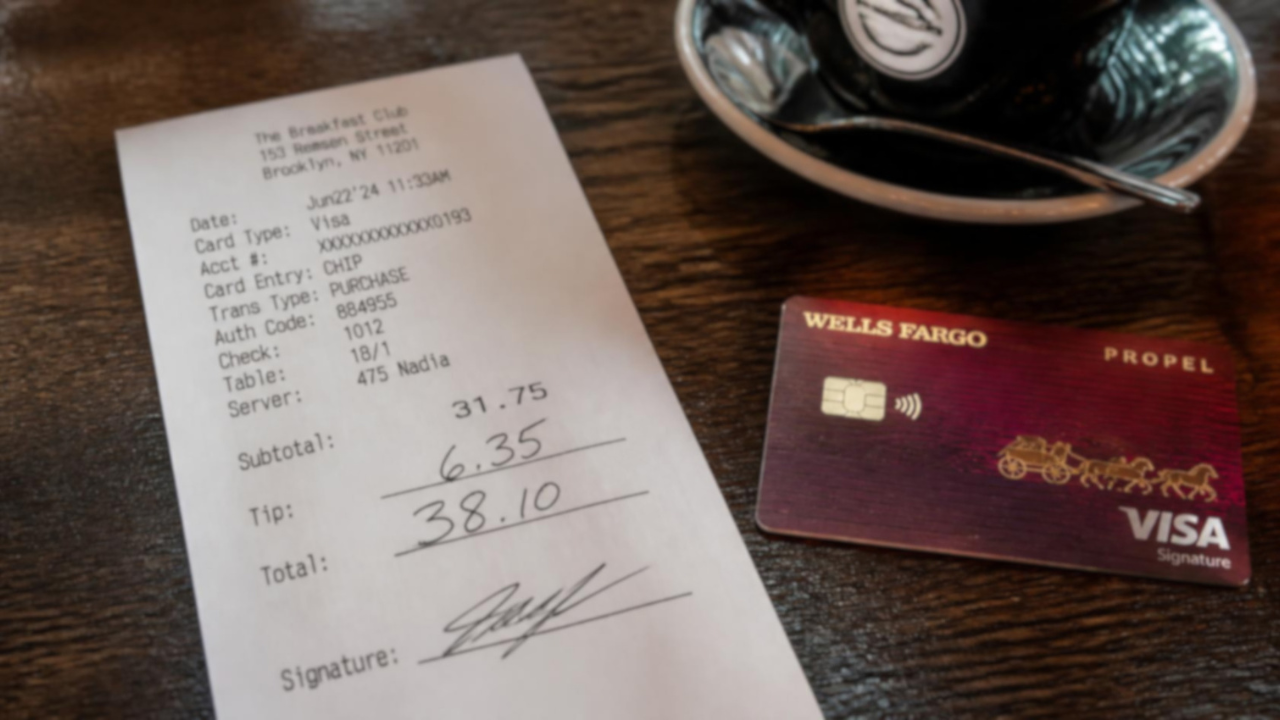
    restaurant bill showing tip
    After eight years in America, Iโ€™ve worked out most of the tipping rules. Most of them.

    Australians Do Tip. Just Not the Way Americans Do.

    Growing up in Australia, tipping was never something my family automatically did.

    I remember occasionally going to restaurants where my parents would leave something extra because the service had been particularly good.

    Theyโ€™d comment on how well the server had looked after us and say they deserved a tip.

    That was the reasoning behind it.

    Someone had done a great job, so you gave them a little extra to show your appreciation.

    It was also something I only remember happening when we were eating in at restaurants.

    We werenโ€™t tipping the person who handed us a takeaway order, the person making our coffee or someone who performed an everyday service.

    You paid the advertised price, and that was generally the end of the transaction.

    But I think thereโ€™s a misconception that Australians simply donโ€™t tip.

    Having spent years working as a chef in Australia, I can tell you that tipping was very much a thing in the restaurants where I worked.

    At one restaurant, the tips went exclusively to the front-of-house staff. At another, more upmarket establishment, they were shared with the kitchen as well.

    The amounts werenโ€™t usually substantial, but occasionally weโ€™d have a particularly good night.

    I remember diners leaving unexpectedly large tips and the staff being genuinely blown away.

    It was a lovely surprise.

    The important distinction was that nobody expected it.

    We werenโ€™t standing around calculating what percentage of the eveningโ€™s sales we should receive from customers.

    If someone left a tip, fantastic. If they didnโ€™t, that was perfectly normal too.


    Why Australian Restaurant Workers Donโ€™t Depend on Tips

    Part of the explanation lies in how hospitality workers are paid.

    Australia has a system of minimum wages and industry awards that establish legally enforceable pay rates and working conditions.

    Under the Restaurant Industry Award, employees are entitled to minimum rates determined by factors including their classification and employment status. Additional payments can apply for evening work, weekends, public holidays and overtime.

    As of July 2026, Australiaโ€™s national minimum wage is A$26.44 an hour, although restaurant employees may be entitled to different rates under their applicable award.

    The important point isnโ€™t the precise hourly figure.

    Itโ€™s that an Australian restaurant workerโ€™s legal minimum wage isnโ€™t dependent on whether I decide to leave an extra ten dollars after dinner.

    That doesnโ€™t mean every hospitality worker in Australia is financially comfortable. The cost of living is a very real issue, and hospitality can involve long hours, difficult customers and physically demanding work.

    I spent enough time in commercial kitchens to know that itโ€™s not an easy way to earn a living.

    But the wage structure is different.

    In Australia, tipping is generally additional income rather than a mechanism employers use to meet their minimum wage obligations.

    And that helps explain why the social expectation surrounding tipping developed differently.

    Chef during service in a restaurant
    Having worked in Australian restaurants, Iโ€™ve seen tips distributed in different ways.

    Why Tipping Matters So Much More in America

    Before moving to America, I already knew tipping was a big part of the culture.

    That wasnโ€™t a surprise.

    What I wasnโ€™t entirely sure about was how much to tip and, perhaps more importantly, who I was supposed to tip.

    I Googled it. I asked American friends.

    Eventually, I worked out the basics.

    But understanding why tipping is so firmly established requires looking at how American hospitality workers are paid.

    Under federal law, employers can pay eligible tipped employees a direct cash wage of just $2.13 an hour, provided their wages and tips together meet the applicable minimum wage.

    The federal minimum wage is $7.25 an hour. If tips donโ€™t bring an employeeโ€™s earnings up to that required minimum, the employer must make up the difference.

    Here in Tennessee, those federal figures apply to covered tipped employees.

    That doesnโ€™t mean every American server earns $2.13 an hour, or that $7.25 represents what servers typically take home.

    Americaโ€™s wage arrangements vary considerably by state, employer and individual worker.

    Washington, for example, requires employers to pay the full state minimum wage before tips. In 2026, that statewide minimum is $17.13 an hour.

    Yet tipping remains a familiar part of restaurant culture in states with very different wage systems.

    So while wages help explain why tipping matters, they arenโ€™t the entire explanation.

    Tipping has also become an established social custom. And once a custom becomes that deeply embedded, changing it isnโ€™t necessarily as simple as changing the wage structure.


    Does Tipping Actually Produce Better Service?

    Hereโ€™s where my experience might surprise some Australians.

    I think tipping can encourage better service.

    Having spent years living in America, Iโ€™ve noticed a considerable difference between the restaurant service I experience here and what Iโ€™ve experienced in Australia.

    American servers are often incredibly attentive.

    They greet you when you arrive, explain the menu, check whether everything is going well and make sure your drinks are topped up.

    Sometimes theyโ€™re a little too attentive.

    There are occasions when Iโ€™d quite like to finish chewing before being asked whether everything is tasting fantastic.

    But generally speaking, I appreciate the effort.

    When we visited Australia last year, the difference was particularly noticeable.

    At several establishments, we werenโ€™t greeted when we arrived. We had to ask for menus, waited a long time to be served and sometimes struggled to get someoneโ€™s attention when we wanted the bill.

    Not everywhere, of course.

    Australia has some wonderful restaurants and exceptional hospitality professionals.

    But across a number of dining experiences during that trip, the service felt noticeably more relaxed than what weโ€™d become accustomed to in America.

    Whether tipping itself causes that difference is a more complicated question.

    Restaurant culture, staffing, management and customer expectations all influence service.

    What I can say is that, from my own experience, the American system often seems to encourage a level of attentiveness that I appreciate. Although perhaps we could find a happy medium somewhere between being completely ignored and having someone ask how my meal is going every four minutes.

    Restaurant server attending to customers at a table in an American restaurant.
    American restaurant service often feels more attentive to me, although occasionally Iโ€™d like to finish a mouthful before the next check-in.

    The Steakhouse Waitress Who Absolutely Deserved Her Tip

    One of my favourite examples of American hospitality happened at a steakhouse.

    I canโ€™t remember which restaurant it was, but I certainly remember the waitress.

    We were dining with our daughters, who were being a little fussy about what they wanted.

    She was incredibly accommodating.

    Nothing seemed too much trouble. She was quick with the drinks, attentive throughout the meal and genuinely friendly.

    It wasnโ€™t simply that she performed her job efficiently.

    It was how she made us feel.

    We felt welcome, comfortable and looked after.

    She received a substantial tip.

    Thatโ€™s the kind of experience that reminds me why I appreciate having the opportunity to reward someone for exceptional service.

    Interestingly, itโ€™s exactly the same thinking I remember from growing up in Australia.

    The difference is that, in America, Iโ€™m also expected to tip when the service is merely adequate.

    And even when itโ€™s downright awful, I find it difficult not to leave something.


    I Once Left a Tip After Some Truly Terrible Service

    I donโ€™t think Iโ€™ve ever left an American restaurant without tipping.

    But I have certainly reduced the amount.

    One experience at a Cracker Barrel in Knoxville comes to mind.

    The server was rude, our order was wrong, everything took forever, and there was virtually no attention throughout the meal.

    It was a thoroughly unpleasant dining experience.

    I still left a tip, although considerably less than usual.

    For particularly poor service, Iโ€™ve sometimes left 10% or simply five dollars.

    My normal approach is around 20%, often with a little rounding.

    If the bill comes to $152 and the service has been good, I might round the total up to $190.

    If it hasnโ€™t been particularly good, I might make it $180.

    Itโ€™s not a complicated mathematical formula.

    Iโ€™m simply acknowledging the quality of the experience.

    But this is one of the tensions in American tipping culture.

    I understand that servers may depend heavily on tips to earn a living.

    At the same time, I donโ€™t think customers should feel obligated to reward genuinely poor service at exactly the same level as exceptional service.

    Thatโ€™s a difficult balance.

    And it becomes even more complicated when you consider how much individual servers can earn.


    Some American Servers Make Serious Money From Tips

    Living in Nashville, Iโ€™ve had conversations with bartenders working on Broadway.

    Some have told me they can make between $1,000 and $2,000 a week in tips.

    Thatโ€™s a substantial amount of money.

    Of course, Broadway is a particularly busy entertainment district, and those figures are what individual bartenders have told me about their own experiences. Theyโ€™re not representative of every bartender in Nashville, let alone America.

    The people Iโ€™ve spoken to described it as hard work, but they also enjoyed the atmosphere.

    They were young, loved the rush of the job and enjoyed the social side of working in such a lively environment.

    For them, tipping could be financially rewarding.

    But Iโ€™ve also spoken to hospitality workers in quieter establishments who tell a very different story.

    Some struggle to make ends meet and need multiple jobs to cover their rent and living expenses.

    Thatโ€™s the difficulty with a system where a significant portion of someoneโ€™s earnings can depend on customer traffic and generosity.

    A busy Saturday night on Broadway can look very different from a quiet Tuesday afternoon in a suburban restaurant.

    It also explains why Iโ€™m not convinced thereโ€™s a simple answer to the question of whether America should eliminate tipping and replace it with higher wages.

    Some workers may prefer the predictability of a higher guaranteed wage.

    Others may value the earning potential of tips.

    The experiences Iโ€™ve heard certainly arenโ€™t all the same.

    A bar on Broadway in Nashville
    Broadway bars are great places to earn tips, but you’ll work for it

    When Did Everyone Start Asking for a Tip?

    This is where American tipping culture starts to lose me.

    Iโ€™m perfectly comfortable tipping at restaurants and bars.

    Iโ€™ve become accustomed to tipping my barber.

    But I donโ€™t understand why Iโ€™m increasingly being presented with tipping options for services that involve little more than handing me something Iโ€™ve already paid for.

    Take Starbucks.

    I use the drive-through, order my coffee, and eventually reach the payment window.

    The employee hands me the payment terminal.

    Then comes the familiar line.

    โ€œItโ€™s just going to ask you a question there.โ€

    I know what the question is.

    You know what the question is.

    The payment terminal certainly knows what the question is.

    Would I like to leave a tip?

    No, thank you.

    Iโ€™m not suggesting that making coffee doesnโ€™t involve work or skill. Of course it does.

    But Iโ€™ve already paid for the coffee.

    If Iโ€™m collecting takeaway and someone simply walks a bag from the kitchen to the front counter, I donโ€™t understand why that transaction should automatically involve a gratuity.

    To me, thatโ€™s the service I purchased.

    Apparently, Iโ€™m not alone in noticing how widespread tipping requests have become.

    A 2023 Pew Research Center survey found that 72% of US adults believed tipping was expected in more places than it had been five years earlier.

    Research reference: Pew Research Center, How Americans See the Norms and Practices of Tipping (2023) .

    That distinction matters.

    Itโ€™s not simply Australians arriving in America and struggling to understand the rules.

    Americans themselves are navigating a tipping culture that can feel increasingly complicated.

    Digital payment terminal displaying suggested tip percentages at a coffee shop counter.
    The familiar payment terminal question. Sometimes I feel like itโ€™s following me everywhere.

    Eight Years Later, Iโ€™m Still Not Sure Who Iโ€™m Supposed to Tip

    When we moved to America, our furniture took three months to arrive by ship from Australia.

    Eventually, a removal company delivered everything and unpacked it.

    That was the service weโ€™d paid for.

    I didnโ€™t tip the removalists.

    At the time, it didnโ€™t even occur to me.

    Now, looking back, I sometimes wonder whether I should have.

    Were they expecting a tip?

    Did I commit some terrible American social offence without realising it?

    I genuinely donโ€™t know.

    Then somebody recently told me they tip their chiropractor.

    Their chiropractor!

    Iโ€™ve never done that.

    Suddenly, I found myself questioning another perfectly ordinary transaction.

    This is what I find most confusing about American tipping culture.

    There are situations where the expectations are clear, and then there are others where you seem to need an instruction manual.

    Restaurants, bars and barbers? Sorted.

    Furniture delivery and chiropractors?

    Apparently, Iโ€™m still learning.


    Why I Think Australians Should Tip When Visiting America

    Despite my occasional frustration with the system, I think Australians visiting America should follow the local tipping customs.

    Itโ€™s part of visiting another country.

    When you travel, you encounter different expectations, traditions and ways of doing things.

    Iโ€™ve lived in several countries, including Samoa and New Zealand, and Iโ€™ve learned that respecting local customs is an important part of adapting to a different culture.

    You donโ€™t walk into a Samoan fale and insist on keeping your shoes on simply because thatโ€™s what you might do at home.

    Likewise, the Mฤori hongi, a traditional greeting involving the touching of noses, is something to approach respectfully when invited to participate.

    Different cultures have different expectations.

    Tipping in America is another example.

    You donโ€™t have to agree with every aspect of the system to recognise that the person serving your dinner didnโ€™t create it.

    Refusing to tip a restaurant server because you disagree with American wage structures isnโ€™t going to change those structures.

    It may simply leave that individual worker worse off.

    My approach is to follow the established customs where I live while reserving the right to question the increasingly inventive places where tipping requests appear.

    I think thatโ€™s a reasonable compromise.


    Would I Want American Tipping Culture in Australia?

    Not really.

    Australia already has a wage structure designed to ensure employees receive a legally enforceable minimum payment for their work.

    I donโ€™t see a compelling reason to replace the traditional Australian approach with an expectation that customers routinely add another percentage to their restaurant bills.

    That doesnโ€™t mean tipping should disappear.

    Far from it.

    I like being able to reward someone who makes an evening special.

    I remember how much an unexpectedly generous tip could mean when I worked in Australian kitchens.

    But Iโ€™d rather it remain a genuine gesture of appreciation than become something customers feel obliged to do every time they encounter a payment terminal.

    And thereโ€™s another aspect of the American system that bothers me.

    Restaurant prices have increased considerably during my time living here, at least in the places my family frequents.

    Yet the expectation to tip remains.

    Because tips are often calculated as a percentage of the bill, higher menu prices also mean a larger tip in dollar terms, even when the percentage doesnโ€™t change.

    A 20% tip on a $100 meal is $20.

    If that same meal costs $150, the tip becomes $30.

    Thatโ€™s a substantial difference when youโ€™re taking a family out for dinner.

    Iโ€™m not opposed to paying for good service.

    I simply think the total cost of dining out is worth considering when discussing how much customers should be expected to contribute.


    Perhaps the Biggest Difference Isnโ€™t Generosity at all

    After eight years in America, tipping has become a fairly normal part of my life.

    I generally leave around 20% in restaurants. Iโ€™ll happily leave more when someone provides outstanding service.

    I also understand that many American hospitality workers depend on tips in a way that Australian workers generally donโ€™t.

    But I still think about those childhood restaurant visits in Australia.

    When my family left a tip, it was because somebody had made the experience special.

    Nobody had to calculate a percentage.

    Nobody felt pressured by a payment terminal.

    It was simply a way of saying thank you.

    Thatโ€™s what I liked about the Australian approach, and itโ€™s still what I appreciate most about tipping in America.

    When someone goes out of their way to make my family feel welcome, Iโ€™m more than happy to acknowledge it.

    Just donโ€™t ask me to tip the chiropractor. Iโ€™m still trying to work that one out.


    Enjoy reading about life in America through Australian eyes?

    If you’ve enjoyed this article and feel like leaving a tip, you can buy me a coffee. Completely optional, of course. I’m Australian.

  • Why Do Australians Swear So Casually? It’s Not Always What You Think

    Why Do Australians Swear So Casually? It’s Not Always What You Think

    AUSTRALIA EXPLAINED


    There are certain things that you learn very quickly when you move from Australia to America.

    You learn to drive on the other side of the road. That biscuits aren’t quite the biscuits you are used to. You discover that asking someone where the toilet is can produce a surprisingly uncomfortable situation.

    You also discover that some of the words you’ve been using quite happily for most of your life can make an American look as though you’ve just insulted their grandma.

    Now I don’t consider myself an especially foul-mouthed kind of person. I know when to watch my language, especially as a Dad to two young girls but even in professional settings as well.

    But after eight years in the United States, I’ve become much more conscious of something I barely thought about back in Australia.

    Australians can be remarkably casual about swearing.

    Not all Australians, obviously. There are plenty of people who wouldnโ€™t dream of dropping an F-bomb over breakfast.

    But in certain Australian social circles, a swear word can slip into a conversation without anybody batting an eyelid.

    It doesnโ€™t necessarily mean someoneโ€™s angry.

    It doesnโ€™t necessarily mean theyโ€™re being rude.

    Sometimes, it doesnโ€™t seem to mean much of anything at all.

    Which raises an interesting question. Why?

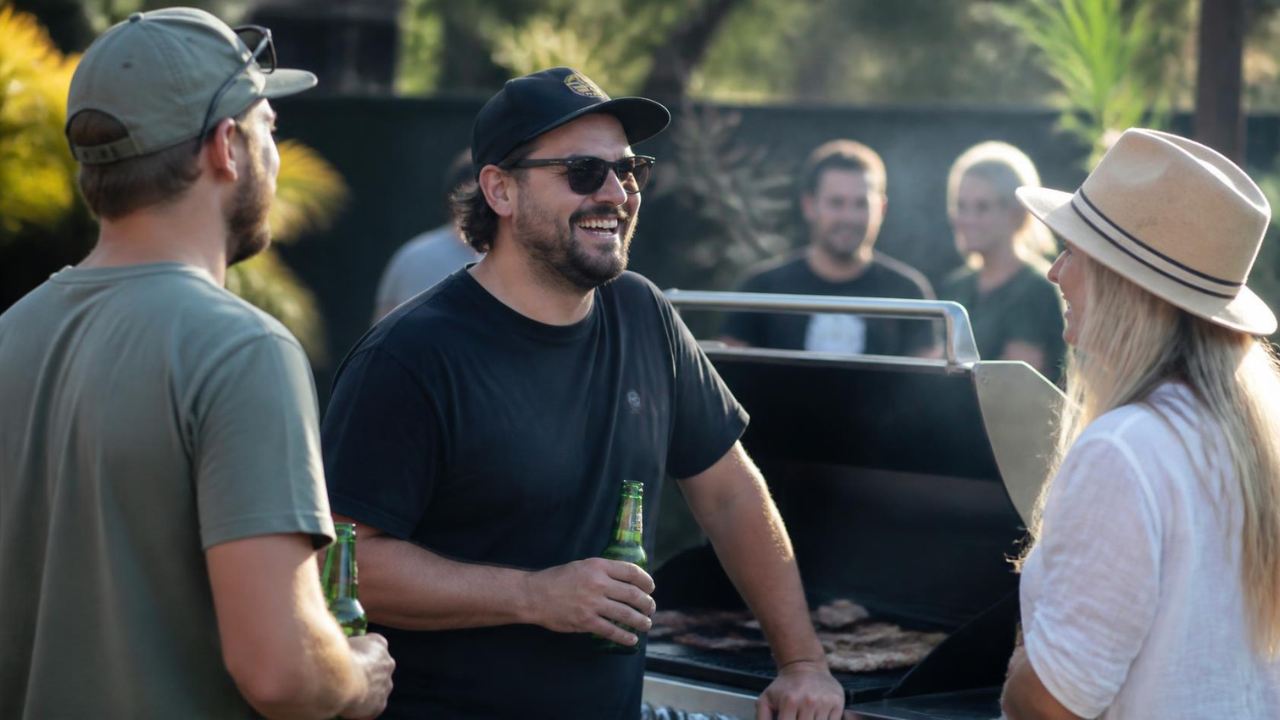
    Friends enjoying a relaxed conversation at an Australian backyard barbecue.
    In Australia, the meaning of a swear word can depend as much on the company as the language itself

    Swearing Isnโ€™t Always About Being Angry

    When someone swears, itโ€™s easy to assume theyโ€™re expressing anger, frustration or hostility.

    Sometimes they are.

    But swearing can serve quite a few other purposes.

    Imagine an Australian watching a friend attempt something spectacularly stupid.

    โ€œYouโ€™re a bloody idiot.โ€

    Now imagine that same Australian saying exactly the same words to someone who has just damaged their car.

    Same sentence.

    Entirely different conversation.

    In the first situation, it might be accompanied by laughter, a shake of the head and another beer.

    In the second, somebody might be about to have a very unpleasant afternoon.

    The words havenโ€™t changed. The relationship, tone and circumstances have.

    Thatโ€™s an important part of understanding Australian swearing.

    Linguists have examined how informal language, swearing and terms of insult can express camaraderie, nonchalance and resistance to excessive formality in Australian English. Itโ€™s a cultural tendency, not a rule that applies to every Aussie.

    The mistake is assuming that every swear word is being used as an insult. Sometimes itโ€™s simply part of the conversation.


    The Australian Art of Insulting Your Friends

    One of the more confusing parts of Australian humor is our willingness to give people we like a hard time.

    If youโ€™ve ever spent time around a group of Aussie mates, you might have noticed that affection isnโ€™t always expressed through compliments.

    Sometimes itโ€™s expressed by pointing out someoneโ€™s stupidity in considerable detail.

    A friend arrives wearing a shirt that looks like it was bought from an op-shop.

    Someone comments on it.

    Everyone laughs.

    The friend fires back with something worse.

    Nobody takes offense.

    In fact, being included in the exchange can be a sign that youโ€™re comfortable with one another.

    Of course, thereโ€™s a difference between friendly teasing and genuine bullying. The distinction depends on whether everyone involved is enjoying themselves.

    The Australian sense of humor doesnโ€™t magically excuse being rude.

    But among friends who understand each other, a little verbal abuse can become an oddly affectionate ritual.

    The trick is knowing the relationship.

    You canโ€™t walk up to a complete stranger, call them an idiot and assume theyโ€™ll appreciate your cultural authenticity.

    Thatโ€™s not how it works. Although Iโ€™m sure someone has tried.

    Australian men at a bbq
    You can always count on your Aussie mates for a bit of banter

    Why Australians Use Swear Words as Punctuation

    Thereโ€™s another kind of Australian swearing that has almost nothing to do with insulting anybody.

    Itโ€™s the casual swear word that sneaks into an otherwise ordinary sentence.

    โ€œWhereโ€™s the bloody remote?โ€

    โ€œItโ€™s bloody hot today.โ€

    โ€œThat was a bloody good game.โ€

    In these examples, bloody isnโ€™t necessarily expressing hostility. Itโ€™s adding emphasis.

    The remote is missing. The weather is hot. The game was good.

    The swear word simply gives the sentence a little extra weight.

    Itโ€™s not entirely different from an American saying something was โ€œdamn good.โ€

    Of course, bloody is a relatively mild example.

    Stronger words can serve similar purposes in some Australian social settings, although the acceptability changes considerably depending on the audience.

    A swear word might emphasize surprise, excitement, disappointment or admiration.

    Sometimes it can do several of those things in the same conversation.

    If you removed every unnecessary swear word from certain Australian conversations, youโ€™d be left with something resembling a very short meeting agenda.

    Technically, all the information would still be there.

    It just wouldnโ€™t sound quite the same.

    Television remote wedged between couch cushions in a living room
    A missing remote can inspire an impressive amount of Aussie lingo

    Why the C-Word Is Different in Australia

    I should probably address the elephant in the room.

    Or, more accurately, the word that tends to make the elephant leave the room.

    The C-word.

    In the United States, itโ€™s widely regarded as an extremely offensive insult, particularly when directed at women.

    In some Australian social circles, however, the word can have a much broader range of meanings.

    It can be an insult.

    It can be a casual reference to a person.

    Among certain friends, it can even be used affectionately.

    A 2026 linguistic study by Henry Carls examined these different uses in Anglo-Australian English, including hostile, neutral and friendly meanings.

    That doesnโ€™t mean the word is universally acceptable in Australia.

    Far from it.

    There are plenty of Australians who dislike it intensely. Age, upbringing, social environment and personal preference can all influence how someone reacts. Personally, I’m not a fan of it either.

    You certainly wouldnโ€™t assume it was appropriate in a workplace, a family gathering or a conversation with someone youโ€™ve just met.

    And using it affectionately with a close friend doesnโ€™t make it harmless when directed at someone who finds it offensive.

    The important distinction is that the wordโ€™s meaning isnโ€™t fixed across every social situation.

    For an American unfamiliar with that usage, hearing it casually exchanged between Australian friends can be pretty shocking.

    For the Australians involved, it might be completely normal.

    Neither reaction is particularly mysterious once you understand the cultural expectations.

    Personally, I wouldnโ€™t recommend testing the boundaries of this particular linguistic difference during your first visit to Australia.

    Start with โ€œGโ€™day.โ€ Work your way up.

    a kangaroo teaching a tourist Australian slang.
    No need to be a hero, take it easy on the slang cobba!

    Even the Word โ€˜Mateโ€™ Can Be an Insult

    Hereโ€™s where Australian English becomes particularly entertaining.

    We donโ€™t even need to swear to sound threatening.

    Take the word mate.

    โ€œThanks, mate.โ€

    Friendly.

    โ€œHow’s it going, mate?โ€

    Probably friendly.

    โ€œListen here, mate.โ€

    Potentially an entirely different situation.

    You can almost hear the change in tone.

    Australian National University linguist Johanna Rendle-Short studied how the placement of mate in conversation affects its interpretation. Her research found that the word can communicate friendliness but can also take on antagonistic meanings depending on how it is used.

    In other words, the supposedly friendly word can sometimes be more concerning than the swear word.

    An Australian calling you a bloody idiot while laughing might be perfectly happy with you.

    An Australian looking you directly in the eye and saying โ€œListen, mateโ€ might suggest the conversation has taken a turn.

    Context is doing most of the work.


    Is Australian Swearing Part of Our Anti-Authority Culture?

    Thereโ€™s a broader cultural explanation worth looking at.

    Australian identity has long been associated with informality, egalitarian ideals and a certain suspicion of people who take themselves too seriously.

    That doesnโ€™t mean Australians reject authority altogether.

    We have rules, institutions, hierarchies and plenty of people who enjoy enforcing them.

    But excessive formality can sometimes feel a little uncomfortable in Australian social settings.

    Using informal language can help reduce the distance between people.

    A boss who speaks casually with employees might be trying to create a relaxed atmosphere.

    Friends might use deliberately rough language to avoid sounding overly sentimental.

    Someone might swear while telling a story simply because thatโ€™s how theyโ€™d naturally tell it.

    Research by linguists Alyssa Severin and Kate Burridge connects Australian colloquial language, including swearing and terms of insult, with cultural ideals such as mateship, egalitarianism and anti-authoritarianism.

    That doesnโ€™t prove every Australian swear word is a miniature rebellion against “The Man”.

    Sometimes youโ€™ve just dropped a hammer on your foot.

    But it helps explain why informality can carry positive social meaning.

    For some Australians, speaking plainly is part of showing that youโ€™re not putting on airs.

    Whether the language actually makes anyone more genuine is another question entirely. A person can swear like a sailor and still be completely full of crap.


    Does That Mean Australians Swear More Than Americans?

    Not necessarily.

    Itโ€™s easy to hear a few Australians swearing casually and conclude that the entire country has a more colorful vocabulary than the United States.

    But thatโ€™s a different claim from saying Australians use particular swear words differently.

    Swearing varies enormously within both countries.

    An American construction site, a military barracks, a family dinner and a corporate boardroom are unlikely to have identical expectations about language.

    Neither are their Australian equivalents.

    Without comparable national data, thereโ€™s no good reason to declare one entire population the champion of profanity.

    What I can say from my own experience is that living in America has made me more aware of when certain words might land differently and that is certainly more noticeable in the southern states.

    Something that would pass without comment among Australian friends might cause a very different reaction here.

    Not because Americans never swear.

    They certainly do.

    But because the same word can carry different social baggage.

    The difference isnโ€™t always how frequently people swear. Sometimes itโ€™s what theyโ€™re prepared to overlook.

    An everyday social setting in Tennessee
    Eight years in America have made me much more conscious of which Australian expressions travel well

    The Swear Words That Arenโ€™t Quite What They Used to Be

    Language changes.

    Words that once caused widespread offense can become relatively mild, while other expressions become less socially acceptable.

    This is particularly interesting in Australia because traditional profanity and language that targets someoneโ€™s identity donโ€™t necessarily carry the same weight.

    A 2025 study published in the Australian Journal of Linguistics surveyed 60 Australian-born university students about taboo language.

    The researchers found that participants considered discriminatory language more taboo than some categories of traditional swearing. The sample was small and limited to university students, so the results shouldnโ€™t be treated as a definitive measure of the entire Australian population.

    Nevertheless, it raises an interesting distinction.

    Someone might be perfectly comfortable with a conversation full of traditional swear words while objecting strongly to language that demeans a particular group of people.

    Being relaxed about profanity doesnโ€™t mean being relaxed about every kind of offensive language.

    Nor does it mean that someone who swears casually is incapable of recognizing when their words have crossed a line.

    The question isnโ€™t simply whether a word is rude. Itโ€™s also what the word is doing and who it affects.


    How to Tell When an Australian Is Actually Insulting You

    Unfortunately, there isnโ€™t a universal Australian translation manual.

    But if youโ€™re visiting Australia or spending time with Australian friends, there are a few things worth paying attention to.

    First, listen to the tone.

    A laughing friend calling you an idiot is very different from an angry stranger saying the same thing.

    Second, consider the relationship.

    People who have known each other for twenty years can get away with language that would be completely inappropriate between strangers.

    Third, look at the reaction of everyone else.

    If the entire group is laughing and the person being teased is laughing too, youโ€™re probably witnessing friendly banter.

    If someone looks uncomfortable, goes quiet or asks for it to stop, the situation is different.

    Finally, donโ€™t assume you need to imitate the language to fit in.

    You can enjoy Aussie humor without adopting every expression you hear.

    In fact, an American arriving in Sydney and immediately attempting to use the strongest Australian swear words imaginable is probably going to sound less like a local and more like someone who learned English exclusively from a series of YouTube videos. Thereโ€™s no rush.


    Living Between Two Versions of English

    One of the fascinating things about moving overseas is discovering how much of your own culture you never consciously noticed.

    You donโ€™t spend your childhood analyzing the language around you.

    You simply absorb it.

    You learn which words are acceptable at home, which ones you can use around friends and which ones will get you into trouble.

    Then you move to another country and discover that the rules have changed.

    The words are largely the same.

    The meanings arenโ€™t always.

    After eight years in America, I find myself paying more attention to those differences.

    I still enjoy the informality of Australian conversation. I appreciate the humor, the teasing and the ability to express frustration without necessarily turning it into a major emotional event.

    But Iโ€™ve also learned that a word I consider relatively harmless might carry a much stronger meaning for someone else.

    Thatโ€™s worth respecting.

    Adapting to another country doesnโ€™t require abandoning your personality.

    It does require understanding that other people havenโ€™t necessarily grown up with the same social rulebook. And sometimes, the most useful thing you can learn about another culture is when to keep your bloody mouth shut.


    Enjoy seeing Australia through a different lens?

    From Australian slang to the little cultural differences you only notice after moving overseas, thereโ€™s always something new to discover.

    If you enjoy these stories, you can support From Down Under to Down South on Buy Me a Coffee . Every coffee helps keep the stories coming.

  • Why Australians Call Flip-Flops โ€œThongsโ€

    Why Australians Call Flip-Flops โ€œThongsโ€

    AUSTRALIA EXPLAINED


    There are certain Aussie words that you don’t realize are particularly Australian until you leave.

    “Thongs” is one of them.

    Growing up in Australia, there was absolutely nothing unusual about somebody saying:

    “I’m just putting my thongs on.”

    Nobody gasped or looked concerned.

    Nobody wondered why you were discussing your underwear before going to the shops.

    You were simply putting a pair of rubber shoes on your feet.

    Then you move to America.

    Suddenly, announcing that you need to find your thongs before leaving the house creates an entirely different mental picture.

    Because in the United States, a thong is generally underwear.

    In Australia, it’s footwear.

    So how did Australians end up calling flip-flops “thongs”?

    The funny thing is, Australians aren’t actually being as weird as Americans might think.

    In fact, there’s a perfectly sensible reason we call them thongs. We’ve even got history on our side.

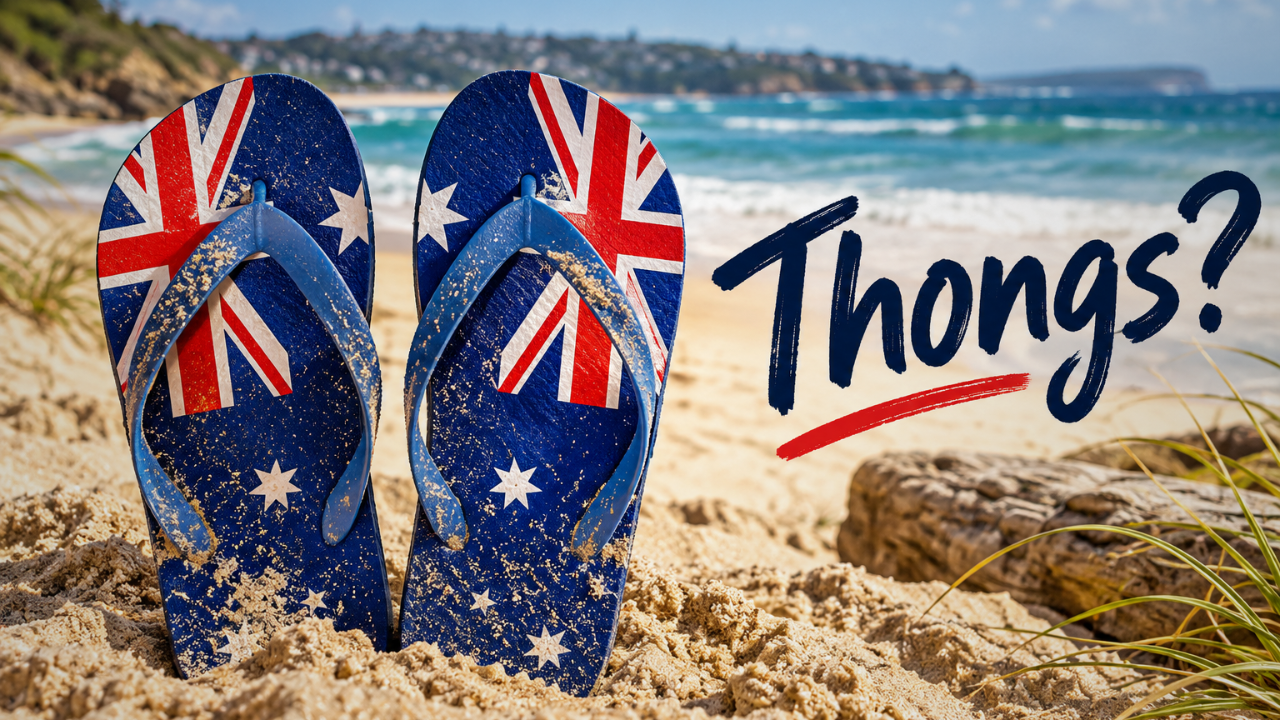
    Australian thongs, known as flip-flops in the United States
    Thongs to an Australian. Flip-flops to an American.

    The Name Comes From the Strap

    The Australian use of the word “thong” makes a lot more sense when you look at how the footwear is constructed.

    A thong was originally a narrow strip or strap of leather.

    The word had been used in English for centuries, long before anyone was using it to describe a certain style of underwear.

    The classic Aussie thong has a sole with a Y-shaped strap that passes between the big toe and second toe.

    That strap is the thong.

    Eventually, the name of the strap became the name we commonly use for the entire piece of footwear.

    So technically, Australians didn’t randomly look at a pair of flip-flops one afternoon and decide to give them the same name as skimpy underwear.

    The footwear meaning has much older linguistic roots. Which is slightly disappointing, because that would have been a much better story.


    Americans Used to Call Them Thongs Too

    Here’s where things get interesting.

    Americans did too.

    In fact, “thong” was once a perfectly normal American name for the sandal, and American dictionaries still recognize that meaning today. The modern rubber version became more popular in the United States after World War II, influenced by the traditional Japanese zลri sandal.

    Traditional Japanese zori sandals that influenced modern flip-flops
    The modern rubber flip-flop was influenced by traditional Japanese zลri sandals

    By the 1960s, another name was becoming popular.

    The flip-flop.

    The origin of that name appears to be really simple.

    It’s the sound they make when you walk.

    Flip.

    Flop.

    Flip.

    Flop.

    For a while, Americans used both “thong” and “flip-flop” for the footwear. Over time, though, flip-flop increasingly won out.

    At roughly the same time, “thong” was developing another meaning in American English, referring to increasingly revealing swimwear and eventually the style of underwear most Americans associate with the word today.

    Exactly when Americans stopped calling their footwear thongs seems to have varied by place and generation. There are Americans who remember using the word for their shoes through the 1960s, 70s and even into the 80s.

    Australia simply never made the switch.

    Which means when an American laughs because an Australian calls a flip-flop a thong, there’s a perfectly reasonable response.

    You used to call them thongs too.


    Thongs Are Almost an Australian Uniform

    The more interesting part isn’t really what Australians call them.

    It’s how completely normal they are. Growing up on the coast in Australia, I essentially lived in thongs from spring through autumn.

    Going to the beach?

    Thongs.

    Duck down to the shops?

    Thongs.

    Barbecue?

    Thongs.

    Taking the bins out?

    Thongs.

    Walking across pavement approximately three degrees below the melting point of human skin?

    Still thongs.

    There are limits, obviously. Australians don’t actually wear thongs everywhere, despite what some stereotypes might suggest.

    But they occupy a particular place in Australian life that’s difficult to explain until you’ve lived somewhere else. They’re cheap, practical, easy to kick off and perfectly suited to a country where beaches, heat and casual clothing are part of everyday life.

    We even have another name for them.

    Pluggers.

    The name comes from those little rubber plugs underneath the sole that hold the straps in place. Which also gives us the wonderfully Australian phrase:

    “I’ve busted me plugga!”

    Every Australian knows exactly what has happened.

    One second you’re walking normally.

    The next, the plug has pulled through the sole and you’re stranded with a piece of rubber attached to absolutely nothing.

    Fortunately, Australians have developed sophisticated technology to deal with this emergency. A bread tie.

    Australian thong repaired with a bread tie after the rubber plug broke
    The Australian emergency thong repair kit: one bread tie

    Push the strap back through the hole, wrap a bread tie around the bottom to stop it pulling through again, and you’re back in business.

    It works surprisingly well.

    It isn’t pretty. But neither are the thongs you’ve probably been wearing for the last three summers.


    I Never Thought Twice About the Word Until I Lived in America

    This is one of my favorite things about living between two countries.

    You discover that words you’ve used your entire life aren’t necessarily universal.

    They’re just normal to you.

    I never grew up thinking Australians had a quirky word for flip-flops.

    They weren’t flip-flops.

    They were thongs.

    That’s what they were called.

    It’s only after living in the United States that I’ve become conscious of how funny some perfectly ordinary Australian sentences can sound to American ears.

    The same thing happens in reverse.

    There are American words and expressions that barely register with me anymore, but sounded completely foreign when I first moved here. After a while, you almost develop two versions of English in your head. You know which word you’d use in Australia and which one will save you an explanation in America.

    Neither country is using English incorrectly.

    We’ve simply taken the same language and spent a couple of centuries tinkering with it. Occasionally with hilarious results.


    So, Are They Thongs or Flip-Flops?

    Thongs.

    Obviously.

    I’m Australian. What did you expect me to say?

    But after years of living in America, I’ve learned that context matters.

    If I’m talking to Australians, they’re thongs.

    If I’m talking to Americans, there’s a small part of my brain that now considers whether saying “thongs” is about to derail the entire conversation.

    Sometimes I’ll say flip-flops.

    Sometimes I’ll still say thongs.

    But sometimes it’s much more entertaining not to explain myself and wait for the American in the room to work out why an Australian man just announced that he left his thongs by the front door.

    That’s one Australian word I’m not quite ready to give up.


    Enjoying From Down Under to Down South?

    If you enjoy seeing Australia and America through my slightly confused eyes, you can help support the stories, articles and podcast by buying me a coffee.

    It helps keep From Down Under to Down South going, and unlike a busted plugga, I can’t fix the website with a bread tie.

    Buy Me a Coffee and support From Down Under to Down South

  • Why Australians Say โ€œYeah Nahโ€ โ€” And Somehow Know Exactly What It Means

    Why Australians Say โ€œYeah Nahโ€ โ€” And Somehow Know Exactly What It Means

    AUSTRALIA EXPLAINED


    There are moments when I realise Australian English makes absolutely no sense.

    โ€œYeah nahโ€ is one of them.

    To an Australian, there is nothing particularly complicated about those two words. Someone asks us a question, we say โ€œyeah nah,โ€ and everybody just gets on with their day.

    To someone unfamiliar with Australian English, however, we have just answered yes and no at exactly the same time.

    Which when you think about it seems less like a useful response and more like something a politician at Parliament House might say when trapped in an interview.

    The strange thing is that Australians generally know exactly what it means.

    Even stranger?

    Change the order and the answer changes.

    โ€œYeah nahโ€ usually means no.

    โ€œNah yeahโ€ usually means yes.

    And if an Australian starts adding additional yeahs and nahs, you may simply have to trust us.

    Australian slang graphic explaining that yeah nah means no and nah yeah means yes.
    Australian English: where โ€œyes, noโ€ means no and โ€œno, yesโ€ means yes.

    So What Does โ€œYeah Nahโ€ Actually Mean?

    The simplest answer is:

    โ€œYeah nahโ€ usually means no.

    But that explanation misses most of what is happening.

    The โ€œyeahโ€ isn’t necessarily an affirmative answer. It can be an acknowledgement.

    You might think of it as:

    โ€œI hear what you’re saying.โ€

    โ€œI understand.โ€

    โ€œI’ve considered that.โ€

    โ€œFair enough.โ€

    Then comes the actual answer.

    Nah.

    For example:

    โ€œDo you want to get up at five tomorrow morning and go for a run?โ€

    โ€œYeah nah.โ€

    There is no ambiguity here.

    I have heard what you asked me.

    I have thought about it.

    I have also concluded that your proposal is ridiculous.

    The answer is no.

    That distinction is important because โ€œyeah nahโ€ isn’t simply Australians being deliberately confusing. Researchers studying Australian English have found that โ€œyeah-noโ€ performs several conversational jobs, including softening disagreement, maintaining conversational flow and helping speakers save face.

    In other words, there is considerably more going on inside those two tiny words than it first appears.


    The โ€œYeahโ€ Is Doing More Work Than You Think

    Imagine someone suggests something you don’t really like.

    โ€œWe should paint the living room bright orange.โ€

    You could simply respond:

    โ€œNo.โ€

    Perfectly clear.

    Also slightly brutal.

    โ€œYeah nah, I’m not sure about that.โ€

    Now you’ve done something different.

    The โ€œyeahโ€ has acknowledged the other person’s idea before the โ€œnahโ€ gently drives a truck through it.

    That softening effect is one reason the expression works so well in conversation. SBS’s Cultural Atlas describes the opening โ€œyeahโ€ as acknowledging the other person’s point before the โ€œnahโ€ introduces disagreement, helping keep the exchange relaxed and less confrontational.

    Aussues have a reputation for being direct, but Australian conversation can also contain an enormous amount of understatement, hedging and meaning hidden in tone.

    We don’t always say exactly what the words appear to mean.

    โ€œThis should be interestingโ€ may not mean the person is looking forward to it.

    โ€œNot badโ€ can be extremely high praise.

    โ€œGood on yaโ€ can be amazingly supportive.

    It can also mean something very different.

    And โ€œyeah nahโ€ fits right into that world.

    The dictionary definition is almost the least interesting part.

    The real meaning lives in the conversation.

    Michael with his daughter during an everyday family outing.
    You don’t really notice the strange little things about the way you speak until someone else points them out.

    Then There Is โ€œNah Yeahโ€

    This is where things become fun.

    If:

    Yeah nah = no

    then:

    Nah yeah = yes.

    Again, the final part generally tells you where we’ve landed.

    โ€œDid you end up liking that restaurant?โ€

    โ€œNah yeah, it was really good.โ€

    Translation:

    I had doubts.

    I wasn’t expecting much.

    I’m responding to something said earlier.

    Whatever happened inside my head, I have now arrived at yes.

    The University of Technology Sydney even includes the wonderfully concise formula in its guide to Australian slang:

    Nah yeah = yes.

    Yeah nah = no.

    Yeah nah yeah = yes.

    At this point, international readers may reasonably wonder whether Australia couldn’t simply have adopted a more efficient system.

    We could have.

    But, we chose not to.


    But โ€œYeah Nahโ€ Doesn’t Always Mean Exactly the Same Thing

    This is the part that lists of Australian slang often miss.

    Language isn’t mathematics.

    You can’t simply memorize:

    YEAH + NAH = NO

    and assume you’ve cracked the Australian code.

    Listen to this:

    โ€œWas the concert any good?โ€

    โ€œYeah nah, it was fantastic.โ€

    That’s clearly positive.

    Now:

    โ€œWas the concert any good?โ€

    โ€œYeah nah, wouldn’t bother.โ€

    Definitely negative.

    Same opening words.

    Completely different destination.

    Australian listeners aren’t sitting there consciously decoding a linguistic formula. We’re listening to tone, emphasis, context and, crucially, what comes next.

    That’s why trying to learn Australian English from a list of slang words only gets you so far.

    You can learn that โ€œarvoโ€ means afternoon.

    You can learn that โ€œservoโ€ means service station.

    You can learn that โ€œbrekkieโ€ means breakfast.

    Those are translations.

    โ€œYeah nahโ€ requires something different.

    You have to learn how Australians talk.

    Some Australian expressions are much easier to translate. A โ€œservo,โ€ for example, is simply what Australians commonly call a service station, although the experience itself can be surprisingly different from an American gas station.


    Americans Say Something Similar

    Living in the United States has made me much more conscious of expressions I used for years without thinking about them.

    You don’t normally analyse your own language while you’re surrounded by people who speak exactly the same way.

    Move 9,000 miles away and suddenly you hear yourself.

    Americans say โ€œyeah, noโ€ too, so I’m not going to pretend we’ve got exclusive ownership of it.

    But when I hear an Australian say โ€œyeah nah,โ€ there’s something about the way we use it that just sounds Australian to me.

    Maybe it’s the tone. Maybe it’s the timing. Maybe it’s because I grew up hearing it.

    Whatever it is, I don’t have to stop and work out whether they mean yes or no.

    I just know.

    Which is handy, because trying to explain why I know is where this whole thing starts falling apart.


    You Can Say an Awful Lot With Two Words

    โ€œYeah nahโ€ can be a refusal.

    โ€œWant another beer?โ€

    โ€œYeah nah, I’m right.โ€

    It can be disagreement.

    โ€œI reckon that’s the best way to do it.โ€

    โ€œYeah nah, I don’t think so.โ€

    It can acknowledge something before changing direction.

    โ€œHe had a pretty good game.โ€

    โ€œYeah nah, he did alright, but he missed a couple he should’ve had.โ€

    It can soften criticism.

    โ€œDid you like the movie?โ€

    โ€œYeah nah, wasn’t really my thing.โ€

    It can even help deflect a compliment.

    โ€œYou were brilliant out there today.โ€

    โ€œYeah nah, everyone played well.โ€

    That feels especially Australian to me.

    Someone gives you a compliment and instead of just accepting it like a normal person, you immediately start trying to give the credit to everyone else.

    We somehow managed to turn yes and no into a way of saying thank you.

    Which, now that I think about it, is probably about as Australian as it gets.

    Sometimes the words themselves matter less than the social message underneath them:

    Don’t make too much fuss.

    Don’t make this awkward.

    I hear you.

    We’re good.

    Now here’s what I actually think.

    โ€œYeah nah.โ€

    Two words.

    Job done.

    Examples showing different meanings of the Australian expression yeah nah.
    The meaning of โ€œyeah nahโ€ depends on much more than the literal words.

    Can You Use โ€œYeah Nahโ€ If You’re Not Australian?

    Of course.

    There is no Australian slang enforcement squad waiting at Sydney Airport, at least that I know of!

    But I wouldn’t try too hard.

    The quickest way to make Australian slang sound unnatural is to assemble every Australian expression you’ve learned into one terrifying sentence.

    โ€œG’day mate, yeah nah, chuck another shrimp on the barbie this arvo.โ€

    Please don’t.

    Especially the shrimp.

    We call them prawns.

    โ€œYeah nahโ€ works because for many speakers it isn’t a performance. It’s just conversation. It slips into a sentence without announcing itself.

    If you’re visiting Australia, you don’t really need to practise saying it.

    Just listen for it.

    Eventually you’ll hear somebody say โ€œyeah nah,โ€ immediately understand what they mean and not even notice that they technically just told you yes and no.

    At that moment, congratulations.

    You’re learning Australian!


    The Answer Is Usually at the End

    If you desperately need a rule, here’s the closest thing to one:

    Listen to where the Australian finishes.

    Yeah nah?

    Probably no.

    Nah yeah?

    Probably yes.

    Yeah nah yeah?

    We’ve somehow returned to yes.

    But don’t become too confident, because tone and context are waiting to ruin your new system.

    That’s really the point.

    โ€œYeah nahโ€ isn’t interesting because Australians invented a bizarre way of saying no.

    It’s interesting because it demonstrates something we rarely notice about our own language.

    We don’t communicate in dictionary definitions.

    We communicate in pauses, tone, shared assumptions, facial expressions, context and little verbal signals we’ve heard thousands of times before.

    To an outsider, โ€œyeah nahโ€ sounds contradictory.

    To an Australian ear, there may be no contradiction at all.

    We heard the yeah.

    We heard the nah.

    We know which one matters.

    Yeah nah.

    Makes perfect sense.

    By this point, if โ€œyeah nahโ€ is starting to make perfect sense to you, congratulations.

    You may now be qualified to own a Yeah Nah T-shirt.

    Wearing it correctly is your responsibility.


    If you enjoy seeing Australia and America through slightly different eyes, you can support From Down Under to Down South through Buy Me a Coffee. It helps me keep creating independent stories about Australian culture, American life and the strange little things you only notice when you’ve lived in both.


  • What Is a Servo in Australia? Itโ€™s Not Quite an American Gas Station

    What Is a Servo in Australia? Itโ€™s Not Quite an American Gas Station

    What is a servo in Australia? A servo is the Australian word for a gas station or petrol station. It’s one of those everyday Australian terms that can completely confuse Americans the first time they hear it.

    When I first moved to America, I quickly learned that what Australians call a servo, Americans call a gas station.

    The funny thing is that Australians use the word so casually that we often forget it’s slang.

    “Just pulling into the servo.”

    “Need anything from the servo?”

    “The servo down the road has cheaper fuel.”

    To an Australian, those sentences sound completely normal. To an American, they can sound like we’re talking about some mysterious piece of machinery.

    Why Do Australians Call It a Servo?

    The word servo is simply a shortened version of service station.

    Australians love shortening words. In fact, it’s almost a national hobby.

    We don’t just have:

    • Servo (service station)
    • Arvo (afternoon)
    • Bottle-o (liquor store)
    • Macca’s (McDonald’s)
    • Rego (vehicle registration)

    We shorten so many words that sometimes visitors feel like they’re learning a second language.

    A service station became a servo, and the name stuck.

    What Happens at a Servo?

    Meat Pie

    Traditionally, a servo was a place to buy petrol and maybe get basic vehicle services.

    Today, Australian servos are much more like American gas stations.

    Most have:

    • Fuel pumps
    • Convenience stores
    • Soft drinks and snacks
    • Coffee machines
    • Ice
    • Toilets
    • Basic automotive supplies

    Some larger servos have surprisingly good food.

    On long road trips across Australia, stopping at a servo is often part of the journey. You fill the tank, grab a meat pie, buy a drink, and stretch your legs before heading back onto the highway.

    • Buying meat pies in the US is so difficult! Here’s a bumper sticker for those of you who want to start spreading the word here on how good they are!

    Servo vs Gas Station

    Although they serve the same purpose, there are a few language differences between Australia and America.

    AustraliaUnited States
    ServoGas station
    PetrolGas
    Fill up the tankFill up the tank
    Unleaded petrolRegular gas
    Service stationGas station

    The first time someone in America asked me where I got gas, I nearly answered, “At the servo.”

    Then I remembered that nobody around me would have any idea what I meant.

    Do Australians Ever Say Gas Station?

    Not usually.

    Most Australians say either servo, service station or petrol station.

    If you said “gas station” in Australia, people would understand you, largely because of American movies and television, but it would sound distinctly American.

    It’s similar to how Australians understand words like “sidewalk” or “apartment,” even though we would normally say “footpath” and “unit.”

    One of Australia’s Most Recognisable Words

    Servo is one of those words that instantly identifies someone as Australian.

    The moment an Australian abroad says, “I need to stop at the servo,” other Australians know exactly where they’re from.

    It’s a small word, but it’s part of a much larger Australian habit of shortening everyday language and turning ordinary words into nicknames.

    And once you’ve spent enough time around Australians, you’ll probably find yourself saying it too.

    If you’ve ever wondered what is a servo in Australia, the answer is simple: it’s the Australian term for a gas station or petrol station.

    Hoo roo maties.

  • Australian Cryptids: The Strange Creatures and Legends Hiding in the Bush

    Australian Cryptids: The Strange Creatures and Legends Hiding in the Bush

    AUSTRALIA EXPLAINED

    America has Bigfoot.

    Scotland has the Loch Ness Monster.

    Australia, apparently deciding that our actual wildlife wasn’t enough to worry about, has the yowie, the bunyip and mysterious lights that follow people through the Outback.

    This is a country, after all, where visitors already arrive concerned about snakes, spiders, crocodiles, sharks and various other things they’ve been assured will kill them within 20 minutes of leaving Sydney Airport.

    Then we tell them there might also be a large hairy man wandering around the bush.

    Welcome to Australia.

    But Australian cryptids and legends are more interesting than simply being our versions of Bigfoot.

    Some have histories stretching back through generations of Aboriginal storytelling. Others grew from the isolation and uncertainty of colonial Australia. Some have perfectly plausible scientific explanations.

    Others remain just strange enough that people are still talking about them.

    And then there’s the drop bear.

    We’ll get to that.

    Australian bunyip in a billabong at sunrise
    Australia has plenty of real animals to worry about. Apparently we needed imaginary ones too.

    What Is an Australian Cryptid?

    A cryptid is an animal or creature whose existence has been claimed but hasn’t been established by science.

    Bigfoot is probably the world’s most famous example.

    Australia has plenty of candidates, although there’s an important distinction to make before we go wandering into the bush with a torch.

    Not every Australian legend is a cryptid.

    The yowie fits the definition fairly neatly. The bunyip is more complicated because stories associated with it have deep connections to Aboriginal cultures and shouldn’t simply be reduced to Australia’s version of a Western monster.

    The Min Min Lights aren’t creatures at all.

    Lasseter’s Reef is supposedly lost gold.

    The SS Maheno is a very real shipwreck that acquired ghost stories.

    What connects them isn’t taxonomy. It’s the Australian landscape.

    Huge distances. Isolated roads. Waterholes. Dense bush. Desert stretching beyond the horizon. Places where, particularly before modern communications, you could be very much on your own.

    Put a strange noise, an unexplained light or an enormous hairy silhouette into that landscape and Australia becomes very good at producing a story.

    Remote Australian landscape showing the isolated environment associated with Australian folklore and cryptid stories.
    In Australia, the landscape is often as important to the legend as whatever is supposedly hiding in it.

    The Yowie: Australia’s Answer to Bigfoot?

    If an American asks me whether Australia has Bigfoot, the easiest answer is:

    Sort of.

    We have the yowie.

    Modern descriptions generally portray the yowie as a large, hairy, human-like creature living in remote bushland, particularly along Australia’s east coast.

    That sounds suspiciously familiar.

    But calling the yowie simply “Australian Bigfoot” strips away much of what makes the story interesting.

    Stories of hairy beings existed in Aboriginal traditions long before modern Bigfoot culture. ABC reporting on the history of the yowie has documented Aboriginal accounts of “hairy men” under different names, while researchers have also pointed out that the modern Western version of the yowie changed significantly over time.

    By the late 19th century, newspaper accounts were describing mysterious hairy creatures. In 1893, for example, the Braidwood Dispatch reported an alleged encounter with a “hairy man” near Braidwood in New South Wales.

    Then popular culture got involved.

    As stories of the Yeti and Bigfoot became internationally famous during the 20th century, the yowie increasingly came to be described through the same enormous, ape-like template.

    Today, alleged sightings continue.

    Kilcoy in Queensland has embraced its association with the creature so enthusiastically that there’s a Yowie Park and a yowie statue. A reported encounter near the town in 1979 involved two students who claimed they’d seen a brown, hairy creature somewhere between two and three metres tall.

    Which is quite large.

    Large enough that if I encountered one while bushwalking, my scientific investigation would mostly involve running in the opposite direction.

    Representation of the yowie, a hairy human-like creature from Australian folklore.
    The yowie has become Australia’s best-known cryptid, but its story is more complicated than simply calling it “Australian Bigfoot.”

    The Bunyip Is Much Harder to Define

    If the yowie is difficult to pin down, the bunyip is almost impossible.

    Ask ten people what a bunyip looks like and you may receive eleven answers.

    It has been described at different times with features resembling seals, dogs, horses, birds and various combinations that sound like somebody was assembling an animal without reading the instructions.

    What remains remarkably consistent is water.

    Bunyip stories became associated with swamps, rivers, billabongs and waterholes, and European settlers were fascinated by Aboriginal accounts of creatures inhabiting inland waters.

    The fascination became so intense that in 1847 the Australian Museum actually displayed what was claimed to be a possible bunyip skull.

    Spoiler alert: we don’t have a bunyip skeleton sitting in a museum today.

    But treating the bunyip purely as a funny monster story misses something important.

    Different Aboriginal cultures have their own distinct stories, names and beliefs associated with powerful beings connected to water and Country. The Australian Museum, for example, records Barkandji knowledge about Ngatyi, or Rainbow Serpents, which can take different forms including what Europeans called a bunyip. Those stories involve creation, Country, respect and places where people should not swim.

    That is considerably more culturally significant than “we have a swamp monster.”

    European Australia took those traditions, mixed them with colonial fears, newspaper reporting, unfamiliar animals and imagination, and eventually created the broad popular image we now call the bunyip.

    Australian billabong representing the waterways associated with bunyip stories and Aboriginal cultural traditions.
    Waterholes, rivers and billabongs feature heavily in stories that Europeans eventually grouped under the name “bunyip.”

    Why Early Settlers Were Ready to Believe

    Here’s the part I find particularly fascinating.

    Imagine arriving in Australia from Europe during the 1800s.

    You encounter a mammal with a duck’s bill that lays eggs.

    Another animal has a pouch, enormous back legs and travels by bouncing.

    There are lizards that look prehistoric, birds that stand taller than you expect and a furry animal that spends most of its life in trees eating leaves that are toxic to many other animals.

    Then somebody tells you there’s another strange animal living in a waterhole.

    How confident are you that this is the ridiculous one?

    Australia had already demonstrated that European ideas about what an animal was supposed to look like weren’t particularly useful here.

    That made the boundary between undiscovered animal and mythical creature rather blurry.

    Even today, I think that’s part of the appeal of Australian cryptid stories.

    You know the yowie probably isn’t going to walk out from behind a gum tree.

    Probably.


    The Min Min Lights: When Something Follows You Through the Outback

    Then there are the Min Min Lights.

    These aren’t cryptids because they aren’t creatures.

    But leave them out of a collection of strange Australian mysteries and people will quite rightly complain.

    Stories describe mysterious lights appearing over the horizon in remote Australia, sometimes seeming to move, hover or follow travellers.

    They are particularly associated with western Queensland and the tiny town of Boulia, where the Min Min has become part of local identity.

    There are also Aboriginal stories about unexplained lights that predate European settlement.

    And unlike the yowie, we know people genuinely see something.

    The question is what.

    One particularly compelling scientific explanation came from University of Queensland neuroscientist Jack Pettigrew. His experiments suggested that certain Min Min sightings could be caused by a type of mirage in which temperature inversions bend distant light around the horizon.

    Under the right conditions, a car light many kilometres away could appear as an unexplained floating light where no light should be.

    Pettigrew even recreated the phenomenon experimentally.

    Which explains a lot.

    It also doesn’t make the experience of seeing one alone in the Outback at night sound any less creepy.

    There is a vast difference between reading “atmospheric refraction” on your phone and standing beside an empty road at midnight while a mysterious light appears to follow you.

    Mysterious light over a remote Australian Outback road representing the Min Min Lights phenomenon.
    Min Min Lights have frightened travellers in remote Australia for generations, although atmospheric conditions may explain at least some sightings.

    Lasseter’s Reef: The Australian Legend People Are Still Searching For

    Australia’s mysteries aren’t limited to creatures.

    Some involve treasure.

    Harold Bell Lasseter claimed to know the location of an extraordinarily rich gold reef somewhere in Central Australia.

    An expedition set out to find it in 1930.

    It went badly.

    Lasseter eventually became separated from the expedition and died in the desert in 1931. The fabulous reef he claimed to have found disappeared with him.

    Or perhaps it never existed.

    Either way, people are still looking.

    Nearly a century later, prospectors and researchers continue arguing about whether Lasseter’s Reef was real and where it might have been. One modern searcher reportedly spent decades pursuing it, while another backer spent more than half a million dollars supporting the hunt.

    That’s the extraordinary power of a good mystery.

    You don’t necessarily need evidence.

    Sometimes you just need enough uncertainty to prevent people from completely letting go.

    There’s also something particularly Australian about Lasseter’s Reef.

    The vastness of the country makes the story possible.

    Hide a legendary gold reef in suburban Melbourne and someone will probably put a Bunnings on top of it by Thursday.

    Hide it somewhere in Central Australia?

    Now you’ve got a century-long mystery.

    Remote Central Australian desert associated with the legend of Lasseter's lost gold reef.
    Lasseter’s supposedly fabulous gold reef has been missing for almost a century, assuming it existed in the first place.

    The SS Maheno: A Real Wreck With Ghost Stories Attached

    Some Australian legends begin with something completely real.

    The SS Maheno is one of them.

    The former ocean liner and First World War hospital ship was being towed to Japan for scrap when a cyclone broke the towline in 1935.

    It washed ashore on K’gari, formerly Fraser Island, where its rusting remains still sit on the beach today.

    I’ve always thought shipwrecks are creepy enough without adding ghosts.

    The Maheno apparently disagrees.

    Over the years, stories have attached themselves to the wreck, helped considerably by the fact that it looks exactly like somewhere a ghost should live.

    Rusting metal.

    Remote beach.

    Waves crashing around the remains.

    Decades of history slowly disappearing into the sand.

    Whether you believe any paranormal stories is beside the point.

    The Maheno shows how legends form around places.

    Sometimes we encounter something dramatic and abandoned and apparently can’t resist giving it another story.

    Rusting SS Maheno shipwreck on the beach at K'gari in Queensland, Australia.
    The SS Maheno has been sitting on the beach at K’gari since 1935. Apparently a shipwreck wasn’t atmospheric enough without ghost stories.

    Then There Are Drop Bears

    Now we come to one of Australia’s most dangerous animals.

    The drop bear.

    A larger, aggressive relative of the koala, the drop bear waits in eucalyptus trees before dropping onto unsuspecting victims from above.

    International visitors are particularly vulnerable.

    Fortunately, Australians have developed several effective precautions, including smearing Vegemite behind your ears.

    There is just one minor complication.

    None of this is true.

    Drop bears are one of Australia’s great collective practical jokes.

    We tell tourists about them.

    We warn new arrivals.

    Australians who have never met each other can somehow cooperate instantly in maintaining the story.

    Even the Australian Museum has joined the joke with a wonderfully straight-faced description of Thylarctos plummetus.

    I love the drop bear because it is completely different from the yowie or bunyip.

    Nobody is genuinely hunting for one.

    There isn’t an unexplained footprint being analysed somewhere.

    It’s social folklore.

    The fun isn’t believing in the creature.

    The fun is convincing you to believe in it.

    Preferably just before you go camping.

    Koala sitting in a eucalyptus tree representing the Australian drop bear joke.
    The terrifying drop bear in its natural habitat. Probably.

    Why Australia Produces Such Good Legends

    Living in America has made me think more about why the folklore of the two countries feels different.

    America has enormous wilderness too, of course.

    But Australian stories often seem inseparable from the landscape itself.

    The bunyip needs the waterhole.

    The Min Min needs the empty horizon.

    The yowie needs the bush.

    Lasseter’s Reef needs the desert.

    Take away the environment and half the story disappears.

    Perhaps that’s because distance has always been such a powerful part of Australian life.

    Australia is enormous, while most of its population is concentrated around the coast. Travel inland and the scale changes quickly.

    There are places where the next town isn’t just down the road.

    It’s down the road.

    For generations, people travelled through landscapes with no mobile phones, no GPS and very little help if something went wrong.

    A light on the horizon mattered.

    A strange noise outside the camp mattered.

    A warning about a dangerous waterhole mattered.

    Stories grew in places where nature was already quite capable of making people feel small.

    Vast Australian landscape showing the isolation behind many Australian myths and legends.
    Australia’s size and isolation have always been part of the country’s storytelling.

    The Stories Tell Us More Than Whether the Creatures Exist

    I don’t expect scientists to announce the discovery of a breeding population of yowies next week.

    I am reasonably confident the drop bear threat level remains manageable.

    But asking whether these stories are literally true isn’t necessarily the most interesting question.

    Folklore tells us what people noticed.

    What frightened them.

    What places mattered.

    What they couldn’t explain.

    And sometimes what they thought would be absolutely hilarious to tell an unsuspecting tourist.

    The stories also come from very different places and shouldn’t all be thrown into the same bucket.

    Some have connections to ancient Aboriginal cultures and Country.

    Some emerged from colonial encounters with a landscape Europeans didn’t understand.

    Some are unexplained natural phenomena.

    Some are modern legends.

    One is basically an international conspiracy conducted by Australians against backpackers.

    Together, though, they reveal something about Australia that lists of “10 deadly animals” never really capture.

    Australia can feel mysterious.

    Even when you’ve grown up there.

    Maybe especially when you’ve grown up there.

    Because somewhere beyond the last streetlight there’s always more bush.

    More desert.

    Another waterhole.

    Another empty road.

    And possibly a yowie.

    Probably not.

    But if you’re heading out there tonight, I wouldn’t completely rule it out.

    If you’d rather hear me tell these stories, including some of the Australian legends that inspired this article, you can watch the original video below.

    If you enjoy exploring the stranger corners of Australian culture with me, you can support From Down Under to Down South through Buy Me a Coffee. It helps me keep creating independent stories about Australia, America and the things you only notice when you’ve lived in both.