AUSTRALIA EXPLAINED
There are certain Aussie words that you don’t realize are particularly Australian until you leave.
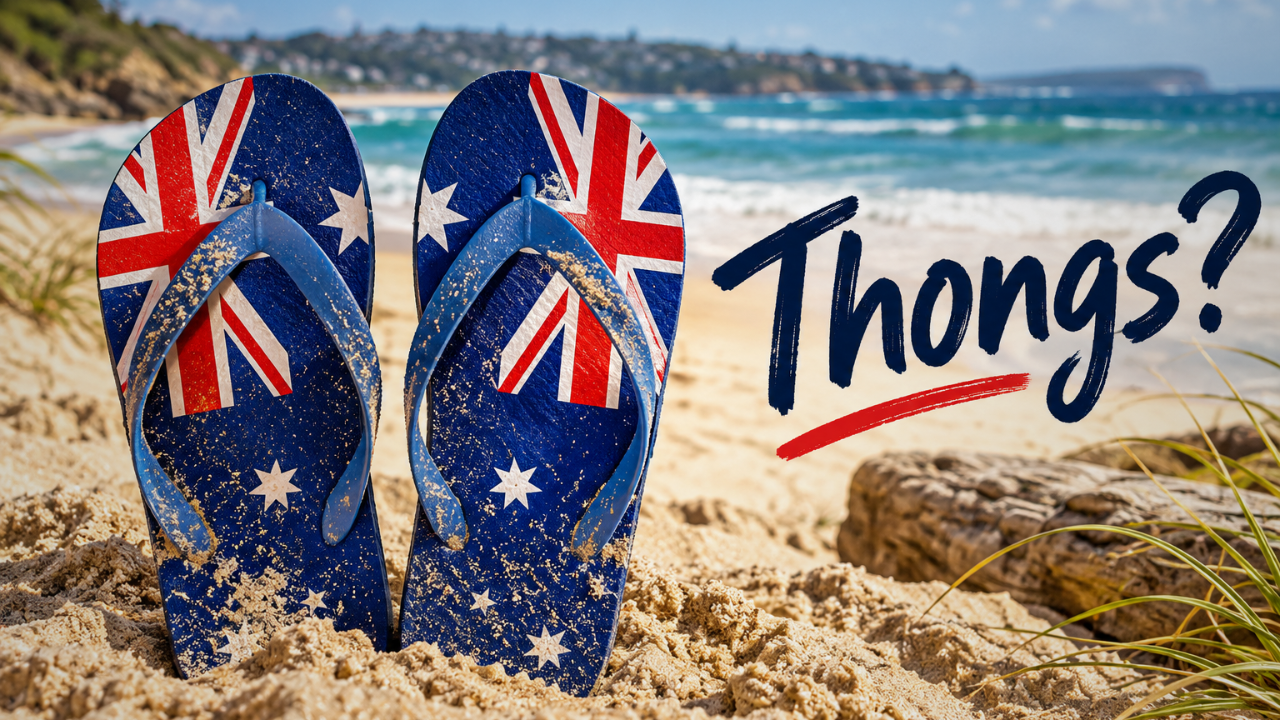
“Thongs” is one of them.
Growing up in Australia, there was absolutely nothing unusual about somebody saying:
“I’m just putting my thongs on.”
Nobody gasped or looked concerned.
Nobody wondered why you were discussing your underwear before going to the shops.
You were simply putting a pair of rubber shoes on your feet.
Then you move to America.
Suddenly, announcing that you need to find your thongs before leaving the house creates an entirely different mental picture.
Because in the United States, a thong is generally underwear.
In Australia, it’s footwear.
So how did Australians end up calling flip-flops “thongs”?
The funny thing is, Australians aren’t actually being as weird as Americans might think.
In fact, there’s a perfectly sensible reason we call them thongs. We’ve even got history on our side.

The Name Comes From the Strap
The Australian use of the word “thong” makes a lot more sense when you look at how the footwear is constructed.
A thong was originally a narrow strip or strap of leather.
The word had been used in English for centuries, long before anyone was using it to describe a certain style of underwear.
The classic Aussie thong has a sole with a Y-shaped strap that passes between the big toe and second toe.
That strap is the thong.
Eventually, the name of the strap became the name we commonly use for the entire piece of footwear.
So technically, Australians didn’t randomly look at a pair of flip-flops one afternoon and decide to give them the same name as skimpy underwear.
The footwear meaning has much older linguistic roots. Which is slightly disappointing, because that would have been a much better story.
Americans Used to Call Them Thongs Too
Here’s where things get interesting.
Americans did too.
In fact, “thong” was once a perfectly normal American name for the sandal, and American dictionaries still recognize that meaning today. The modern rubber version became more popular in the United States after World War II, influenced by the traditional Japanese zōri sandal.

By the 1960s, another name was becoming popular.
The flip-flop.
The origin of that name appears to be really simple.
It’s the sound they make when you walk.
Flip.
Flop.
Flip.
Flop.
For a while, Americans used both “thong” and “flip-flop” for the footwear. Over time, though, flip-flop increasingly won out.
At roughly the same time, “thong” was developing another meaning in American English, referring to increasingly revealing swimwear and eventually the style of underwear most Americans associate with the word today.
Exactly when Americans stopped calling their footwear thongs seems to have varied by place and generation. There are Americans who remember using the word for their shoes through the 1960s, 70s and even into the 80s.
Australia simply never made the switch.
Which means when an American laughs because an Australian calls a flip-flop a thong, there’s a perfectly reasonable response.
You used to call them thongs too.
Thongs Are Almost an Australian Uniform
The more interesting part isn’t really what Australians call them.
It’s how completely normal they are. Growing up on the coast in Australia, I essentially lived in thongs from spring through autumn.
Going to the beach?
Thongs.
Duck down to the shops?
Thongs.
Barbecue?
Thongs.
Taking the bins out?
Thongs.
Walking across pavement approximately three degrees below the melting point of human skin?
Still thongs.
There are limits, obviously. Australians don’t actually wear thongs everywhere, despite what some stereotypes might suggest.
But they occupy a particular place in Australian life that’s difficult to explain until you’ve lived somewhere else. They’re cheap, practical, easy to kick off and perfectly suited to a country where beaches, heat and casual clothing are part of everyday life.
We even have another name for them.
Pluggers.
The name comes from those little rubber plugs underneath the sole that hold the straps in place. Which also gives us the wonderfully Australian phrase:
“I’ve busted me plugga!”
Every Australian knows exactly what has happened.
One second you’re walking normally.
The next, the plug has pulled through the sole and you’re stranded with a piece of rubber attached to absolutely nothing.
Fortunately, Australians have developed sophisticated technology to deal with this emergency. A bread tie.

Push the strap back through the hole, wrap a bread tie around the bottom to stop it pulling through again, and you’re back in business.
It works surprisingly well.
It isn’t pretty. But neither are the thongs you’ve probably been wearing for the last three summers.
I Never Thought Twice About the Word Until I Lived in America
This is one of my favorite things about living between two countries.
You discover that words you’ve used your entire life aren’t necessarily universal.
They’re just normal to you.
I never grew up thinking Australians had a quirky word for flip-flops.
They weren’t flip-flops.
They were thongs.
That’s what they were called.
It’s only after living in the United States that I’ve become conscious of how funny some perfectly ordinary Australian sentences can sound to American ears.
The same thing happens in reverse.
There are American words and expressions that barely register with me anymore, but sounded completely foreign when I first moved here. After a while, you almost develop two versions of English in your head. You know which word you’d use in Australia and which one will save you an explanation in America.
Neither country is using English incorrectly.
We’ve simply taken the same language and spent a couple of centuries tinkering with it. Occasionally with hilarious results.
So, Are They Thongs or Flip-Flops?
Thongs.
Obviously.
I’m Australian. What did you expect me to say?
But after years of living in America, I’ve learned that context matters.
If I’m talking to Australians, they’re thongs.
If I’m talking to Americans, there’s a small part of my brain that now considers whether saying “thongs” is about to derail the entire conversation.
Sometimes I’ll say flip-flops.
Sometimes I’ll still say thongs.
But sometimes it’s much more entertaining not to explain myself and wait for the American in the room to work out why an Australian man just announced that he left his thongs by the front door.
That’s one Australian word I’m not quite ready to give up.
Enjoying From Down Under to Down South?
If you enjoy seeing Australia and America through my slightly confused eyes, you can help support the stories, articles and podcast by buying me a coffee.
It helps keep From Down Under to Down South going, and unlike a busted plugga, I can’t fix the website with a bread tie.
Buy Me a Coffee and support From Down Under to Down South
