AUSTRALIA EXPLAINED
America has Bigfoot.
Scotland has the Loch Ness Monster.
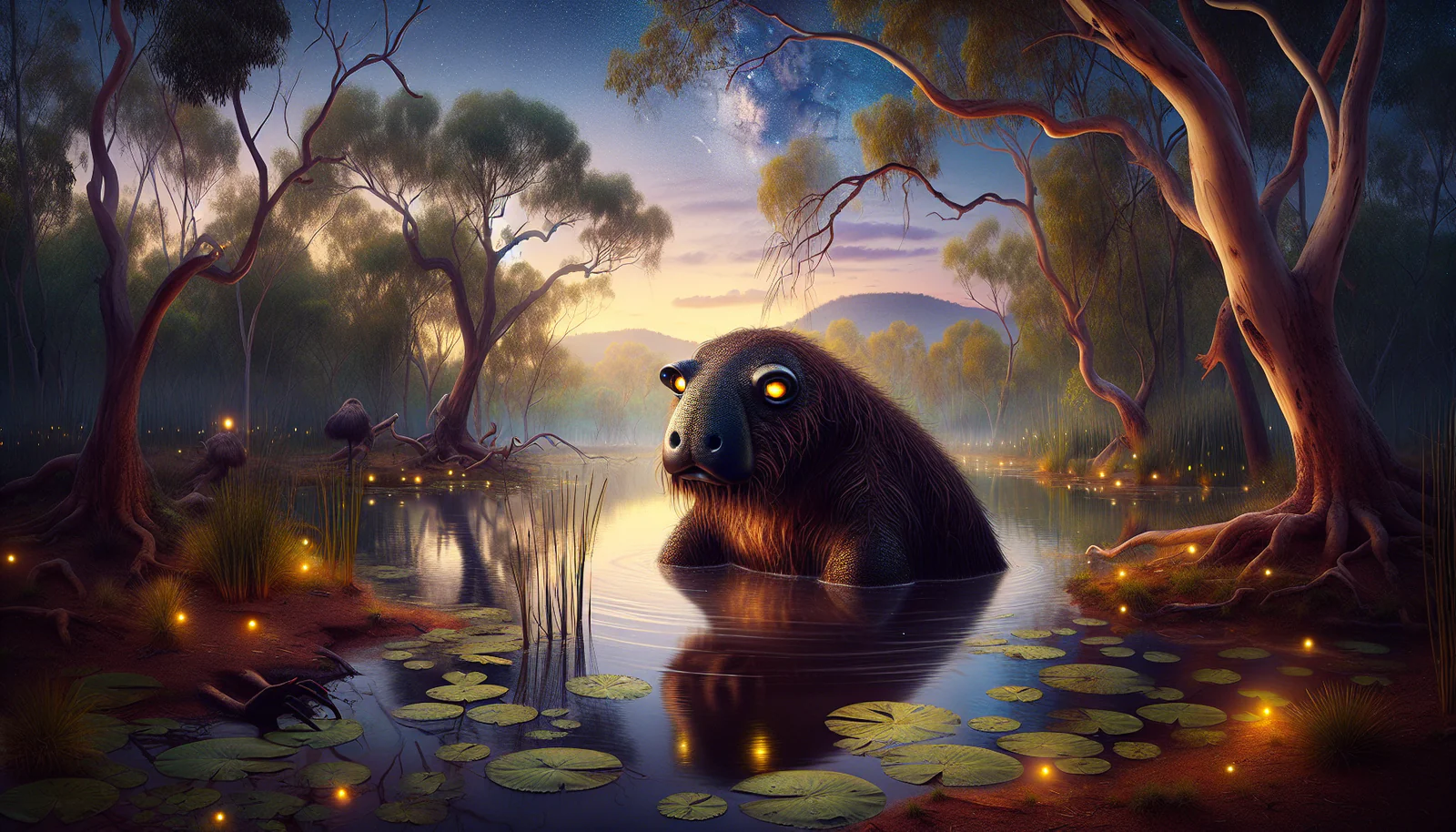
Australia, apparently deciding that our actual wildlife wasn’t enough to worry about, has the yowie, the bunyip and mysterious lights that follow people through the Outback.
This is a country, after all, where visitors already arrive concerned about snakes, spiders, crocodiles, sharks and various other things they’ve been assured will kill them within 20 minutes of leaving Sydney Airport.
Then we tell them there might also be a large hairy man wandering around the bush.
Welcome to Australia.
But Australian cryptids and legends are more interesting than simply being our versions of Bigfoot.
Some have histories stretching back through generations of Aboriginal storytelling. Others grew from the isolation and uncertainty of colonial Australia. Some have perfectly plausible scientific explanations.
Others remain just strange enough that people are still talking about them.
And then there’s the drop bear.
We’ll get to that.

What Is an Australian Cryptid?
A cryptid is an animal or creature whose existence has been claimed but hasn’t been established by science.
Bigfoot is probably the world’s most famous example.
Australia has plenty of candidates, although there’s an important distinction to make before we go wandering into the bush with a torch.
Not every Australian legend is a cryptid.
The yowie fits the definition fairly neatly. The bunyip is more complicated because stories associated with it have deep connections to Aboriginal cultures and shouldn’t simply be reduced to Australia’s version of a Western monster.
The Min Min Lights aren’t creatures at all.
Lasseter’s Reef is supposedly lost gold.
The SS Maheno is a very real shipwreck that acquired ghost stories.
What connects them isn’t taxonomy. It’s the Australian landscape.
Huge distances. Isolated roads. Waterholes. Dense bush. Desert stretching beyond the horizon. Places where, particularly before modern communications, you could be very much on your own.
Put a strange noise, an unexplained light or an enormous hairy silhouette into that landscape and Australia becomes very good at producing a story.

The Yowie: Australia’s Answer to Bigfoot?
If an American asks me whether Australia has Bigfoot, the easiest answer is:
Sort of.
We have the yowie.
Modern descriptions generally portray the yowie as a large, hairy, human-like creature living in remote bushland, particularly along Australia’s east coast.
That sounds suspiciously familiar.
But calling the yowie simply “Australian Bigfoot” strips away much of what makes the story interesting.
Stories of hairy beings existed in Aboriginal traditions long before modern Bigfoot culture. ABC reporting on the history of the yowie has documented Aboriginal accounts of “hairy men” under different names, while researchers have also pointed out that the modern Western version of the yowie changed significantly over time.
By the late 19th century, newspaper accounts were describing mysterious hairy creatures. In 1893, for example, the Braidwood Dispatch reported an alleged encounter with a “hairy man” near Braidwood in New South Wales.
Then popular culture got involved.
As stories of the Yeti and Bigfoot became internationally famous during the 20th century, the yowie increasingly came to be described through the same enormous, ape-like template.
Today, alleged sightings continue.
Kilcoy in Queensland has embraced its association with the creature so enthusiastically that there’s a Yowie Park and a yowie statue. A reported encounter near the town in 1979 involved two students who claimed they’d seen a brown, hairy creature somewhere between two and three metres tall.
Which is quite large.
Large enough that if I encountered one while bushwalking, my scientific investigation would mostly involve running in the opposite direction.

The Bunyip Is Much Harder to Define
If the yowie is difficult to pin down, the bunyip is almost impossible.
Ask ten people what a bunyip looks like and you may receive eleven answers.
It has been described at different times with features resembling seals, dogs, horses, birds and various combinations that sound like somebody was assembling an animal without reading the instructions.
What remains remarkably consistent is water.
Bunyip stories became associated with swamps, rivers, billabongs and waterholes, and European settlers were fascinated by Aboriginal accounts of creatures inhabiting inland waters.
The fascination became so intense that in 1847 the Australian Museum actually displayed what was claimed to be a possible bunyip skull.
Spoiler alert: we don’t have a bunyip skeleton sitting in a museum today.
But treating the bunyip purely as a funny monster story misses something important.
Different Aboriginal cultures have their own distinct stories, names and beliefs associated with powerful beings connected to water and Country. The Australian Museum, for example, records Barkandji knowledge about Ngatyi, or Rainbow Serpents, which can take different forms including what Europeans called a bunyip. Those stories involve creation, Country, respect and places where people should not swim.
That is considerably more culturally significant than “we have a swamp monster.”
European Australia took those traditions, mixed them with colonial fears, newspaper reporting, unfamiliar animals and imagination, and eventually created the broad popular image we now call the bunyip.

Why Early Settlers Were Ready to Believe
Here’s the part I find particularly fascinating.
Imagine arriving in Australia from Europe during the 1800s.
You encounter a mammal with a duck’s bill that lays eggs.
Another animal has a pouch, enormous back legs and travels by bouncing.
There are lizards that look prehistoric, birds that stand taller than you expect and a furry animal that spends most of its life in trees eating leaves that are toxic to many other animals.
Then somebody tells you there’s another strange animal living in a waterhole.
How confident are you that this is the ridiculous one?
Australia had already demonstrated that European ideas about what an animal was supposed to look like weren’t particularly useful here.
That made the boundary between undiscovered animal and mythical creature rather blurry.
Even today, I think that’s part of the appeal of Australian cryptid stories.
You know the yowie probably isn’t going to walk out from behind a gum tree.
Probably.
The Min Min Lights: When Something Follows You Through the Outback
Then there are the Min Min Lights.
These aren’t cryptids because they aren’t creatures.
But leave them out of a collection of strange Australian mysteries and people will quite rightly complain.
Stories describe mysterious lights appearing over the horizon in remote Australia, sometimes seeming to move, hover or follow travellers.
They are particularly associated with western Queensland and the tiny town of Boulia, where the Min Min has become part of local identity.
There are also Aboriginal stories about unexplained lights that predate European settlement.
And unlike the yowie, we know people genuinely see something.
The question is what.
One particularly compelling scientific explanation came from University of Queensland neuroscientist Jack Pettigrew. His experiments suggested that certain Min Min sightings could be caused by a type of mirage in which temperature inversions bend distant light around the horizon.
Under the right conditions, a car light many kilometres away could appear as an unexplained floating light where no light should be.
Pettigrew even recreated the phenomenon experimentally.
Which explains a lot.
It also doesn’t make the experience of seeing one alone in the Outback at night sound any less creepy.
There is a vast difference between reading “atmospheric refraction” on your phone and standing beside an empty road at midnight while a mysterious light appears to follow you.

Lasseter’s Reef: The Australian Legend People Are Still Searching For
Australia’s mysteries aren’t limited to creatures.
Some involve treasure.
Harold Bell Lasseter claimed to know the location of an extraordinarily rich gold reef somewhere in Central Australia.
An expedition set out to find it in 1930.
It went badly.
Lasseter eventually became separated from the expedition and died in the desert in 1931. The fabulous reef he claimed to have found disappeared with him.
Or perhaps it never existed.
Either way, people are still looking.
Nearly a century later, prospectors and researchers continue arguing about whether Lasseter’s Reef was real and where it might have been. One modern searcher reportedly spent decades pursuing it, while another backer spent more than half a million dollars supporting the hunt.
That’s the extraordinary power of a good mystery.
You don’t necessarily need evidence.
Sometimes you just need enough uncertainty to prevent people from completely letting go.
There’s also something particularly Australian about Lasseter’s Reef.
The vastness of the country makes the story possible.
Hide a legendary gold reef in suburban Melbourne and someone will probably put a Bunnings on top of it by Thursday.
Hide it somewhere in Central Australia?
Now you’ve got a century-long mystery.

The SS Maheno: A Real Wreck With Ghost Stories Attached
Some Australian legends begin with something completely real.
The SS Maheno is one of them.
The former ocean liner and First World War hospital ship was being towed to Japan for scrap when a cyclone broke the towline in 1935.
It washed ashore on K’gari, formerly Fraser Island, where its rusting remains still sit on the beach today.
I’ve always thought shipwrecks are creepy enough without adding ghosts.
The Maheno apparently disagrees.
Over the years, stories have attached themselves to the wreck, helped considerably by the fact that it looks exactly like somewhere a ghost should live.
Rusting metal.
Remote beach.
Waves crashing around the remains.
Decades of history slowly disappearing into the sand.
Whether you believe any paranormal stories is beside the point.
The Maheno shows how legends form around places.
Sometimes we encounter something dramatic and abandoned and apparently can’t resist giving it another story.

Then There Are Drop Bears
Now we come to one of Australia’s most dangerous animals.
The drop bear.
A larger, aggressive relative of the koala, the drop bear waits in eucalyptus trees before dropping onto unsuspecting victims from above.
International visitors are particularly vulnerable.
Fortunately, Australians have developed several effective precautions, including smearing Vegemite behind your ears.
There is just one minor complication.
None of this is true.
Drop bears are one of Australia’s great collective practical jokes.
We tell tourists about them.
We warn new arrivals.
Australians who have never met each other can somehow cooperate instantly in maintaining the story.
Even the Australian Museum has joined the joke with a wonderfully straight-faced description of Thylarctos plummetus.
I love the drop bear because it is completely different from the yowie or bunyip.
Nobody is genuinely hunting for one.
There isn’t an unexplained footprint being analysed somewhere.
It’s social folklore.
The fun isn’t believing in the creature.
The fun is convincing you to believe in it.
Preferably just before you go camping.

Why Australia Produces Such Good Legends
Living in America has made me think more about why the folklore of the two countries feels different.
America has enormous wilderness too, of course.
But Australian stories often seem inseparable from the landscape itself.
The bunyip needs the waterhole.
The Min Min needs the empty horizon.
The yowie needs the bush.
Lasseter’s Reef needs the desert.
Take away the environment and half the story disappears.
Perhaps that’s because distance has always been such a powerful part of Australian life.
Australia is enormous, while most of its population is concentrated around the coast. Travel inland and the scale changes quickly.
There are places where the next town isn’t just down the road.
It’s down the road.
For generations, people travelled through landscapes with no mobile phones, no GPS and very little help if something went wrong.
A light on the horizon mattered.
A strange noise outside the camp mattered.
A warning about a dangerous waterhole mattered.
Stories grew in places where nature was already quite capable of making people feel small.

The Stories Tell Us More Than Whether the Creatures Exist
I don’t expect scientists to announce the discovery of a breeding population of yowies next week.
I am reasonably confident the drop bear threat level remains manageable.
But asking whether these stories are literally true isn’t necessarily the most interesting question.
Folklore tells us what people noticed.
What frightened them.
What places mattered.
What they couldn’t explain.
And sometimes what they thought would be absolutely hilarious to tell an unsuspecting tourist.
The stories also come from very different places and shouldn’t all be thrown into the same bucket.
Some have connections to ancient Aboriginal cultures and Country.
Some emerged from colonial encounters with a landscape Europeans didn’t understand.
Some are unexplained natural phenomena.
Some are modern legends.
One is basically an international conspiracy conducted by Australians against backpackers.
Together, though, they reveal something about Australia that lists of “10 deadly animals” never really capture.
Australia can feel mysterious.
Even when you’ve grown up there.
Maybe especially when you’ve grown up there.
Because somewhere beyond the last streetlight there’s always more bush.
More desert.
Another waterhole.
Another empty road.
And possibly a yowie.
Probably not.
But if you’re heading out there tonight, I wouldn’t completely rule it out.
If you’d rather hear me tell these stories, including some of the Australian legends that inspired this article, you can watch the original video below.
If you enjoy exploring the stranger corners of Australian culture with me, you can support From Down Under to Down South through Buy Me a Coffee. It helps me keep creating independent stories about Australia, America and the things you only notice when you’ve lived in both.
