AUSTRALIA EXPLAINED
An Australian childhood, a kangaroo outside the toilet, and a word that captures something wonderfully old-fashioned about Australia.
I must have been about ten years old when I found myself sitting in an outdoor toilet on my uncle’s property in regional New South Wales, staring at a kangaroo through a crack in the door.
Not something you generally expect during a trip to the toilet.
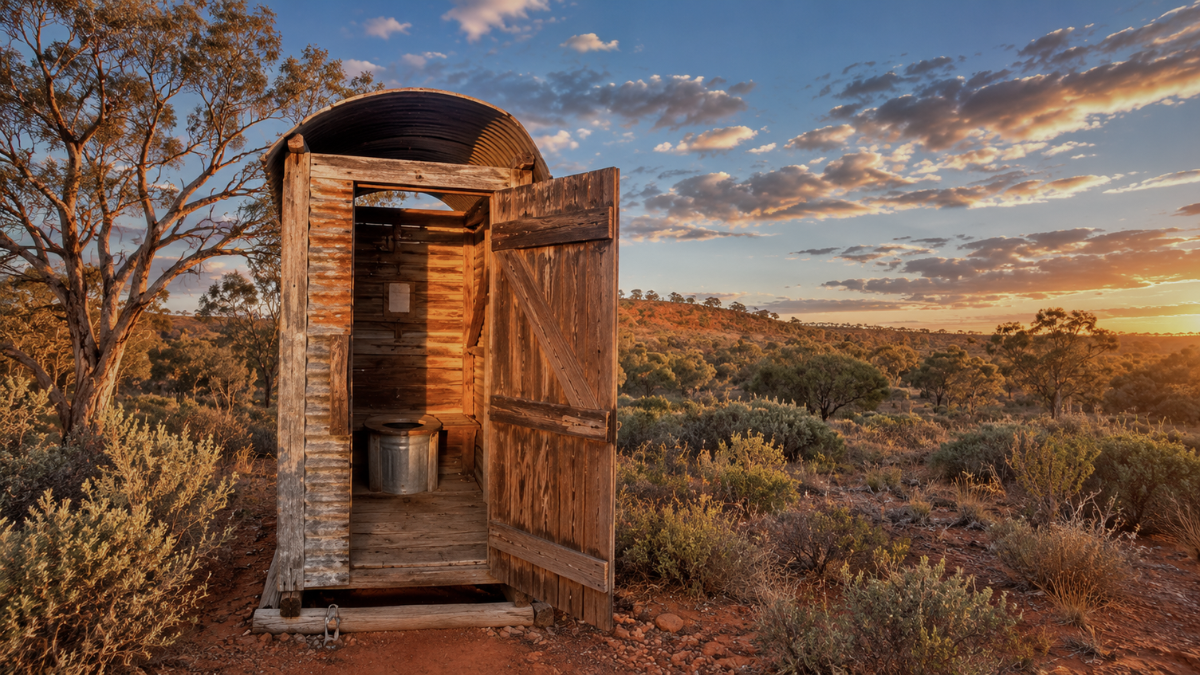
I’d gone outside, walked around the back of the house, and entered a little building that offered the bare essentials. A hole, a pit underneath, some toilet paper, and, if you were feeling adventurous, yesterday’s newspaper.
Privacy was provided by a wooden door with a metal latch.
Comfort was apparently somebody else’s problem.
Then I noticed something moving outside.
A kangaroo.
Just standing there.
I remember getting a fright initially, then thinking it was actually pretty cool.
After all, this was Australia. Kangaroos were hardly unusual on my uncle’s property. They were forever getting into the crops, and there were enough parrots attacking the zucchinis to make you wonder whether the local wildlife had formed an agricultural union.

Still, encountering a kangaroo while sitting on the toilet wasn’t something I’d experienced before.
And frankly, given the alternatives, I was quite happy it was a kangaroo.
Because the other potential visitors included spiders and brown snakes. Welcome to the Australian dunny.
So, Why Do Australians Call It a Dunny?
The short answer is that dunny is Australian slang for a toilet, particularly an old-fashioned outdoor toilet or outhouse.
But the word didn’t actually originate in Australia.
According to the Australian National Dictionary Centre at the Australian National University, dunny comes from the old British dialect word dunnekin, meaning an outdoor privy.
That word is generally traced to dung, meaning excrement, and ken, an old slang term for a house.
So, translated rather literally, a dunny was a house for dung.
Charming. The longer form, dunnekin, appeared in Australian sources as early as the 1840s, while the shortened word dunny is recorded from the 1930s.
Australians eventually made the word their own, as we tend to do with perfectly respectable English.
Today, dunny can refer to just about any toilet, including a modern indoor one.
Although if someone walked into my house and asked where the dunny was, I’d probably assume they’d just stepped off a sheep station somewhere west of Bourke.
I’d know exactly what they meant. I’d also think they were being pretty bloody ocker.
The Australian Dunny Wasn’t Always a Pleasant Experience
My uncle lived on a large property in regional NSW.
It was a long way from town, with rainwater rather than a town water supply, and no connection to a municipal sewerage system.
The outdoor dunny wasn’t some quaint historical feature preserved for visitors.
It was the toilet.
And it came with a few rules.
Don’t fall in.
Don’t put anything down there that wasn’t supposed to go down there.
Watch where you step.
Check for spiders.
Keep an eye out for snakes.
That last one was particularly important.
My uncle’s property had brown snakes, and there had been occasions when one had found its way into the dunny.
I never personally encountered one in there, thankfully.
Spiders, on the other hand, were practically part of the furniture.
Then there was the smell.

If you’ve never experienced an Australian outdoor toilet during the height of summer, imagine a small wooden building sitting in temperatures well above 30 degrees Celsius, with a pit full of human waste underneath.
Now imagine opening the door.
There are certain childhood memories that never leave you.
Some are wonderful.
Some involve your grandmother’s cooking, Christmas mornings, or family holidays.
Others involve desperately trying to hold your breath while doing a poo.
Going to the Dunny After Dark Was Another Adventure
My uncle’s dunny wasn’t particularly far from the house.
But you couldn’t simply wander down a hallway and flick on the bathroom light.
You had to go outside, walk around the house, and make your way to the little building at the back.
There was an outside light, thankfully.
That didn’t mean you could stop watching where you were going.
I remember being particularly conscious of the wildlife at night.
During the day, a kangaroo outside the toilet might be entertaining.
At night, when something rustled in the darkness and you couldn’t immediately see what it was, the experience became considerably less amusing.
It was rather like going camping, except you hadn’t actually gone camping.
You were just trying to use the toilet.
And I suspect that’s one reason the old Australian dunny has remained such a colourful part of our cultural memory.
It wasn’t simply a place to relieve yourself.
It was an experience.
Sometimes an unpleasant one.
Occasionally a frightening one. And, years later, often a very funny one.
What Was the Dunny Man?
Not every Australian dunny was built over a pit.
In towns and suburbs before modern sewerage systems became widespread, many outdoor toilets used removable metal pans.
These collected the waste and were emptied or replaced by a worker commonly known as the dunny man, or night soil man.
The dunny man would make his rounds, collecting the contents and transporting them for disposal.
It was a real occupation, and an important part of keeping communities functioning before sewerage infrastructure reached every home. Museums Victoria has preserved examples of the old sanitary pans, including ones dating from around the 1930s to 1950s. Some areas continued using pan collection systems long after other suburbs had been connected to sewers.
It wasn’t glamorous work.
In fact, it’s difficult to imagine a job title less likely to impress someone at a dinner party.
What do you do for a living?
I’m the dunny man.
Right. Lovely. Could you pass the potatoes?
My uncle’s toilet was a pit-style arrangement, but I also remember a truck coming to the property to empty it.
The important distinction is that outdoor dunnies weren’t all built the same way. Some relied on pits, others on removable pans, and the arrangements for managing the waste varied.
There’s a fascinating piece of Australian social history here, too.
In a 2017 ABC News interview, former Brisbane dunny man Ron Barlow recalled collecting waste pans from dozens of houses each week. He also remembered that the occupation carried a social stigma, despite providing an essential service.
It’s easy to laugh about the dunny man today.
But those blokes did a job most of us would rather not think about, let alone perform.
And without them, things would have become unpleasant very quickly.

Australians Have Always Had a Sense of Humour About the Dunny
One thing I love about Australian English is our ability to take something perfectly ordinary, give it a ridiculous name, and then act as though everyone else is strange for not understanding it.
The dunny is a wonderful example.
We didn’t stop at naming the toilet.
We developed an entire vocabulary around it.
There’s the dunny roll, which is simply toilet paper.
A dunny budgie is a blowfly, presumably named because of its fondness for places where you really don’t want flies congregating. Then there’s dunny diver, a humorous term for a plumber, which the Australian National Dictionary Centre has traced through historical usage.
And while we’re discussing colourful Australian expressions, there’s the magnificent description built like a brick shithouse.
Not exactly something you’d expect to hear at a formal dinner.
But in Australia, it describes someone or something exceptionally solid or powerfully built.
Usually a bloke who looks capable of carrying a refrigerator under each arm. The Australian National Dictionary Centre even records an old comic curse wishing that someone’s chickens would turn into emus and knock their dunny down.
Think about that for a moment.
We managed to turn an outdoor toilet into part of a national insult involving oversized poultry. That’s quite an achievement.
Do Australians Actually Say Dunny Anymore?
Here’s where I think some international impressions of Australia can be a little misleading.
Yes, dunny is a genuine Australian word.
Yes, Australians understand it.
But that doesn’t mean we’re all wandering around saying it every time we need the toilet.
Growing up, I generally said toilet.
If I was asking someone where to go, I’d probably say loo.
Dunny was more something you’d say when you were trying to be funny.
Perhaps after a few beers with your mates.
Or when deliberately putting on a particularly ocker Australian character.
To my ears, dunny belongs to a slightly older, more rural Australia.
The Australia of farmers, country pubs, battlers, and blokes who’d spent their lives working outdoors.
I can imagine hearing it on a property somewhere in regional New South Wales.
I have a harder time imagining someone casually using it in a modern Canberra office.
That doesn’t mean nobody does.
And there’s no good reason to declare the word extinct.
But I do think it carries a particular character.
It’s earthy.
Unpretentious.
Maybe a little bit cheeky.
And there’s something distinctly Australian about that.
Even Modern Australian Roadside Toilets Can Bring Back Memories
Outdoor toilets aren’t entirely a thing of the past.
Australia still has remote roadside facilities that use pit or other non-flushing systems, although designs and standards have improved considerably.
I remember encountering them at rest stops near Lake George on the way to Canberra, and at Stockinbingal near the railway station.
Those facilities have since been upgraded, but I remember the older versions rather well.
Particularly the smell.
My wife, Nikki, had an unfortunate encounter with one during a road trip.
She was horrified.
Not just by the smell, but by how close the contents were getting to the seat.
There’s something uniquely confronting about looking into a toilet and discovering that the previous visitors have been building a small mountain.
At that point, you’re no longer wondering whether the facilities are clean.
You’re wondering whether you should have stopped at the last town.
It’s moments like those that remind me why modern plumbing is one of humanity’s greatest achievements.
Forget the internet.
Forget smartphones. Give me a toilet that flushes and doesn’t contain a brown snake, and I’m a happy man.
Dunny, Loo, Toilet, Bathroom: What’s the Difference?
Living in America for more than eight years has made me particularly aware of the different ways English-speaking countries talk about toilets.
In Australia, I’d naturally ask where the toilet or loo was.
In America, I ask where the bathroom is.
Sometimes the restroom.
Which still strikes me as a little funny.
I’m not planning to have a bath.
I’m certainly not going in there for a rest.
I have a very specific purpose in mind.
But I’ve adapted.
When I’m speaking to Americans, I generally use the American terminology because it’s easier.
In my head, though, I’m still going to the toilet.
Here’s how I’d explain the differences to someone unfamiliar with Australian English.
| Word | How it’s generally used |
| Dunny | Informal Australian slang, traditionally associated with outdoor toilets |
| Loo | Casual, everyday term for a toilet |
| Toilet | The ordinary, direct word used widely in Australia |
| Bathroom | Common American term for the room containing a toilet |
| Restroom | Common American term, particularly in public places |
| Outhouse | American term for a separate outdoor toilet |
Of course, Americans have their own colourful expressions, and Australians don’t all use the same words.
But the differences can be entertaining.
Just as they are when an Australian announces they’re putting on their
thongs before leaving the house.
Different countries.
Same language. Endless opportunities for confusion.
The Dunny Is Part of an Australia I Hope We Never Lose
I don’t particularly miss outdoor toilets.
The smell.
The spiders.
And I certainly don’t miss wondering whether a brown snake might be waiting for me when I opened the door.
Modern plumbing is wonderful, and I have absolutely no desire to return to the days of walking around the house in the middle of the night just to use the toilet.
But there’s something about the word dunny that makes me nostalgic.
It reminds me of visiting my uncle’s property in regional New South Wales.

Of the old family dairy farm where my great-grandmother lived.
Of a childhood when the Australian countryside still felt wonderfully wild, and when even a trip to the toilet could become a story you’d remember decades later.
More than anything, though, it reminds me of a certain type of Australian.
The battler.
The farmer.
The country bloke with a dry sense of humour and a story for every occasion.
The sort of person who didn’t need much, didn’t make a fuss, and could find something funny in just about anything.
I know Australia has changed.
Of course it has.
And in many ways, for the better.
But I hope we never completely lose that part of our national character.
That wonderful mixture of resilience, irreverence, practicality, and larrikin humour.
Because when I hear someone say dunny, I don’t just think of a toilet.
I think of the people who’d use that word without giving it a second thought.
And I miss them.
Not the spiders, mind you. They can stay right where they bloody are.
If you enjoy these stories about Australian language, culture, and the little things that make us who we are, you can support From Down Under to Down South through Buy Me a Coffee . Every bit of support helps keep the stories coming.
