
Tag: Career Change

  • Too Old to Get Hired, Too Young to Retire: My 2,500 Job Applications in America

    Too Old to Get Hired, Too Young to Retire: My 2,500 Job Applications in America


    A quarter-century of experience, thousands of applications and four interviews. At 52, I’m beginning to wonder what employers are actually looking for.

    I’ve reached a rather interesting stage of life.

    I’m apparently too old to get a job, but still young enough that the mortgage company expects me to keep paying them.

    It’s a bit of an awkward arrangement.

    I’m 52 years old. I’ve spent around 25 years working in banking, managing teams, making decisions, dealing with customers, solving problems and occasionally wondering who on earth decided to promote certain people in the first place.

    I’ve worked in Australia, Samoa, Fiji, Tuvalu, New Zealand and the United States. Handled difficult situations, managed staff, trained people and watched some of those people go on to achieve things well beyond what I’d originally hired them to do.

    You’d think that might count for something.

    Yet over roughly two years of looking for work in America, I submitted more than 2,500 job applications.

    I got four interviews.

    Four.

    That’s one interview for approximately every 625 applications. At that point, you start wondering whether you’re applying for jobs or simply providing employment websites with something to do.


    When Experience Becomes Something to Hide

    One of the strangest things about looking for work in your fifties is the advice you’re given.

    Shorten your résumé.

    Remove jobs from twenty years ago.

    Don’t include the year you graduated.

    Make sure your résumé looks modern.

    Essentially, you’ve spent decades building experience, and now you’re supposed to make sure nobody notices how long you’ve been doing it.

    Online job application screen

    I understand the argument for keeping a résumé relevant. Nobody needs to know every responsibility I had in a banking job back in 1998.

    But there’s a difference between removing irrelevant information and concealing experience because you’re worried somebody might work out your age.

    Imagine getting on an aircraft and discovering the captain had removed twenty years of flying experience from his résumé because he didn’t want the airline thinking he’d been flying for too long.

    Personally, I’d find those twenty years rather reassuring.

    Apparently, recruitment doesn’t always work that way.

    And it’s not simply a question of whether an older applicant can do the job. Sometimes I wonder whether employers look at somebody with extensive experience and immediately assume they’ll be too expensive, too set in their ways or unlikely to accept direction from a younger manager.

    Perhaps some employers do. Perhaps others don’t. The frustrating part is that you rarely get the opportunity to find out.

    If you’re over 50 and finding yourself in a similar position, there are books written specifically for people trying to navigate the modern job market later in life. One worth looking into is Over 50 Job Seekers Survival Guide, which focuses on the challenges older applicants face, including age discrimination.

    I can’t promise a book will get you an interview. After 2,500 applications, I reckon I’d be the last person qualified to make that promise.


    The Interview That Made Me Wonder

    Of those four interviews, only one was for a banking position.

    It was an in-person interview with a regional manager.

    I remember coming away with the impression that I had considerably more experience in certain areas of banking than the person interviewing me.

    That didn’t bother me.

    I’ve reported to people younger than me. I’ve worked alongside people with less experience and learned an enormous amount from people who hadn’t been in the industry nearly as long.

    Being a good manager isn’t about having the longest résumé in the room.

    Being a good manager isn’t about having the longest résumé in the room.

    But I did wonder whether my experience had made the interview more awkward than it needed to be.

    Perhaps I was completely wrong. Perhaps there was another candidate who was a better fit.

    I never found out.

    There are books like 101 Great Answers to the Toughest Interview Questions by Ron Fry that help people prepare for those difficult questions employers love asking.

    There was no follow-up. No explanation. Nothing.

    Just another application disappearing into the great employment mystery. And after you’ve experienced that a few hundred times, you begin to understand why people become disillusioned with the whole process.

    Printed résumé and notebook beside a laptop displaying an online job application, illustrating the challenges of finding work after 50.
    After more than 2,500 job applications and just four interviews, I began wondering whether anyone was actually reading my résumé.

    Has Artificial Intelligence Made Job Hunting Worse?

    Recently, I watched a 60 Minutes report about age discrimination and artificial intelligence in recruitment.

    One part involved a website that analysed résumés and identified potential issues.

    Something caught my attention.

    The filename.

    Not the qualifications, not the experience, not whether somebody could actually perform the job.

    The name of the résumé file itself.

    Now, to be fair, the demonstration involved a résumé-checking tool. It wasn’t proof that employers are automatically rejecting applicants because of what they’ve named their files.

    But it did get me thinking about how complicated recruitment has become.

    Years ago, you applied for a position, somebody read your application, and you might receive a letter or a telephone call.

    That system certainly wasn’t perfect. There was discrimination, favouritism and plenty of incompetence long before anybody invented artificial intelligence.

    Laptop displaying a résumé being scanned by an automated recruitment system, illustrating concerns about artificial intelligence in job applications.

    But today, an application can pass through multiple layers of software before a hiring manager ever sees it.

    Applicant tracking systems can organise applications, search for relevant qualifications and help recruiters filter candidates. Some employers also use more sophisticated automated tools to assess or rank applicants.

    And that raises a question I’ve been asking myself for quite some time.

    How many of my 2,500 applications were ever seriously considered by another human being?

    I genuinely don’t know.

    There’s no way for me to prove that artificial intelligence rejected me or prove that my age was a factor. I can’t even prove that every position I applied for was still available by the time somebody reviewed my application.

    But I can tell you what the experience feels like. It feels as though you’re standing outside a building with all the qualifications needed to work inside, but nobody will open the door long enough to hear what you’ve got to say.


    America Has Laws Against Age Discrimination. But Proving It Is Another Matter.

    In the United States, the Age Discrimination in Employment Act provides employment protections for people aged 40 and older, including job applicants, subject to the law’s coverage requirements.

    Those protections don’t disappear simply because an employer uses automated recruitment technology.

    But there’s an enormous difference between having a legal protection and knowing whether somebody has violated it.

    Suppose you apply for a job and receive an automated rejection.

    Was it because another candidate had better qualifications?

    Was the position filled internally?

    Did the employer decide you were overqualified?

    Or did something about your application lead to an assumption about your age?

    Without more information, you have no way of knowing.

    And that uncertainty is part of the problem.

    I’m not suggesting every unsuccessful older applicant is a victim of discrimination. Employers have legitimate reasons for choosing one candidate over another.

    But when people spend months or years applying for jobs without meaningful feedback, it becomes almost impossible to understand what they’re supposed to change.

    You can improve your résumé and rewrite your cover letter.

    You can complete another training course or even rename your résumé file if that’s what the latest advice suggests.

    But you can’t make yourself twenty years younger. Nor should you have to.

    Infographic comparing more than 2,500 job applications with just four interviews, illustrating the challenges of finding employment after 50.
    More than 2,500 applications. Four interviews. After 25 years in banking, I never imagined finding another job would be this difficult.

    The Part of Experience That Doesn’t Fit on a Résumé

    One of the things I’m proudest of from my banking career has very little to do with my own promotions or job titles.

    It’s the people I helped develop.

    I hired people who had little or no experience and watched them grow into confident, capable employees.

    HSBC Premier bank manager standing with two female colleagues holding employee recognition awards in front of an HSBC Premier sign.

    Some earned promotions. Others moved into positions that were well beyond anything I could personally offer them.

    That was enormously satisfying.

    There’s something special about recognising potential in somebody before they recognise it themselves.

    And I think that’s one of the things employers can overlook when they’re assessing candidates purely through qualifications, dates and job descriptions.

    Experience isn’t just knowing how to perform a task.

    It’s knowing how to handle somebody who’s angry without making the situation worse.

    Recognising when an employee needs encouragement rather than criticism.

    It’s making a decision when there isn’t a perfect answer.

    It’s knowing when a problem is serious and when somebody is making a mountain out of a molehill.

    Those are things you learn through years of actually doing the job.

    Of course, being older doesn’t automatically make somebody wiser or better at managing people.

    I’ve met plenty of experienced people who probably shouldn’t have been allowed near a management position.

    But I’ve also met some outstanding managers whose greatest asset was the knowledge they’d accumulated over decades. And I can’t help wondering how much of that knowledge gets overlooked when recruitment becomes an exercise in filtering applications.


    The Financial Reality of Being 52 and Looking for Work

    There’s another side to all this that doesn’t get discussed nearly enough.

    At 52, you can’t necessarily afford to spend years waiting for somebody to give you another opportunity.

    You’ve still got bills.

    You might have children at home, a mortgage, car expenses and all the other financial responsibilities that don’t magically disappear because you’re having difficulty finding work.

    Retirement is still years away.

    And unlike somebody starting their career, you don’t necessarily have another thirty or forty years to recover from a prolonged period without suitable employment.

    I’ve written about how Americans seem fascinated by what you do for work, and I think that says something about how closely our jobs become tied to our identities. When you’re struggling to find work, it can feel as though you’ve lost a little of that identity too.

    That’s what makes the phrase overqualified particularly frustrating.

    If somebody applies for a job, understands the salary and genuinely wants to do the work, why should having additional experience automatically be treated as a problem?

    I can understand an employer wanting somebody who’s likely to stay.

    But perhaps the experienced applicant who’s spent months trying to find a decent position might actually be rather keen to keep it. Just a thought.


    What Two Years of Rejection Actually Does to You

    The hardest part of applying for thousands of jobs isn’t necessarily receiving a rejection.

    It’s receiving nothing.

    You spend time reading the job advertisement, checking the requirements, updating your résumé and answering questions that occasionally seem to have been written by somebody who’s never actually held a job.

    You submit the application.

    Then you wait.

    Sometimes you receive an automated email thanking you for your interest.

    Sometimes, weeks later, you receive another email explaining that the company has decided to pursue other candidates.

    Quite often, you hear absolutely nothing.

    After a while, it starts to affect the way you see yourself.

    It’s also mentally exhausting, and it makes me wonder why everyone seems so exhausted these days. Looking for work can become a full-time job in itself, except there’s no salary and precious little encouragement.

    You begin questioning skills you’ve spent decades developing.

    Wonder whether the industry has changed so much that you’re no longer relevant.

    You start thinking perhaps the problem really is you.

    One thing I’ve always admired about America is its culture of encouragement. Americans are often the first to tell you to have a go, back yourself and chase an opportunity.

    But after more than 2,500 applications, I found myself wondering whether anyone was prepared to give me that opportunity.

    And that’s a strange feeling when you’ve spent most of your working life being confident in your ability to do a job.

    I don’t expect somebody to hire me simply because I’ve worked for twenty-five years.

    I don’t expect special treatment because I’m over fifty.

    But I do think applicants deserve a fair opportunity to demonstrate what they can offer. And when somebody has applied for 2,500 positions and received four interviews, it’s reasonable to wonder whether something about the system isn’t working particularly well.


    Perhaps It’s Time to Stop Asking for Permission

    These days, I’m putting much more of my energy into building From Down Under to Down South.

    I write articles, make videos, produce podcasts and spend a ridiculous amount of time trying to understand what makes people click on things.

    It’s a different world from banking.

    There’s no regional manager deciding whether I’m suitable.

    No recruitment department assessing my résumé.

    No interview where I have to explain why twenty-five years of experience might actually be useful.

    If I want to create something, I create it.

    If it doesn’t work, I try something else.

    And if I make a complete mess of it, at least I know who’s responsible.

    Building From Down Under to Down South has also changed the way I see my life here. I’ve written before about the moment America stops feeling like a foreign country, and perhaps this is another part of that process. Instead of waiting for an American employer to give me an opportunity, I’m trying to create one for myself.

    There are no guarantees in building your own business, of course. You still have to find an audience, earn an income and pay the bills.

    But there’s something refreshing about being judged on what you produce rather than whether somebody thinks you look right on paper.

    I’m not pretending this is a practical solution for every older worker struggling to find employment.

    Starting a business at 52 comes with its own risks, and not everybody has the opportunity or desire to do it.

    But for me, it has provided something that two years of job applications gradually took away. A sense that I can still build something worthwhile.

    Australian YouTuber recording a From Down Under to Down South video in his home studio in Tennessee, wearing a red flannel shirt and speaking into a microphone.
    These days, I’m putting my experience into building From Down Under to Down South, creating videos, podcasts and articles about life in America through Australian eyes.

    I’ve Still Got a Few Miles Left on the Clock

    I don’t know whether age discrimination played a part in my job search.

    I suspect I’ll never know.

    What I do know is that turning 50 didn’t suddenly erase everything I’d learned during the previous thirty years.

    I can still work.

    I can still learn and I can still adapt.

    And I’m certainly not ready to retire.

    There are plenty of people in their fifties and sixties who have enormous amounts to contribute, whether they’re working in banking, teaching, managing businesses or starting something entirely new.

    It seems rather wasteful to overlook them simply because they’ve accumulated a few birthdays.

    As for me, I’ve got a few miles on the clock.

    The engine still runs, the bodywork has seen better days, and there are occasionally some strange noises when I get out of a chair.

    But there’s plenty of life left in the old model yet.

    And unlike some used cars, I reckon the mileage is a selling point. If you’ve found yourself starting over, changing careers or looking for work later in life, I’d be interested to hear what your experience has been. And if you’d like to support the stories, videos and podcasts I’m building instead of sending out another 2,500 résumés, you can buy me a coffee. At least that application is guaranteed to reach a human being.
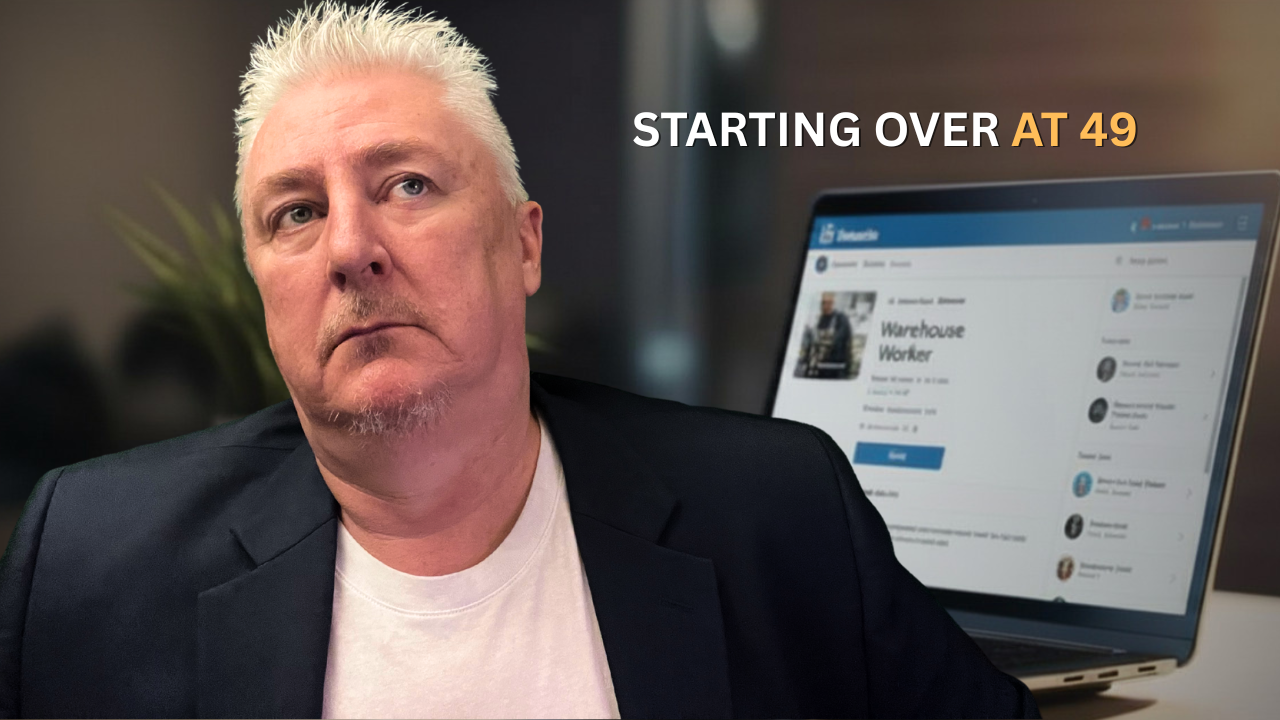
  • Starting Over at 49 Was Harder Than I Expected

    Starting Over at 49 Was Harder Than I Expected

    In the past three years, I’ve applied for more than 2500 jobs.

    That number sounds made up.

    Honestly, if somebody had told me a few years ago that a former regional banking manager with 24 years of experience would end up applying for Amazon warehouse jobs, driving for Uber, uploading résumés at midnight and getting rejected from roles he could probably do blindfolded… I would’ve assumed they’d taken a wrong turn somewhere.

    But here we are.

    And somewhere between application number 700 and application number 1800, I realised modern job searching has become its own form of psychological warfare.

    Upload your résumé.

    Now manually type your résumé back into smaller boxes.

    Write a cover letter.

    Now answer personality questions designed to determine whether you’re passionate enough about moving cardboard boxes.

    Then hear absolutely nothing ever again.

    I suspect I may now hold the unofficial world record for hearing nothing from HR departments.

    The strange part is… I wasn’t always “starting over.”

    I’ve actually done this before.


    Apparently I Have a Habit of Reinventing Myself

    When I left high school in Australia, I completed a four-year chef’s apprenticeship.

    Young Australian chef early in his hospitality career before later transitioning into banking and eventually media and storytelling.
    Before banking, there was hospitality, kitchens, Samoa, and another life altogether.

    I eventually became a sous chef and then landed an executive chef role in Samoa. Later I moved into hotel management in Fiji.

    Then I came back to Australia and realised something uncomfortable:

    I didn’t want to do it anymore.

    So I started again.

    I got a job as a bank teller.

    That somehow turned into a 24-year banking career.

    Over time I worked my way up through management until eventually I became a regional banking manager.

    Australian regional banking manager during his corporate career before leaving banking and later rebuilding his life in Tennessee.
    On paper, this probably looked like success. In many ways, it was.

    On paper, it probably looked like success.

    And financially, in many ways, it was.

    But toward the end, my life had quietly narrowed into work.

    I was commuting three hours a day.

    Working six days a week.

    Seventy-hour weeks had become normal.

    My youngest daughter was three and barely knew me.

    I’d become one of those blokes who spends his entire life providing for his family while somehow barely getting to participate in it.

    Then came the moment that broke me.

    In July 2023, after finally securing a transfer closer to home, my boss had me fire my second-in-charge before I even started. I’d have no backup which meant even longer hours.

    Then I was informed my office was being removed.

    No desk.

    No office.

    After 24 years.

    I quit on the spot.

    No backup plan.

    No next job.

    Nothing.

    At the time, I thought I was escaping burnout.

    In hindsight, I think I was also escaping a version of myself.


    The Part Nobody Talks About

    When most people picture unemployment, they imagine somebody sitting around not wanting to work.

    That wasn’t my reality at all.

    I wanted to work.

    I just didn’t want my entire identity consumed by corporate life anymore.

    When I first moved to America, I actually hoped I could transition into something more meaningful.

    Fraud or Investigations.

    Just wanting to help people without chasing targets and goals.

    Something where experience mattered.

    Instead, after four or five months, I ended up back in retail banking managing a downtown branch.

    And somehow, years later, I found myself sitting in front of LinkedIn at midnight applying for literally everything.

    Insurance roles.

    Fraud teams.

    Case management.

    911 dispatcher positions.

    Local police departments.

    Sheriff’s offices.

    Warehouse jobs.

    At one point I think I applied for enough positions to qualify as a full-time applicant.

    Laptop displaying online job applications late at night during a prolonged period of unemployment and career rebuilding.
    Somewhere along the way, job searching became its own full-time job.

    The strangest part was being simultaneously “overqualified” and unemployable.

    In the very few interviews I actually got, people would ask me why I wanted such “basic” jobs.

    Which is a very polite way of saying:

    “Why is somebody with your background here?”

    The truth?

    Because bills still arrive and kids still need dance lessons.

    Because groceries still cost money and pride doesn’t pay the electricity bill.

    And because somewhere along the way, I realised I no longer cared about status nearly as much as I cared about having a life.


    The Job I Thought Changed Everything

    There was one role that nearly broke me emotionally.

    A position with the Department of Community Services.

    It genuinely felt like the first job I’d ever applied for that aligned with who I actually was.

    I would’ve been working with victims of human trafficking and child abuse. Things I had experience in as a Bank Manager.

    Helping people.

    Something meaningful.

    I had a phone interview.

    Then a panel interview.

    Then I got the call.

    I got the job.

    I accepted it.

    Long government building hallway symbolizing the emotional weight and disappointment of losing a meaningful job opportunity later in life.
    For a little while, I thought I’d finally found something meaningful.

    I remember feeling absolutely ecstatic. Telling people excitedly.

    Honestly, I thought maybe my entire career had been leading toward this.

    Then it disappeared.

    Background checks revealed I didn’t have a university degree.

    Nobody had mentioned one was required.

    I had 24 years of banking leadership experience.

    International experience.

    Extensive management experience.

    The Chief Justice of the Tennessee Supreme Court as one of my references.

    Didn’t matter.

    No degree.

    No job.

    That one flattened me.

    I think that was the moment job searching stopped feeling frustrating and started feeling personal.

    After that, even the thought of another application made me physically recoil.


    The Quiet Shame of Starting Over Later in Life

    I’m 52 now.

    And while nobody will openly say it, I do believe age plays a role.

    Maybe it was age, or maybe it was being Australian.

    Maybe it was experience or that employers saw somebody who’d managed large teams and assumed I’d leave.

    Or maybe they preferred younger graduates, maybe all of it.

    I’ll never know.

    But I do know this:

    At some point, repeated rejection stops feeling professional and starts feeling existential.

    You stop wondering:

    “Why didn’t I get the job?”

    And start wondering:

    “Has the world quietly decided I’m past my use-by date?”

    That’s a hard feeling to explain to people.

    Especially as a man who spent most of his adult life being the provider.

    For years my role was simple:

    Work.

    Provide.

    Keep moving.

    And to be fair, I did that.

    But I also burned myself out doing it. Multiple times.

    I missed huge parts of life while climbing ladders that, in hindsight, weren’t attached to anything meaningful.

    Losing my Mum a few years ago changed something in me too.

    It made me realise life is a lot more fragile than corporations would like us to believe.

    One day you’re working 70-hour weeks.

    The next day the people you spoke to every day disappear.

    That was another strange lesson.

    People you think are your friends at work often aren’t.

    The moment you leave the system, the system moves on.

    Very quickly.


    The Unexpected Part

    Here’s the part I didn’t expect.

    Somewhere inside all this uncertainty, I accidentally found parts of myself again.

    Australian ballroom dancer practicing in Tennessee after rediscovering creativity, movement and identity beyond corporate life.
    Somewhere during all of this, I found my way back onto a dance floor too.

    I rediscovered dance.

    Built a media brand from scratch.

    I taught myself podcasting.

    Audio editing.

    Video editing.

    Writing.

    Graphics.

    Storytelling.

    I spend over 40 hours a week building it now. I’m sitting here at midnight writing this.

    Australian creator and podcaster building a media brand from home in Tennessee after leaving a long corporate banking career.
    Building the brand didn’t just give me work. It gave me a creative life again.

    And the funny part is… it doesn’t feel like work.

    Not because it isn’t real work.

    It absolutely is.

    But because for the first time in a very long time, it actually feels like me.

    Ironically, people often don’t see content creation as a “real job.”

    So these days when somebody asks what I do, I usually say:

    “I’m a writer.”

    That tends to confuse people less than saying:

    “I’m an Australian YouTuber and podcaster living in Tennessee trying to explain American goodbyes to the internet.”

    But while the financial side has been difficult, this period also gave me something banking never could.

    Time.

    I’ve been able to drive my daughters Georgia and Brianna to school.

    Take them to dance.

    Australian father with his daughters in Tennessee after leaving corporate banking and rebuilding a more present family life.
    For years I provided for my family. This period finally let me participate in it.

    Music lessons.

    Do the groceries.

    Be present.

    And honestly?

    I’ve loved it.

    I think somewhere along the way, I realised the version of success I’d spent decades chasing may not actually have been mine.


    So Where Does That Leave Me?

    Recently, after nearly three years of applications and rejection, I was offered a part-time job in a completely unrelated field.

    The interview was quick.

    Simple.

    Human.

    And the next day they offered me the role.

    No endless personality tests, or corporate theatre.

    No twenty-stage recruitment process requiring the emotional resilience of a Navy SEAL.

    Just:

    “You seem capable. We’d like to hire you.”

    Honestly, I felt everything at once.

    Relief.

    Exhaustion.

    Sadness.

    Gratitude.

    Maybe even grief.

    Because part of me wanted the media brand to become fully sustainable before I ever had to go back to regular employment.

    But another part of me knows something important now:

    I don’t actually want my old life back.

    Australian creator in Tennessee rediscovering humour and everyday joy after leaving a long corporate banking career.
    Turns out happiness sometimes looks less like a boardroom and more like bothering skeletons at a Spirit Halloween store.

    Financially?

    Sure.

    There are parts of it I miss.

    But the version of me who only existed to work?

    No.

    I’ve already done that.

    Twice, apparently.

    And maybe that’s the strangest lesson in all of this.

    Careers are chapters.

    Not identities.

    At 18, I thought I was a chef.

    Then at 30, I thought I was a banker.

    At 52, I’m honestly not completely sure what I am yet.

    But I know this:

    I’m bigger than my job title.

    And if this whole experience has taught me anything, it’s that starting over can happen to anyone.

    Even the people who looked successful from the outside.


    Life After Corporate Work

    There were nights during all of this where I’d finish another application, close the laptop, and wonder whether I’d somehow become invisible.

    That was part of the reason I started writing more honestly about identity, migration and life between cultures here on the website. Articles like What America Gets Right, After Living Here for 8 Years and When the Show Becomes the Focus came directly out of this period of my life.

    I think when your career identity starts falling apart a bit, you begin trying to make sense of yourself in other ways.

    For me, that became storytelling.

    Podcasting.

    Writing.

    And weirdly enough… ballroom dancing.

    Going back to dance after all these years genuinely helped my mental health more than I expected. There’s something strangely grounding about having to focus on timing, movement and not tripping over your own feet for ninety minutes.

    Honestly, this whole brand exists because I finally stopped pretending work was the only meaningful thing about me.

    If you’ve found yourself in that strange middle ground too — between careers, identities, countries, expectations, or versions of yourself — you might also connect with some of the other stories I’ve written:

    And if you prefer listening while driving, walking or pretending to exercise like I do, the podcast lives here too:

    From Down Under to Down South Podcast

    You’ll also find it on iTunes and Spotify or wherever you listen to podcasts.

    These days I’m still building.

    Still figuring things out.

    Still trying to create something sustainable.

    But for the first time in a very long time, I actually feel connected to the life I’m living while I’m living it.

    And that feels worth something.

    If you’d like to support the brand while I continue building all this from Tennessee, you can also shout an Aussie creator a coffee here:

    Hoo roo maties.