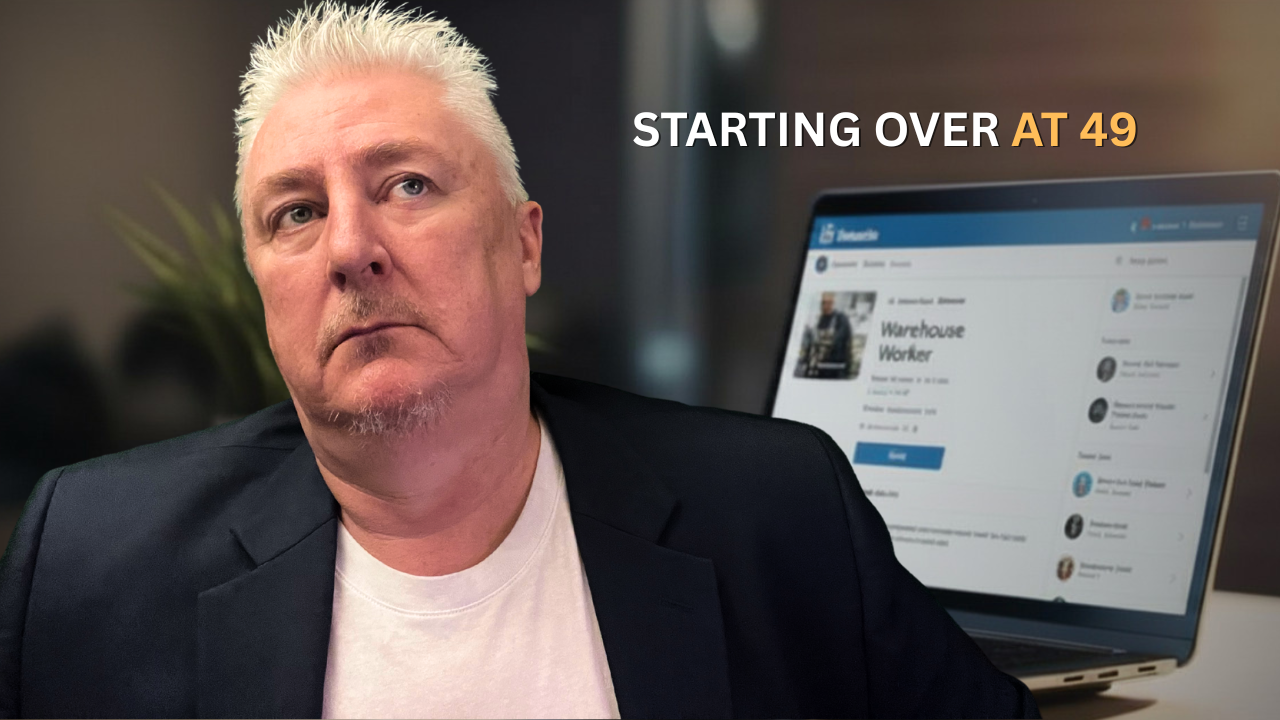
In the past three years, I’ve applied for more than 2500 jobs.
That number sounds made up.
Honestly, if somebody had told me a few years ago that a former regional banking manager with 24 years of experience would end up applying for Amazon warehouse jobs, driving for Uber, uploading résumés at midnight and getting rejected from roles he could probably do blindfolded… I would’ve assumed they’d taken a wrong turn somewhere.
But here we are.
And somewhere between application number 700 and application number 1800, I realised modern job searching has become its own form of psychological warfare.
Upload your résumé.
Now manually type your résumé back into smaller boxes.
Write a cover letter.
Now answer personality questions designed to determine whether you’re passionate enough about moving cardboard boxes.
Then hear absolutely nothing ever again.
I suspect I may now hold the unofficial world record for hearing nothing from HR departments.
The strange part is… I wasn’t always “starting over.”
I’ve actually done this before.
Apparently I Have a Habit of Reinventing Myself
When I left high school in Australia, I completed a four-year chef’s apprenticeship.

I eventually became a sous chef and then landed an executive chef role in Samoa. Later I moved into hotel management in Fiji.
Then I came back to Australia and realised something uncomfortable:
I didn’t want to do it anymore.
So I started again.
I got a job as a bank teller.
That somehow turned into a 24-year banking career.
Over time I worked my way up through management until eventually I became a regional banking manager.

On paper, it probably looked like success.
And financially, in many ways, it was.
But toward the end, my life had quietly narrowed into work.
I was commuting three hours a day.
Working six days a week.
Seventy-hour weeks had become normal.
My youngest daughter was three and barely knew me.
I’d become one of those blokes who spends his entire life providing for his family while somehow barely getting to participate in it.
Then came the moment that broke me.
In July 2023, after finally securing a transfer closer to home, my boss had me fire my second-in-charge before I even started. I’d have no backup which meant even longer hours.
Then I was informed my office was being removed.
No desk.
No office.
After 24 years.
I quit on the spot.
No backup plan.
No next job.
Nothing.
At the time, I thought I was escaping burnout.
In hindsight, I think I was also escaping a version of myself.
The Part Nobody Talks About
When most people picture unemployment, they imagine somebody sitting around not wanting to work.
That wasn’t my reality at all.
I wanted to work.
I just didn’t want my entire identity consumed by corporate life anymore.
When I first moved to America, I actually hoped I could transition into something more meaningful.
Fraud or Investigations.
Just wanting to help people without chasing targets and goals.
Something where experience mattered.
Instead, after four or five months, I ended up back in retail banking managing a downtown branch.
And somehow, years later, I found myself sitting in front of LinkedIn at midnight applying for literally everything.
Insurance roles.
Fraud teams.
Case management.
911 dispatcher positions.
Local police departments.
Sheriff’s offices.
Warehouse jobs.
At one point I think I applied for enough positions to qualify as a full-time applicant.

The strangest part was being simultaneously “overqualified” and unemployable.
In the very few interviews I actually got, people would ask me why I wanted such “basic” jobs.
Which is a very polite way of saying:
“Why is somebody with your background here?”
The truth?
Because bills still arrive and kids still need dance lessons.
Because groceries still cost money and pride doesn’t pay the electricity bill.
And because somewhere along the way, I realised I no longer cared about status nearly as much as I cared about having a life.
The Job I Thought Changed Everything
There was one role that nearly broke me emotionally.
A position with the Department of Community Services.
It genuinely felt like the first job I’d ever applied for that aligned with who I actually was.
I would’ve been working with victims of human trafficking and child abuse. Things I had experience in as a Bank Manager.
Helping people.
Something meaningful.
I had a phone interview.
Then a panel interview.
Then I got the call.
I got the job.
I accepted it.

I remember feeling absolutely ecstatic. Telling people excitedly.
Honestly, I thought maybe my entire career had been leading toward this.
Then it disappeared.
Background checks revealed I didn’t have a university degree.
Nobody had mentioned one was required.
I had 24 years of banking leadership experience.
International experience.
Extensive management experience.
The Chief Justice of the Tennessee Supreme Court as one of my references.
Didn’t matter.
No degree.
No job.
That one flattened me.
I think that was the moment job searching stopped feeling frustrating and started feeling personal.
After that, even the thought of another application made me physically recoil.
The Quiet Shame of Starting Over Later in Life
I’m 52 now.
And while nobody will openly say it, I do believe age plays a role.
Maybe it was age, or maybe it was being Australian.
Maybe it was experience or that employers saw somebody who’d managed large teams and assumed I’d leave.
Or maybe they preferred younger graduates, maybe all of it.
I’ll never know.
But I do know this:
At some point, repeated rejection stops feeling professional and starts feeling existential.
You stop wondering:
“Why didn’t I get the job?”
And start wondering:
“Has the world quietly decided I’m past my use-by date?”
That’s a hard feeling to explain to people.
Especially as a man who spent most of his adult life being the provider.
For years my role was simple:
Work.
Provide.
Keep moving.
And to be fair, I did that.
But I also burned myself out doing it. Multiple times.
I missed huge parts of life while climbing ladders that, in hindsight, weren’t attached to anything meaningful.
Losing my Mum a few years ago changed something in me too.
It made me realise life is a lot more fragile than corporations would like us to believe.
One day you’re working 70-hour weeks.
The next day the people you spoke to every day disappear.
That was another strange lesson.
People you think are your friends at work often aren’t.
The moment you leave the system, the system moves on.
Very quickly.
The Unexpected Part
Here’s the part I didn’t expect.
Somewhere inside all this uncertainty, I accidentally found parts of myself again.

I rediscovered dance.
Built a media brand from scratch.
I taught myself podcasting.
Audio editing.
Video editing.
Writing.
Graphics.
Storytelling.
I spend over 40 hours a week building it now. I’m sitting here at midnight writing this.

And the funny part is… it doesn’t feel like work.
Not because it isn’t real work.
It absolutely is.
But because for the first time in a very long time, it actually feels like me.
Ironically, people often don’t see content creation as a “real job.”
So these days when somebody asks what I do, I usually say:
“I’m a writer.”
That tends to confuse people less than saying:
“I’m an Australian YouTuber and podcaster living in Tennessee trying to explain American goodbyes to the internet.”
But while the financial side has been difficult, this period also gave me something banking never could.
Time.
I’ve been able to drive my daughters Georgia and Brianna to school.
Take them to dance.

Music lessons.
Do the groceries.
Be present.
And honestly?
I’ve loved it.
I think somewhere along the way, I realised the version of success I’d spent decades chasing may not actually have been mine.
So Where Does That Leave Me?
Recently, after nearly three years of applications and rejection, I was offered a part-time job in a completely unrelated field.
The interview was quick.
Simple.
Human.
And the next day they offered me the role.
No endless personality tests, or corporate theatre.
No twenty-stage recruitment process requiring the emotional resilience of a Navy SEAL.
Just:
“You seem capable. We’d like to hire you.”
Honestly, I felt everything at once.
Relief.
Exhaustion.
Sadness.
Gratitude.
Maybe even grief.
Because part of me wanted the media brand to become fully sustainable before I ever had to go back to regular employment.
But another part of me knows something important now:
I don’t actually want my old life back.

Financially?
Sure.
There are parts of it I miss.
But the version of me who only existed to work?
No.
I’ve already done that.
Twice, apparently.
And maybe that’s the strangest lesson in all of this.
Careers are chapters.
Not identities.
At 18, I thought I was a chef.
Then at 30, I thought I was a banker.
At 52, I’m honestly not completely sure what I am yet.
But I know this:
I’m bigger than my job title.
And if this whole experience has taught me anything, it’s that starting over can happen to anyone.
Even the people who looked successful from the outside.
Life After Corporate Work
There were nights during all of this where I’d finish another application, close the laptop, and wonder whether I’d somehow become invisible.
That was part of the reason I started writing more honestly about identity, migration and life between cultures here on the website. Articles like What America Gets Right, After Living Here for 8 Years and When the Show Becomes the Focus came directly out of this period of my life.
I think when your career identity starts falling apart a bit, you begin trying to make sense of yourself in other ways.
For me, that became storytelling.
Podcasting.
Writing.
And weirdly enough… ballroom dancing.
Going back to dance after all these years genuinely helped my mental health more than I expected. There’s something strangely grounding about having to focus on timing, movement and not tripping over your own feet for ninety minutes.
Honestly, this whole brand exists because I finally stopped pretending work was the only meaningful thing about me.
If you’ve found yourself in that strange middle ground too — between careers, identities, countries, expectations, or versions of yourself — you might also connect with some of the other stories I’ve written:
- Warmth, Friendship & Cultural Differences
- Why Americans Seem More Polite Than Australians
- Why American Goodbyes Feel Faster Than Australian Goodbyes
- The Small Things Australians Miss After Moving to America
And if you prefer listening while driving, walking or pretending to exercise like I do, the podcast lives here too:
From Down Under to Down South Podcast
You’ll also find it on iTunes and Spotify or wherever you listen to podcasts.
These days I’m still building.
Still figuring things out.
Still trying to create something sustainable.
But for the first time in a very long time, I actually feel connected to the life I’m living while I’m living it.
And that feels worth something.
If you’d like to support the brand while I continue building all this from Tennessee, you can also shout an Aussie creator a coffee here:

Hoo roo maties.