Tag: Australian English

  • Why Australians Shorten Words (It’s Not Laziness)

    Why Australians Shorten Words (It’s Not Laziness)


    Even after eight years of live in the United States, I still have to translate Australian into English before opening my mouth.

    Not because Americans don’t speak English. They do. Apparently, so do I. But if I tell someone I’ll see them this arvo, they’ll look at me as though I’ve just sneezed halfway through a sentence.

    “Sorry, what?”

    “This afternoon.”

    “Oh.”

    And there it is. Another successful international communication.

    When I first moved to America, I constantly had to stop myself from saying things like brekkie, servo, bottle-o, tradie, firie, smoko and Maccas.

    All perfectly normal words where I come from.

    In Australia, you might grab some brekkie, stop at the servo, chat to a tradie having smoko, pick up Maccas in the arvo, then head to the bottle-o.

    In America, that sounds less like a typical Saturday and more like someone suffering a stroke.

    These days, I say gas station instead of servo. Brekkie has survived, though, and in my head, the Australian words are still there. I’ve just learned to replace them before they come out.

    Which raises a question I’ve never really thought about until living overseas.

    Why on earth do Australians shorten absolutely everything?

    As it turns out, there’s a surprisingly long history behind it, some fascinating linguistic research, and a pretty good explanation for why we do it.

    And no, it’s not simply because we’re lazy.

    Although I wouldn’t entirely rule that out either.

    Australian English uses shortened words such as servo, brekkie and arvo in everyday conversation.
    In Australia, it’s a servo. In America, I have to remember to call it a gas station.

    Australians Have Been Doing This Since the 1800s

    Believe it or not, Australians were chopping bits off words long before anyone had heard of Maccas.

    The habit can be traced back to colonial Australia in the nineteenth century, when our uniqie version of English was beginning to take shape.

    And some of the earliest recorded expressions are absolute beauties.

    Take spell-o, for example.

    I’d never heard this one before researching the article, but it was an early Australian call signalling that it was time to take a break from work.

    A spell-o.

    Eventually, another familiar expression, smoko, became more common.

    Then there was schoolie, an early recorded Australian term for a schoolteacher.

    And there were the occupational nicknames: milko for someone delivering milk, bottle-o for someone collecting bottles, and rabbito for someone selling rabbits.

    Yes, rabbits.

    In nineteenth-century Australia, rabbit sellers were a familiar sight in some cities, calling out to customers as they made their way through the streets.

    And if you’re an Australian rugby league supporter, that last word might sound familiar.

    The Rabbitohs Were Real People

    South Sydney’s famous rugby league team, the Rabbitohs, takes its nickname from the rabbit sellers who once worked the streets of Sydney.

    The vendors became known as rabbitohs, and the name eventually became associated with the football club.

    So every time South Sydney runs onto the field, they’re carrying a little piece of nineteenth-century Australian street culture with them.

    I knew the Rabbitohs as a football team, of course. What I hadn’t appreciated was how neatly their name fitted into this much older linguistic tradition.

    It’s amazing that a street vendor’s nickname has survived into modern professional sport.

    Although I reckon the original rabbit sellers would be surprised to learn what professional footballers earn these days.

    Historical Australian rabbit sellers inspired the South Sydney Rabbitohs rugby league nickname.
    Long before the Rabbitohs became a famous rugby league club, rabbit sellers were calling out their wares on Sydney streets.

    We Didn’t Invent Shortening Words, But We Certainly Ran With It

    Australians didn’t invent the idea of chopping up the English language.

    British and Irish speakers were doing similar things long before European settlement in Australia.

    The old street cries of British vendors sometimes ended with an extended “oh” sound, and linguists have suggested that Irish English may also have influenced Australia’s passion for the O ending.

    But Australians took these inherited habits and turned them into something much more widespread.

    Place names like Fremantle became Freo. Paddington became Paddo. Rottnest Island became Rotto.

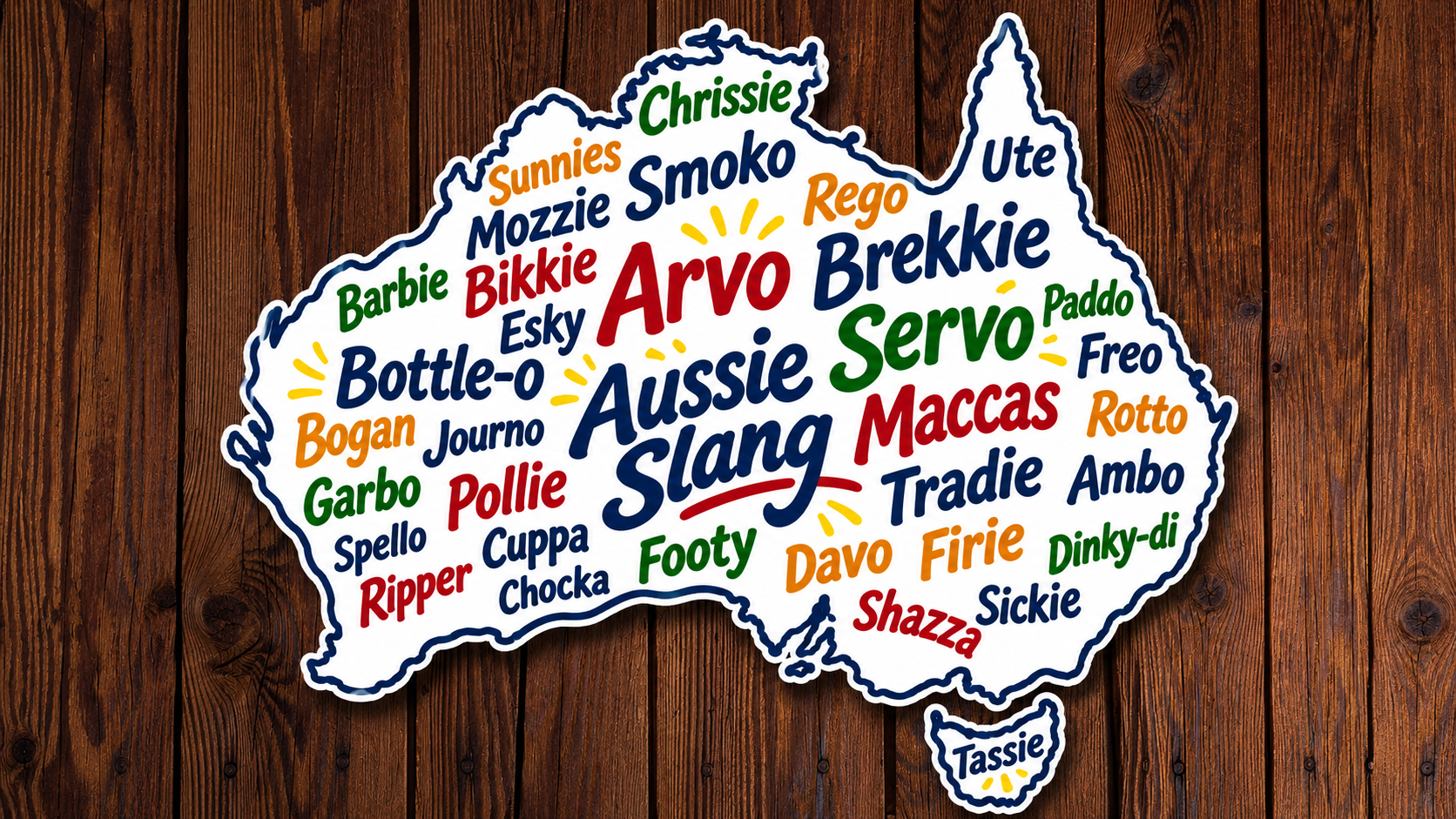
    Australian slang words

    An ambulance officer became an ambo. A journalist became a journo. A politician became a pollie.

    And somewhere along the way, we decided Christmas was too much effort and started calling it Chrissie.

    What makes Australian English distinctive isn’t simply that we shorten words.

    It’s how extensively we do it, and how completely ordinary those shortened words have become.

    An Australian asking where the nearest servo is isn’t deliberately using colourful slang.

    He’s asking where the servo is.

    That’s what it’s called.

    And until you move overseas, you might never realise there’s anything unusual about it.


    Linguists Have Actually Studied This

    This is where things get interesting.

    Apparently, Australia’s obsession with shortening words is sufficiently widespread that academics have devoted serious research to it.

    There’s even a technical name for many of these expressions.

    Hypocoristics.

    Which is a fancy word for a linguistic habit based on making words shorter.

    I’m surprised we haven’t shortened it to hypoccos.

    In a 2011 study published in the academic journal Language Sciences, researchers Evan Kidd, Nenagh Kemp and Sara Quinn examined the use of these expressions among 115 Australian adults aged between 17 and 84.

    Participants were asked to write down as many Australian shortened words as they could remember in ten minutes.

    The researchers also discussed earlier linguistic collections, including one by Roland Sussex containing approximately 4,300 different Australian shortened or modified forms.

    That’s not 4,300 words used by every Australian, and it doesn’t mean 4% of everything we say is abbreviated. It’s an estimate of the number of different word forms in the vocabulary collected by researchers.

    Still, 4,300 is a huge number.

    Imagine how much effort we have put in to avoiding effort.

    The study also confirmed something important. These expressions aren’t simply the language of uneducated people or a particular social class.

    They’re widely recognised and used across Australian society.

    If you fancy testing just how much Australian slang you actually know, Australian Idioms – The Ultimate Guide to Aussie Phrases, Slang and Expressions is one place to start. I reckon most Australians would discover a few expressions they’d never heard before.

    You can hear them in workplaces, on television, in politics and around the family dinner table.

    And the researchers’ findings lead us to the most interesting question of all.

    If we aren’t simply trying to save time by shortening these words, why are we doing it?


    It’s Not Really About Saving Time

    The strongest explanation is that we use these expressions to make language sound more informal, familiar and socially connected.

    Linguists Kate Burridge and Howard Manns from Monash University have explored how Australian shortened words communicate familiarity and reinforce social bonds.

    They also discuss the work of Australian National University linguist Anna Wierzbicka, who connected these expressions with Australia’s traditions of informality and social solidarity.

    You can read their explanation in Brekkies, Barbies, Mozzies: Why Do Aussies Shorten So Many Words?.

    And when you think about it, that makes sense.

    Australians have traditionally had a fairly relaxed attitude towards formality.

    We don’t really enjoy people putting on airs. We like things straightforward, and we tend to be almost suspicious of anyone who seems a bit too impressed with themselves.

    Our language reflects some of that.

    A journalist is a journo.

    A politician is a pollie.

    A tradesperson is a tradie.

    A firefighter is a firie.

    It doesn’t mean we don’t respect these professions. It’s simply a more familiar way of talking about them.

    There’s something rather Australian about giving a politician essentially the same linguistic treatment as the bloke who collects your rubbish.

    And importantly, it’s not just about shortening a word.

    It’s about making the word feel like it belongs in an everyday conversation.

    Three overflowing Australian rubbish bins surrounded by garbage outside Parliament House in Canberra, Australia.
    Even Parliament House isn’t safe from Australian slang. A garbage collector is a garbo, and apparently there’s plenty of work to go around.

    Sometimes We Make Words Longer, Which Defeats the Entire Purpose

    Of course, if shortening words were genuinely about efficiency, Australians would have some explaining to do.

    Take nicknames.

    David becomes Davo. John becomes Johno. Gary becomes Gazza. Sharon becomes Shazza.

    We’ve taken perfectly serviceable names and added syllables.

    Growing up in Australia, nicknames like these were everywhere.

    I was Mick.

    But during my school years, I also had another nickname.

    Battered Sav.

    My surname is Saville, and I played cricket.

    Somewhere along the way, someone made the connection with a battered saveloy, and that was that.

    Battered Sav.

    Not exactly a flattering comparison, but I guess there are worse things to be named after than a deep-fried sausage.

    These days in America, I’m Mike.

    Maybe a tad boring by comparison.

    Australian nicknames are often affectionate, sometimes ridiculous, and occasionally make absolutely no sense to anyone outside the group.

    But that’s part of their appeal.

    And the same thing happens with everyday words.

    We don’t call a garbage collector a garbie. They’re a garbo.

    A truck driver is a truckie, not a trucko.

    A musician is a muso, not a musie.

    There are patterns behind some of these endings, but linguists acknowledge that the choices can be complicated and inconsistent.

    Apparently, even academics haven’t entirely worked out why we prefer one ending over another.

    Which is comforting, because neither have the rest of us.

    Australian occupational nicknames including tradie, firie, garbo and ambo.
    In Australia, even respectable professions aren’t safe from having their names shortened.

    Americans Shorten Words Too, Just Not Quite Like Us

    Now, before Americans start feeling too superior, you’re not entirely innocent either.

    Americans say gym instead of gymnasium, fridge instead of refrigerator, and info instead of information.

    You’ll hear words like vacay for vacation and veggies for vegetables.

    So shortening words certainly isn’t uniquely Australian.

    The difference is how extensively Australians use these particular O and IE endings, and how naturally they fit into everyday adult conversation.

    In Australia, brekkie isn’t necessarily a cute word you’d use when talking to a small child.

    It’s breakfast.

    Maccas isn’t something you say ironically.

    It’s McDonald’s.

    And if someone says they’re stopping at the bottle-o on the way home, nobody needs to ask for clarification.

    When I first arrived in America, this caused endless little moments of confusion.

    I’d say something completely normal, get a blank stare, and then have to explain myself.

    Eventually, I started catching the words before they came out.

    Servo became gas station.

    Arvo became afternoon.

    But brekkie has managed to survive.

    My two daughters are growing up American. They go to school here, their friends are American, and the language they hear every day is American English.

    So they generally use the American expressions although funnily enough they do know what a chockie bikkie is.

    Meanwhile, I’m still running a little Australian-to-American translation service inside my head.

    It’s been eight years, and apparently the software hasn’t finished updating.


    The Strange Thing That Happens When Two Australians Meet Overseas

    Here’s something I’ve noticed living in America.

    I can spend months carefully adjusting my vocabulary so everyone understands me.

    Then I’ll meet another Australian.

    Suddenly, the accent becomes broader, the words become shorter, and it’s like meeting a long-lost cousin.

    All those expressions I’ve been quietly replacing come straight back.

    The servo is a servo again.

    The arvo is an arvo.

    And I don’t have to stop halfway through a sentence to explain what I mean.

    Neither of us is consciously doing it.

    It just happens.

    If you’re an American trying to get your head around Australian English, Aussie Lingo: Australian Expressions is a handy little guide to the words and phrases you’re likely to encounter Down Under.

    Linguists describe the broader process of adjusting how we speak in different social settings as style-shifting.

    But there’s something else happening too.

    Those familiar Australian words create an immediate sense of belonging.

    We might be thousands of miles from home, but suddenly we’re speaking the same language again.

    Quite literally.

    And maybe that’s the real reason these expressions have lasted so long.

    They’re not just shortcuts.

    They’re little signals that tell another Australian we’re from the same place, understand the same references and share something familiar.

    Even if we’ve never met before.


    Is Australian Slang Slowly Disappearing?

    This is one part of the story I find particularly interesting.

    When I returned to Australia last year, I noticed how much the country had changed since we left in 2018.

    The population, the shops, the people working in them, and the general atmosphere in some places felt different from what I remembered.

    Of course, countries change. They always have.

    And language changes with them.

    But I would hate to see this particular part of Australian culture disappear.

    Fortunately, the research suggests the picture is more complicated than simply saying younger Australians are abandoning traditional slang.

    The 2011 study found some differences between generations in the types of shortened words participants recalled.

    And Burridge and Manns have noted that while some older expressions fade, Australians continue inventing new ones.

    The IE ending in particular remains common.

    So while individual words might disappear, the habit itself appears to be remarkably resilient.

    There’s also an Australian word that has become an international success story.

    Selfie.

    Yes, the word that now appears on millions of phones around the world has Australian origins.

    It became so widely recognised that Oxford Dictionaries selected it as its Word of the Year in 2013.

    After generations of Australians chopping up the English language, we finally managed to export one of our creations to the rest of the planet.

    And everyone started using it.

    Not bad for a country that apparently can’t be bothered finishing its words.

    The word selfie originated in Australia and became internationally popular.
    One of Australia’s most successful linguistic exports. We shortened a word, and the rest of the world adopted it.

    So Why Do Australians Really Shorten Every Word?

    After looking at the history and the research, I think the answer is fairly simple.

    We inherited some linguistic habits from Britain and Ireland, developed our own versions during the nineteenth century, and spent the following century turning them into a distinctive feature of Australian English.

    But the reason they’ve lasted isn’t simply convenience.

    It’s because they fit the way Australians have traditionally liked to communicate.

    Informally, familiarly, and without making too much of a fuss.

    These expressions make everyday conversation feel relaxed. They help establish familiarity. And they give Australian English a character that is recognisably our own.

    Growing up, I never gave any of this a second thought.

    Brekkie was brekkie. The servo was the servo. A chockie bikkie was delicious and yes, I’ll have two thanks Mum.

    It took moving to America to realise just how unusual our language could sound to everyone else.

    And while I’ve learned to adjust the way I speak, I haven’t stopped thinking in Australian.

    The words are still there.

    They always will be.

    So if you’re American and you think words like arvo, brekkie and servo sound a bit ridiculous, that’s perfectly fine.

    I’d probably laugh and agree with you.

    Then I’d tell you the truth.

    You’re just jealous you don’t have a secret code.


    I’m an Australian who’s been living in Tennessee since 2018, trying to explain the differences between two countries that supposedly speak the same language. You can find more stories about Australian culture and life in America at From Down Under to Down South.

    If you enjoy these stories about Australian language, culture, and the little things that make us who we are, you can support From Down Under to Down South through Buy Me a Coffee . Every bit of support helps keep the stories coming.

    This article contains affiliate links. If you purchase through them, I may earn a small commission at no additional cost to you.
  • Why Australians Say “No Worries” (And What It Really Means)

    Why Australians Say “No Worries” (And What It Really Means)


    I’ve lived in America for eight years now, but there are some Australian habits I simply cannot shake.

    One of them is saying “no worries.”

    I was at work here in Tennessee recently when I said it to a customer. Nothing unusual about that. Just another conversation, another “no worries,” and on with my day.

    About ten minutes later, I was talking to a different bloke and out it came again.

    “No worries.”

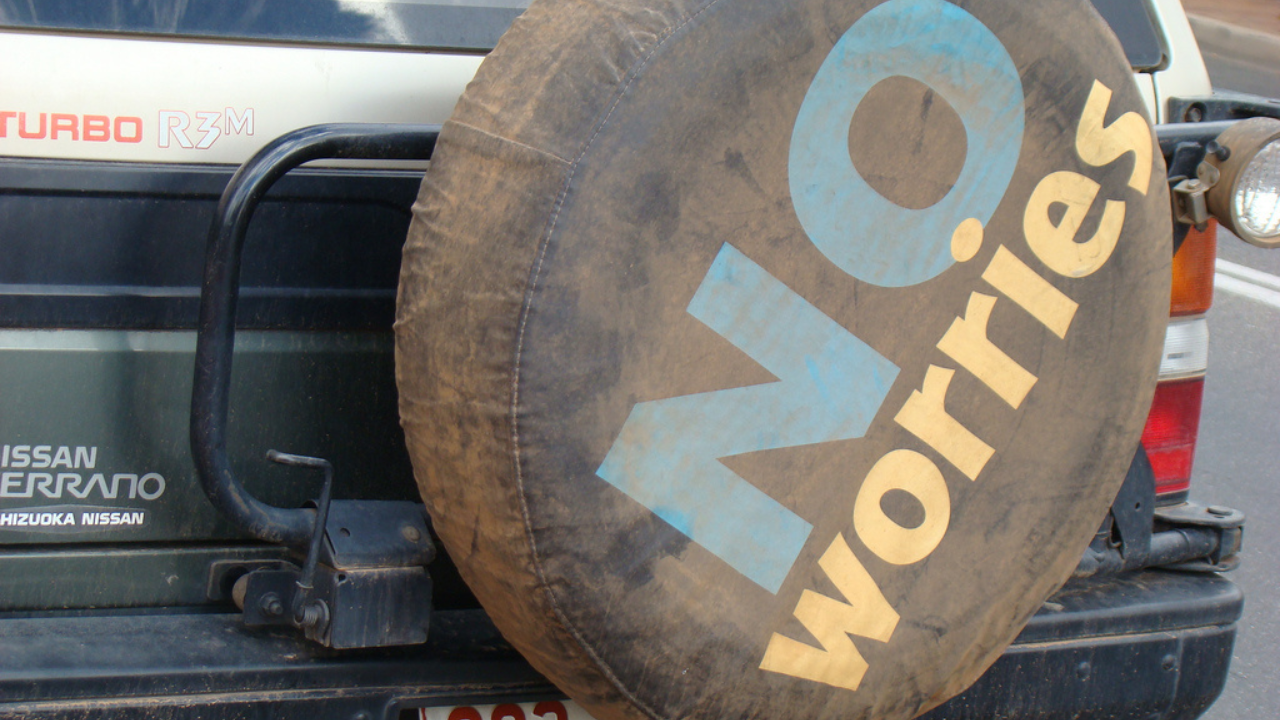
    No worries

    Unfortunately, the woman from earlier was still standing nearby.

    That’s when I realised she’d heard me say exactly the same thing to two different people within ten minutes.

    She must think I’m the No Worries Guy.

    The funny thing is, I don’t even notice I’m saying it. It’s practically automatic. Someone thanks me? No worries. Someone apologises? No worries. Someone asks for help? No worries.

    Someone creates an enormous problem that is absolutely going to ruin my afternoon?

    Still no worries.

    It’s one of those expressions that comes so naturally to Australians that we rarely stop to think about what we’re actually saying.

    But why do Australians say “no worries” so much, and what do those two little words really mean?

    Australian working in Tennessee using the expression no worries with customers.
    After eight years in America, some Australian expressions are proving impossible to shake.

    What Does “No Worries” Mean in Australia?

    The simplest explanation is that “no worries” means “it’s okay,” “no problem,” “don’t mention it,” or “you’re welcome.”

    But that doesn’t quite capture how Australians use it.

    It’s one of the most versatile expressions in Australian English. Depending on the situation, it can be an acknowledgement, reassurance, acceptance, or simply a polite way of ending a conversation.

    For example:

    Someone says thank you.

    “Thanks for giving me a hand.”

    “No worries.”

    Someone apologises.

    “Sorry I’m running late.”

    “No worries.”

    Someone asks you to do something.

    “Can you grab that for me?”

    “No worries.”

    Someone changes their mind.

    “Actually, I don’t need it anymore.”

    “No worries.”

    Four completely different situations. Exactly the same response.

    You could probably get through an entire working day in Australia using “no worries” as your primary form of communication.

    I reckon i’m making a reasonable attempt at doing exactly that here in Tennessee.

    The important thing is that “no worries” doesn’t necessarily mean there was never a problem. More often, it means the other person doesn’t need to feel bad about it.

    It’s a way of saying that whatever happened, we’re fine.

    It’s a bit like the Australian habit of calling people mate. The words sound simple, but their meaning depends on the situation.


    Where Did the Expression “No Worries” Come From?

    Although “no worries” feels as though it’s been part of Australian life forever, its documented history is actually fairly recent.

    The expression appears to have become common during the 1960s.

    By 1967, it had even made its way into a television advertisement for the State Savings Bank of Victoria.

    The advertisement promoted the bank as a place where customers could manage their finances without unnecessary worry.

    Which is rather amusing, considering that banking and worrying about money tend to go together rather nicely.

    By the late 1970s, “no worries” was already being described as something resembling a national motto.

    Crocodile Dundee movie

    Its popularity overseas received another boost during the 1980s, particularly through Australian films and television.

    Paul Hogan’s Crocodile Dundee introduced international audiences to a particular version of Australian life, complete with broad accents, bush humour and a rather relaxed approach to almost everything.

    Later, personalities such as Steve Irwin helped make Australian expressions familiar to audiences around the world.

    But “no worries” was never just a line from a film.

    It was something Australians were already saying to each other in shops, workplaces, pubs, schools and homes.

    And unlike a few other Australian expressions that have gradually fallen out of everyday use, this one has shown remarkable staying power.

    Black-and-white vintage advertisement for State Bank of South Australia featuring the slogan “No worries” and promoting banking with the State.
    “No worries” was more than just an everyday Australian expression. It even made its way into bank advertising, reflecting how deeply the phrase had become part of Australian culture.

    Why Australians Say It So Much

    I think part of the appeal of “no worries” is that it removes unnecessary formality from everyday interactions.

    Australians generally aren’t fond of making a big production out of small things.

    If someone asks for a hand carrying something, you help them.

    If someone thanks you, you acknowledge it.

    Nobody needs to deliver a speech.

    “No worries” does the job beautifully.

    There’s also something uniquely Australian about the idea that helping someone shouldn’t automatically be treated as an inconvenience.

    When I say “no worries” to someone who thanks me, what I’m really saying is that they haven’t put me out.

    It wasn’t a burden. There’s no debt to repay. We’re all good, mate.

    Don’t get me wrong, that doesn’t mean all Australians are relaxed, helpful or easygoing.

    Anyone who has spent time in Sydney traffic during the morning peak hour can confirm that the national commitment to remaining calm has certain limitations.

    But as a social expression, “no worries” creates a sense of ease between people.

    It makes an interaction feel less formal and more equal.

    It doesn’t matter whether you’re speaking to a customer, a neighbour, a friend or someone you’ve never met.

    The words work just as well.

    And maybe that’s why I still use them so naturally after eight years in America.

    They’re not something I consciously choose to say.

    They’re simply part of how I speak to people.


    Is “No Worries” the Same as “You’re Welcome”?

    This is where things get interesting, particularly when you move from Australia to the United States.

    In America, “you’re welcome” is a familiar response when someone says thank you.

    You’ll also hear “no problem,” “of course,” “you bet,” and, sometimes in customer service, “my pleasure.”

    Australians use some of those expressions too, but “no worries” has a slightly different flavour.

    “You’re welcome” acknowledges the person’s thanks.

    “No worries” reassures them that whatever you did wasn’t an inconvenience.

    It’s a subtle distinction, but an interesting one.

    Researchers studying Australian English have examined how “no worries” works as a form of politeness, helping reduce the sense of obligation or inconvenience between people.

    In plain language, we’re telling the other person not to make a fuss.

    I find that really interesting because I’ve noticed how much Americans value friendly, enthusiastic customer service.

    People here can be very warm and welcoming, often in ways that surprised me when I first arrived.

    Another expression that caught my attention after moving here was “I appreciate you,” which still sounds surprisingly personal to my Aussie ears.

    But the language of politeness can be different.

    An American might say “It’s my pleasure.”

    An Australian might say “No worries, mate.”

    Both can be equally sincere.

    One places emphasis on the pleasure of helping. The other places emphasis on the fact that helping wasn’t a problem.

    Different words, similar intentions.

    Personally, I like both approaches.

    Although I reckon I’ll be saying “no worries” long after I’ve forgotten where I left my car keys.


    When “No Worries” Actually Means There Are Plenty of Worries

    Here’s where Australian English becomes a tad entertaining.

    Sometimes “no worries” means exactly what it says.

    Other times, it means something closer to “this is an absolute disaster, but I don’t wanna discuss it.”

    Imagine someone has just informed you that a job you thought would take twenty minutes is actually going to take three hours.

    “No worries.”

    There are worries.

    Several of them.

    Or a mate has borrowed something and returned it in considerably worse condition.

    “No worries.”

    You might be furious, but apparently we’re all maintaining diplomatic relations for the moment.

    Then there’s the classic situation where someone asks whether you can manage a task that you have absolutely no idea how to do.

    “No worries.”

    You’ve now committed yourself to something you may deeply regret, forever.

    I think there’s an element of Australian understatement involved.

    We don’t always feel the need to announce every inconvenience, irritation or difficulty.

    Sometimes we just get on with it.

    That can be admirable, but it can also be ridiculous.

    There are times when we probably should admit that something is a worry instead of pretending everything is under control.

    Still, there’s something reassuring about hearing those two words when a situation becomes tough.

    Even if the person saying them is quietly wondering how on earth they’re going to sort things out.

    Australian man standing casually beside a completely broken lawnmower in a suburban backyard, with scattered tools, a detached wheel and a speech bubble reading “No Worries.”
    The lawnmower is in pieces, the repair has gone horribly wrong, but the response is still the same: “No worries.” In Australia, sometimes it’s less a statement of fact and more a declaration of optimism.

    No Wuckers, No Dramas and Other Aussie Variations

    Australians have never been content to leave a perfectly good expression alone.

    Once we’ve found something that works, we tend to shorten it, rearrange it or make it slightly more ridiculous.

    “No worries” is no exception.

    There’s “no probs,” which is simply a shorter version of “no problems.”

    There’s “no dramas,” which suggests that whatever has happened doesn’t need to become a major production.

    Then there’s “no wuckers.”

    This is a distinctly Aussie slang variation, derived from the rather less polite expression “no wucking furries,” reverse that one and you’ll catch my drift.

    It’s not something I’d recommend using at a formal job interview, although it would no doubt make you unforgettable.

    That sort of wordplay is also part of why Australians can sound so casual about swearing, even when nobody’s particularly upset.

    If you’re planning a trip to Australia and want to understand what the locals are saying, an Australian slang dictionary is worth a look. Although I should warn you, learning the words is one thing. Working out when we’re being sarcastic is an entirely different challenge.

    You’ll also hear “she’ll be right,” another famous Australian expression.

    The two are related, but they aren’t quite interchangeable.

    “No worries” often reassures someone that a request, apology or situation is fine.

    “She’ll be right” expresses confidence that something will work out.

    Sometimes that confidence is justified.

    Sometimes it’s based on absolutely nothing.

    And occasionally it’s being expressed by a bloke standing beside a broken lawnmower with a screwdriver and no particular plan.

    Australian optimism can be a special thing.

    Of course, we’ve also managed to turn “yeah nah” into a perfectly understandable answer, so maybe none of this should come as a shock.


    Has “No Worries” Become an American Expression?

    One of the interesting things about living in America is hearing Aussie expressions that have crossed the Pacific.

    “No worries” is one of them.

    Although it became associated with Australia, it has also found a place in American English.

    You might hear it in a coffee shop, at work or during an ordinary conversation between two Americans.

    For some people, it’s simply another way of saying “no problem.”

    Not everyone is enthusiastic about its popularity, though.

    In 2022, Lake Superior State University in Michigan included “no worries” on its annual Banished Words List, which collects expressions people nominate for overuse or misuse.

    If you’re curious about where some of Australia’s stranger expressions came from, there’s a whole history behind the way we speak. Kel Richards’ dictionary of Australian phrase and fable explores the origins of hundreds of Australian sayings, including some that might leave visitors completely bewildered.

    Apparently, some Americans were becoming tired of hearing it used in place of “you’re welcome.”

    As an Australian, I find that quite funny.

    We exported a perfectly harmless expression, and somehow it ended up on a list of words people wanted banished.

    That’s a fairly impressive achievement for two words that are supposed to make everyone feel more relaxed.

    But language changes, and expressions travel.

    Americans have influenced the way Australians speak for generations through television, films, music and popular culture.

    It’s not surprising that the traffic occasionally moves the other way.

    What I find amusing is that after eight years in America, I’m still saying “no worries” without thinking, while Americans use it themselves.

    So maybe I’m not the only No Worries Guy after all.


    Two Little Words That Say Quite a Lot

    I’ve spent over eight years living in the United States, and in that time I’ve adapted to plenty of American habits.

    I drive on the other side of the road, use American terms when I need to, and have become used to the everyday differences that come with living in another country.

    But some things remain stubbornly Australian.

    “No worries” is one of them.

    It’s not something I deliberately hold on to as a reminder of home. I don’t wake up each morning determined to preserve Australian English one yarn at a time.

    It just happens.

    Because underneath those two words is a simple idea that I think is worth keeping.

    Don’t make someone feel like a burden when they haven’t been one.

    Don’t turn every little inconvenience into a major event.

    And when you can help someone, just help them.

    Of course, none of this guarantees that life will be free of worries.

    It hasn’t worked that way for me.

    But maybe that’s the whole point.

    Sometimes “no worries” isn’t a description of how life is.

    It’s how we’d like to approach it.

    So if you happen to visit Tennessee and encounter an Australian bloke who says “no worries” three times in five minutes, there’s a decent chance you’ve found me.

    Don’t worry about it.

    Apparently, I can’t help myself.


    Enjoying these little explanations of Australian life? You can support From Down Under to Down South through Buy Me a Coffee. It helps keep the stories, articles and podcast going. No worries if you can’t, of course!

  • The Strange History of Australia’s Famous Dunny

    The Strange History of Australia’s Famous Dunny


    I must have been about ten years old when I found myself sitting in an outdoor toilet on my uncle’s property in regional New South Wales, staring at a kangaroo through a crack in the door.

    Not something you generally expect during a trip to the toilet.

    I’d gone outside, walked around the back of the house, and entered a little building that offered the bare essentials. A hole, a pit underneath, some toilet paper, and, if you were feeling adventurous, yesterday’s newspaper.

    Privacy was provided by a wooden door with a metal latch.

    Comfort was apparently somebody else’s problem.

    Then I noticed something moving outside.

    A kangaroo.

    Just standing there.

    I remember getting a fright initially, then thinking it was actually pretty cool.

    After all, this was Australia. Kangaroos were hardly unusual on my uncle’s property. They were forever getting into the crops, and there were enough parrots attacking the zucchinis to make you wonder whether the local wildlife had formed an agricultural union.

    Kangaroos in Clandulla NSW

    Still, encountering a kangaroo while sitting on the toilet wasn’t something I’d experienced before.

    And frankly, given the alternatives, I was quite happy it was a kangaroo.

    Because the other potential visitors included spiders and brown snakes. Welcome to the Australian dunny.


    So, Why Do Australians Call It a Dunny?

    The short answer is that dunny is Australian slang for a toilet, particularly an old-fashioned outdoor toilet or outhouse.

    But the word didn’t actually originate in Australia.

    According to the Australian National Dictionary Centre at the Australian National University, dunny comes from the old British dialect word dunnekin, meaning an outdoor privy.

    That word is generally traced to dung, meaning excrement, and ken, an old slang term for a house.

    So, translated rather literally, a dunny was a house for dung.

    Charming. The longer form, dunnekin, appeared in Australian sources as early as the 1840s, while the shortened word dunny is recorded from the 1930s.

    Australians eventually made the word their own, as we tend to do with perfectly respectable English.

    Today, dunny can refer to just about any toilet, including a modern indoor one.

    Although if someone walked into my house and asked where the dunny was, I’d probably assume they’d just stepped off a sheep station somewhere west of Bourke.

    I’d know exactly what they meant. I’d also think they were being pretty bloody ocker.


    The Australian Dunny Wasn’t Always a Pleasant Experience

    My uncle lived on a large property in regional NSW.

    It was a long way from town, with rainwater rather than a town water supply, and no connection to a municipal sewerage system.

    The outdoor dunny wasn’t some quaint historical feature preserved for visitors.

    It was the toilet.

    And it came with a few rules.

    Don’t fall in.

    Don’t put anything down there that wasn’t supposed to go down there.

    Watch where you step.

    Check for spiders.

    Keep an eye out for snakes.

    That last one was particularly important.

    My uncle’s property had brown snakes, and there had been occasions when one had found its way into the dunny.

    I never personally encountered one in there, thankfully.

    Spiders, on the other hand, were practically part of the furniture.

    Then there was the smell.

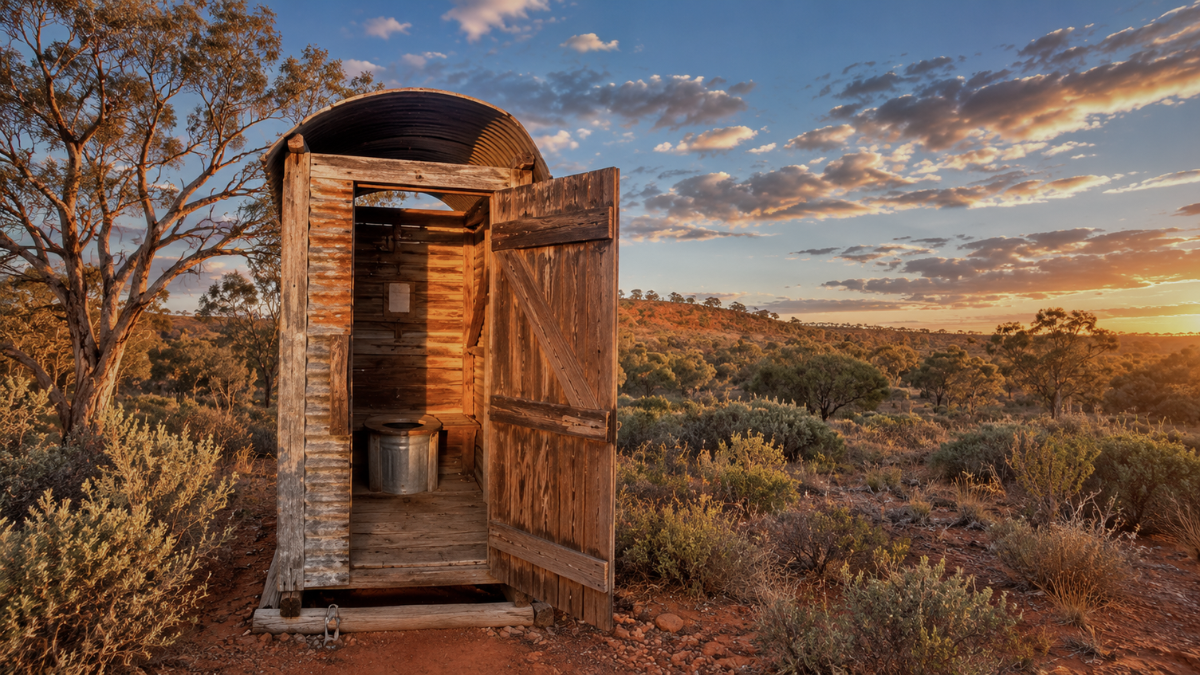
    the outback dunny in Australia

    If you’ve never experienced an Australian outdoor toilet during the height of summer, imagine a small wooden building sitting in temperatures well above 30 degrees Celsius, with a pit full of human waste underneath.

    Now imagine opening the door.

    There are certain childhood memories that never leave you.

    Some are wonderful.

    Some involve your grandmother’s cooking, Christmas mornings, or family holidays.

    Others involve desperately trying to hold your breath while doing a poo.


    Going to the Dunny After Dark Was Another Adventure

    My uncle’s dunny wasn’t particularly far from the house.

    But you couldn’t simply wander down a hallway and flick on the bathroom light.

    You had to go outside, walk around the house, and make your way to the little building at the back.

    There was an outside light, thankfully.

    That didn’t mean you could stop watching where you were going.

    I remember being particularly conscious of the wildlife at night.

    During the day, a kangaroo outside the toilet might be entertaining.

    At night, when something rustled in the darkness and you couldn’t immediately see what it was, the experience became considerably less amusing.

    It was rather like going camping, except you hadn’t actually gone camping.

    You were just trying to use the toilet.

    And I suspect that’s one reason the old Australian dunny has remained such a colourful part of our cultural memory.

    It wasn’t simply a place to relieve yourself.

    It was an experience.

    Sometimes an unpleasant one.

    Occasionally a frightening one. And, years later, often a very funny one.


    What Was the Dunny Man?

    Not every Australian dunny was built over a pit.

    In towns and suburbs before modern sewerage systems became widespread, many outdoor toilets used removable metal pans.

    These collected the waste and were emptied or replaced by a worker commonly known as the dunny man, or night soil man.

    The dunny man would make his rounds, collecting the contents and transporting them for disposal.

    It was a real occupation, and an important part of keeping communities functioning before sewerage infrastructure reached every home. Museums Victoria has preserved examples of the old sanitary pans, including ones dating from around the 1930s to 1950s. Some areas continued using pan collection systems long after other suburbs had been connected to sewers.

    It wasn’t glamorous work.

    In fact, it’s difficult to imagine a job title less likely to impress someone at a dinner party.

    What do you do for a living?

    I’m the dunny man.

    Right. Lovely. Could you pass the potatoes?

    My uncle’s toilet was a pit-style arrangement, but I also remember a truck coming to the property to empty it.

    The important distinction is that outdoor dunnies weren’t all built the same way. Some relied on pits, others on removable pans, and the arrangements for managing the waste varied.

    There’s a fascinating piece of Australian social history here, too.

    In a 2017 ABC News interview, former Brisbane dunny man Ron Barlow recalled collecting waste pans from dozens of houses each week. He also remembered that the occupation carried a social stigma, despite providing an essential service.

    It’s easy to laugh about the dunny man today.

    But those blokes did a job most of us would rather not think about, let alone perform.

    And without them, things would have become unpleasant very quickly.

    The Australian Dunny Man emptying a load.
    Before widespread sewerage, dunny men collected and replaced waste pans from outdoor toilets.

    Australians Have Always Had a Sense of Humour About the Dunny

    One thing I love about Australian English is our ability to take something perfectly ordinary, give it a ridiculous name, and then act as though everyone else is strange for not understanding it.

    The dunny is a wonderful example.

    We didn’t stop at naming the toilet.

    We developed an entire vocabulary around it.

    There’s the dunny roll, which is simply toilet paper.

    A dunny budgie is a blowfly, presumably named because of its fondness for places where you really don’t want flies congregating. Then there’s dunny diver, a humorous term for a plumber, which the Australian National Dictionary Centre has traced through historical usage.

    And while we’re discussing colourful Australian expressions, there’s the magnificent description built like a brick shithouse.

    Not exactly something you’d expect to hear at a formal dinner.

    But in Australia, it describes someone or something exceptionally solid or powerfully built.

    Usually a bloke who looks capable of carrying a refrigerator under each arm. The Australian National Dictionary Centre even records an old comic curse wishing that someone’s chickens would turn into emus and knock their dunny down.

    Think about that for a moment.

    We managed to turn an outdoor toilet into part of a national insult involving oversized poultry. That’s quite an achievement.


    Do Australians Actually Say Dunny Anymore?

    Here’s where I think some international impressions of Australia can be a little misleading.

    Yes, dunny is a genuine Australian word.

    Yes, Australians understand it.

    But that doesn’t mean we’re all wandering around saying it every time we need the toilet.

    Growing up, I generally said toilet.

    If I was asking someone where to go, I’d probably say loo.

    Dunny was more something you’d say when you were trying to be funny.

    Perhaps after a few beers with your mates.

    Or when deliberately putting on a particularly ocker Australian character.

    To my ears, dunny belongs to a slightly older, more rural Australia.

    The Australia of farmers, country pubs, battlers, and blokes who’d spent their lives working outdoors.

    I can imagine hearing it on a property somewhere in regional New South Wales.

    I have a harder time imagining someone casually using it in a modern Canberra office.

    That doesn’t mean nobody does.

    And there’s no good reason to declare the word extinct.

    But I do think it carries a particular character.

    It’s earthy.

    Unpretentious.

    Maybe a little bit cheeky.

    And there’s something distinctly Australian about that.


    Even Modern Australian Roadside Toilets Can Bring Back Memories

    Outdoor toilets aren’t entirely a thing of the past.

    Australia still has remote roadside facilities that use pit or other non-flushing systems, although designs and standards have improved considerably.

    I remember encountering them at rest stops near Lake George on the way to Canberra, and at Stockinbingal near the railway station.

    Those facilities have since been upgraded, but I remember the older versions rather well.

    Particularly the smell.

    My wife, Nikki, had an unfortunate encounter with one during a road trip.

    She was horrified.

    Not just by the smell, but by how close the contents were getting to the seat.

    There’s something uniquely confronting about looking into a toilet and discovering that the previous visitors have been building a small mountain.

    At that point, you’re no longer wondering whether the facilities are clean.

    You’re wondering whether you should have stopped at the last town.

    It’s moments like those that remind me why modern plumbing is one of humanity’s greatest achievements.

    Forget the internet.

    Forget smartphones. Give me a toilet that flushes and doesn’t contain a brown snake, and I’m a happy man.


    Dunny, Loo, Toilet, Bathroom: What’s the Difference?

    Living in America for more than eight years has made me particularly aware of the different ways English-speaking countries talk about toilets.

    In Australia, I’d naturally ask where the toilet or loo was.

    In America, I ask where the bathroom is.

    Sometimes the restroom.

    Which still strikes me as a little funny.

    I’m not planning to have a bath.

    I’m certainly not going in there for a rest.

    I have a very specific purpose in mind.

    But I’ve adapted.

    When I’m speaking to Americans, I generally use the American terminology because it’s easier.

    In my head, though, I’m still going to the toilet.

    Here’s how I’d explain the differences to someone unfamiliar with Australian English.

    WordHow it’s generally used
    DunnyInformal Australian slang, traditionally associated with outdoor toilets
    LooCasual, everyday term for a toilet
    ToiletThe ordinary, direct word used widely in Australia
    BathroomCommon American term for the room containing a toilet
    RestroomCommon American term, particularly in public places
    OuthouseAmerican term for a separate outdoor toilet

    Of course, Americans have their own colourful expressions, and Australians don’t all use the same words.

    But the differences can be entertaining.

    Just as they are when an Australian announces they’re putting on their

    thongs before leaving the house.

    Different countries.

    Same language. Endless opportunities for confusion.


    The Dunny Is Part of an Australia I Hope We Never Lose

    I don’t particularly miss outdoor toilets.

    The smell.

    The spiders.

    And I certainly don’t miss wondering whether a brown snake might be waiting for me when I opened the door.

    Modern plumbing is wonderful, and I have absolutely no desire to return to the days of walking around the house in the middle of the night just to use the toilet.

    But there’s something about the word dunny that makes me nostalgic.

    It reminds me of visiting my uncle’s property in regional New South Wales.

    Old shed in Clandulla NSW

    Of the old family dairy farm where my great-grandmother lived.

    Of a childhood when the Australian countryside still felt wonderfully wild, and when even a trip to the toilet could become a story you’d remember decades later.

    More than anything, though, it reminds me of a certain type of Australian.

    The battler.

    The farmer.

    The country bloke with a dry sense of humour and a story for every occasion.

    The sort of person who didn’t need much, didn’t make a fuss, and could find something funny in just about anything.

    I know Australia has changed.

    Of course it has.

    And in many ways, for the better.

    But I hope we never completely lose that part of our national character.

    That wonderful mixture of resilience, irreverence, practicality, and larrikin humour.

    Because when I hear someone say dunny, I don’t just think of a toilet.

    I think of the people who’d use that word without giving it a second thought.

    And I miss them.

    Not the spiders, mind you. They can stay right where they bloody are.


  • What Is a Tradie in Australia? More Than Just a Bloke With a Toolbox

    What Is a Tradie in Australia? More Than Just a Bloke With a Toolbox

    If you’ve spent any time in Australia, you’ve probably heard someone mention a tradie.

    Maybe the plumber is coming around to fix the hot water. Perhaps the sparky has been called because half the house has lost power. Or someone has announced that the tradies next door have started work at seven in the morning, which is lovely if you happen to be a rooster.

    For Australians, the word barely requires an explanation. It’s simply part of everyday conversation.

    For anyone unfamiliar with Australian English, though, it can sound like an entirely different occupation.

    So what exactly is a tradie?

    The short answer is that a tradie is an Australian slang term for a tradesperson, particularly someone working in a skilled manual trade such as plumbing, electrical work, carpentry or bricklaying.

    But that simple definition doesn’t quite capture the whole picture.

    Because in Australia, tradies have developed a recognisable identity of their own, complete with distinctive clothing, workplace traditions, a vocabulary that occasionally requires translation, and an almost legendary relationship with the local bakery.


    What jobs do tradies actually do?

    A tradie isn’t one particular type of worker. It’s an umbrella term covering a wide range of skilled trades.

    The word comes from tradesperson, shortened and given the familiar Australian ending that has also produced words such as brekkie, barbie and mozzie.

    Some of the occupations commonly described as tradies include:

    Australian termWhat they do
    SparkyElectrician
    ChippyCarpenter
    BrickieBricklayer
    Dunny diverPlumbing and pipework
    RoofieInstalls roof tiles
    PlastererPlastering and wall finishing
    PainterPainting and decorating
    ConcreterConcrete work

    Not every tradesperson necessarily calls themselves a tradie, and the term is mainly associated with construction and related industries.

    A mechanic, for example, might also be described as a tradie, although Australians are just as likely to call them a mechanic.

    The important distinction is that a tradie is generally someone with practical trade skills, often developed through formal training and experience on the job.

    It isn’t simply another word for anyone who works with their hands.

    Australian electrician working on an electrical installation.
    From sparkies to chippies, the word tradie covers a wide range of skilled occupations

    Why do Australians call them tradies?

    Australians have a longstanding habit of shortening words and adding an informal ending.

    Breakfast becomes brekkie. A barbecue becomes a barbie. A mosquito becomes a mozzie.

    A tradesperson becomes a tradie.

    There’s no complicated secret behind it, although the broader Australian habit of shortening words is worth exploring in its own right.

    What makes tradie interesting is how naturally the shortened word has become part of everyday language.

    You might hear someone say:

    “The tradie’s coming around tomorrow.”

    “The tradies are working on the house next door.”

    “We need to get a tradie in to have a look at that.”

    Nobody needs to specify which trade unless it’s relevant to the conversation.

    It’s also a useful example of how Australian English can sound informal without necessarily being disrespectful.

    Calling someone a tradie is generally a perfectly ordinary way of referring to their occupation.

    You can be talking about a highly experienced, licensed electrician running a substantial business and still call them a tradie.

    The nickname doesn’t erase the skill involved.

    In fact, if your hot water system has stopped working in the middle of a Canberra winter, that tradie might suddenly become the most important person in your life.


    The apprenticeship: how someone becomes a tradie

    One of the things worth understanding about Australian trades is that many involve structured training.

    A common pathway is an apprenticeship, where someone combines paid employment with formal vocational education.

    Depending on the trade, that training might involve a registered training organisation such as TAFE, which stands for Technical and Further Education.

    An apprentice learns practical skills while working alongside experienced tradespeople and completing the relevant training requirements.

    Many traditional trade apprenticeships take around three to four years, although the exact duration and qualification requirements vary.

    Some trades also require licensing or registration before a person can carry out certain work independently.

    An electrician, for example, cannot simply buy a toolbox, watch a few YouTube videos and start rewiring houses.

    There are training and licensing requirements.

    The same principle applies to various aspects of plumbing and other regulated work, with requirements differing between Australian states and territories.

    So while tradie sounds wonderfully casual, the occupations behind it can involve substantial technical knowledge, qualifications and legal responsibilities.

    And that brings me to something I understand rather well.


    I was an apprentice myself

    I completed a four-year chef apprenticeship in Australia, went to culinary school and eventually worked as both a sous chef and an executive chef.

    Now, chefs aren’t usually the first people Australians picture when someone says tradie. Most people immediately imagine someone on a building site.

    But the apprenticeship system is familiar territory to me.

    You learn the theory, work alongside experienced people and discover fairly quickly that knowing how something should be done and actually doing it under pressure are two very different things.

    In a kitchen, that might mean learning to prepare a complicated dish while someone is shouting that table twelve has been waiting twenty minutes.

    On a building site, I imagine the pressure comes in slightly different forms.

    Either way, practical skills aren’t something you acquire simply by buying the equipment.

    I own a toolbox.

    That doesn’t mean you should let me anywhere near your electrical wiring.

    Apprentice learning practical trade skills during vocational training.
    Apprenticeships combine practical experience with formal training. I went through the system myself as a chef.

    The unofficial tradie uniform

    If you want to spot a tradie in Australia, the clothing can be a fairly useful clue.

    High-visibility shirts, work shorts, steel-capped boots and a ute parked somewhere nearby are all familiar parts of the picture.

    Of course, not every tradesperson dresses like this. Workwear depends on the job, employer, weather and safety requirements.

    But the combination is recognisable enough that Australian workwear has become something of a cultural identity.

    What’s a ute?

    For American readers, a ute is short for utility vehicle.

    Think of something in the general family of a pickup truck, although the Australian ute has its own history and has included both car-based vehicles and larger pickup-style vehicles.

    A tradie’s ute might contain tools, materials, ladders, equipment and several objects that look suspiciously like they haven’t moved since 2017.

    Some are immaculately organised.

    Others look as though a hardware store has exploded in the back.

    I’m not judging. You should see my garage.

    Australian tradie's utility vehicle carrying tools and building equipment.
    The ute is a familiar sight on Australian building sites, although the contents of the tray are another matter entirely

    The tradie breakfast: Australia’s unofficial construction-site cuisine

    Now we arrive at an important subject.

    Food.

    If you’ve ever visited an Australian bakery early in the morning, you might have noticed workers in high-visibility clothing lining up for breakfast.

    A meat pie, sausage roll or bacon and egg roll can make a convenient meal when you’ve got a long day ahead of you.

    Naturally, not every tradie eats this way. Some bring lunch from home, some stop at cafés, and some probably eat something sensible involving fruit.

    But the association between tradies, bakeries and takeaway food is a familiar part of Australian popular culture.

    And as a former chef, I can appreciate the practical appeal.

    A meat pie is portable, filling and requires very little ceremony.

    It also has the potential to deposit molten gravy directly onto your shirt, which is why eating one while driving is an activity best left to people with considerably more confidence than me.

    The humble sausage roll is another popular bakery option.

    For anyone unfamiliar with Australian food, it’s seasoned sausage meat wrapped in pastry and baked until golden.

    Not a sausage sitting inside a bread roll.

    That’s a different thing entirely.

    Traditional Australian meat pie and sausage roll displayed at a bakery.
    A meat pie and sausage roll. Not compulsory tradie equipment, but certainly convenient when you’re hungry.

    What is a smoko?

    There’s another Australian workplace word you might encounter when people are talking about tradies.

    Smoko.

    Traditionally, smoko referred to a short break from work, often associated with having a cigarette.

    The word has been used in Australian workplaces for generations, including factories, farms and building sites.

    These days, someone might say they’re going on smoko even if they don’t smoke.

    They might be having a coffee, eating a sandwich or simply taking a break.

    The term isn’t exclusive to tradies, and not every workplace uses it, but it remains a recognisable piece of Australian working vocabulary.

    If someone announces that they’re heading off for smoko, don’t automatically assume they’re about to light a cigarette.

    They might just be looking for somewhere to sit down and eat their sausage roll.


    The tradie stereotype: what’s true and what’s exaggerated?

    Australian humour loves a recognisable character.

    The tradie is no exception.

    In advertising, television and everyday jokes, you’ll sometimes encounter the familiar image of a bloke wearing work shorts, driving a ute, drinking enormous coffees and discussing football.

    He might have a few colourful expressions in his vocabulary.

    He might also have strong opinions about which brand of power tools is worth buying.

    But that’s a stereotype, not a description of every person working in the trades.

    Australian tradespeople come from different backgrounds, include women as well as men, and work in everything from small family businesses to major industrial projects.

    Some run their own companies. Others work for contractors or large employers.

    Some spend their days on residential building sites, while others work in hospitals, factories, mines or infrastructure projects.

    There’s also a difference between being a qualified tradesperson and being a general construction labourer, although the two might work alongside each other.

    The popular image of the tradie is only one small part of a much broader workforce.


    What about female tradies?

    The word tradie isn’t restricted to men.

    A woman working as a qualified electrician, plumber or carpenter can absolutely be called a tradie.

    You might also hear the informal expression lady tradie, although simply calling someone a tradie is perfectly sufficient.

    The fact that popular stereotypes often portray tradespeople as men doesn’t mean the occupation or the nickname belongs exclusively to them.

    Female Australian carpenter working with timber and wearing appropriate safety equipment.
    Tradie is a gender-neutral term, even if the familiar stereotypes haven’t always reflected that

    Do tradies earn good money in Australia?

    This is one of those questions where the answer depends enormously on the trade.

    An apprentice learning the job will generally earn less than an experienced, qualified tradesperson.

    Someone running their own electrical business has a very different financial situation from someone working as an employee.

    Location matters too.

    So do overtime, specialised qualifications, industry demand and whether the work is residential, commercial or industrial.

    A tradesperson working on a remote mining project might have very different earnings and conditions from a carpenter working for a small residential builder.

    It’s also important to distinguish between a business’s revenue and the owner’s personal income.

    A plumber might charge a substantial amount for a job, but that fee has to cover more than the time spent holding a spanner.

    There may be vehicle costs, insurance, tools, materials, administration, licensing and other business expenses.

    If you’re researching trade careers or wages in Australia, the Fair Work Ombudsman  is a useful starting point for employment conditions and applicable minimum pay rates.

    Apprentice pay depends on the relevant award, training stage and other applicable rules.

    The important point is that tradie isn’t an income bracket.

    It’s a description of the work someone does.


    Is calling someone a tradie offensive?

    Generally, no.

    Tradie is an informal, widely understood Australian term for a tradesperson.

    It isn’t inherently insulting, and many people use it comfortably to describe themselves or their work.

    As with most language, context matters.

    Someone might use it affectionately, neutrally or sarcastically, depending on what they’re saying.

    “The tradie did a brilliant job” is obviously a compliment.

    “The tradie said he’d be here at eight, but apparently he meant next Thursday” is rather less complimentary.

    That second example is also a joke about a familiar customer frustration, not a claim that tradespeople are universally unreliable.

    If you’re speaking formally, particularly in professional writing or employment documentation, tradesperson is usually the safer choice.

    In everyday conversation, tradie is entirely natural.


    Is a tradie the same as a contractor in America?

    Not exactly.

    An American might hear the word tradie and think of a contractor, construction worker or skilled tradesperson.

    There’s some overlap, but the terms aren’t interchangeable.

    A contractor generally describes a business or working arrangement rather than a specific occupation.

    A contractor might be a licensed electrician, a builder or someone coordinating an entire construction project.

    A tradie, meanwhile, describes someone working in a trade, regardless of whether they’re self-employed or working for someone else.

    A plumber employed by a large company is still a tradie.

    An electrician running a one-person business is also a tradie.

    A general contractor who manages subcontractors but doesn’t personally practise a trade isn’t necessarily what an Australian would have in mind when using the word.

    For American readers, skilled tradesperson is probably the closest general translation.

    Although it doesn’t sound quite as Australian.

    Australian carpenter measuring timber during a residential construction project.
    Whether employed by a company or running their own business, a qualified tradesperson can be called a tradie

    The tradie is part of everyday Australian life

    What I find interesting about the word tradie is that it manages to be both informal and perfectly respectable.

    You can use it in a conversation about a leaking tap, a major building project or someone’s career.

    It doesn’t require an elaborate explanation in Australia because everyone understands what you’re talking about.

    The same goes for sparky, chippy and brickie.

    These are ordinary occupational nicknames, not mysterious secret codes.

    Although I do wonder what an American would make of a conversation involving a sparky, a chippy and a smoko.

    It sounds like the beginning of a particularly strange children’s television programme.

    Ultimately, a tradie is someone who works in a skilled trade.

    The clothing, utes, bakery breakfasts and workplace slang are interesting parts of the surrounding culture, but they aren’t what defines the occupation.

    The skills are.

    Because when the power goes out, the pipes burst or the roof starts leaking, nobody is particularly concerned about whether the person arriving has the correct tradie uniform.

    You just want someone who knows what they’re doing.

    Preferably before the water reaches the carpet.


    Enjoy learning about Australia?

    From Down Under to Down South explores Australian language, culture and the little things that make life interesting on both sides of the Pacific.

    If you’ve enjoyed this article, you can buy me a coffee  to help support more independent stories and cultural explainers.

  • Why Do Australians Swear So Casually? It’s Not Always What You Think

    Why Do Australians Swear So Casually? It’s Not Always What You Think

    AUSTRALIA EXPLAINED


    There are certain things that you learn very quickly when you move from Australia to America.

    You learn to drive on the other side of the road. That biscuits aren’t quite the biscuits you are used to. You discover that asking someone where the toilet is can produce a surprisingly uncomfortable situation.

    You also discover that some of the words you’ve been using quite happily for most of your life can make an American look as though you’ve just insulted their grandma.

    Now I don’t consider myself an especially foul-mouthed kind of person. I know when to watch my language, especially as a Dad to two young girls but even in professional settings as well.

    But after eight years in the United States, I’ve become much more conscious of something I barely thought about back in Australia.

    Australians can be remarkably casual about swearing.

    Not all Australians, obviously. There are plenty of people who wouldn’t dream of dropping an F-bomb over breakfast.

    But in certain Australian social circles, a swear word can slip into a conversation without anybody batting an eyelid.

    It doesn’t necessarily mean someone’s angry.

    It doesn’t necessarily mean they’re being rude.

    Sometimes, it doesn’t seem to mean much of anything at all.

    Which raises an interesting question. Why?

    Friends enjoying a relaxed conversation at an Australian backyard barbecue.
    In Australia, the meaning of a swear word can depend as much on the company as the language itself

    Swearing Isn’t Always About Being Angry

    When someone swears, it’s easy to assume they’re expressing anger, frustration or hostility.

    Sometimes they are.

    But swearing can serve quite a few other purposes.

    Imagine an Australian watching a friend attempt something spectacularly stupid.

    “You’re a bloody idiot.”

    Now imagine that same Australian saying exactly the same words to someone who has just damaged their car.

    Same sentence.

    Entirely different conversation.

    In the first situation, it might be accompanied by laughter, a shake of the head and another beer.

    In the second, somebody might be about to have a very unpleasant afternoon.

    The words haven’t changed. The relationship, tone and circumstances have.

    That’s an important part of understanding Australian swearing.

    Linguists have examined how informal language, swearing and terms of insult can express camaraderie, nonchalance and resistance to excessive formality in Australian English. It’s a cultural tendency, not a rule that applies to every Aussie.

    The mistake is assuming that every swear word is being used as an insult. Sometimes it’s simply part of the conversation.


    The Australian Art of Insulting Your Friends

    One of the more confusing parts of Australian humor is our willingness to give people we like a hard time.

    If you’ve ever spent time around a group of Aussie mates, you might have noticed that affection isn’t always expressed through compliments.

    Sometimes it’s expressed by pointing out someone’s stupidity in considerable detail.

    A friend arrives wearing a shirt that looks like it was bought from an op-shop.

    Someone comments on it.

    Everyone laughs.

    The friend fires back with something worse.

    Nobody takes offense.

    In fact, being included in the exchange can be a sign that you’re comfortable with one another.

    Of course, there’s a difference between friendly teasing and genuine bullying. The distinction depends on whether everyone involved is enjoying themselves.

    The Australian sense of humor doesn’t magically excuse being rude.

    But among friends who understand each other, a little verbal abuse can become an oddly affectionate ritual.

    The trick is knowing the relationship.

    You can’t walk up to a complete stranger, call them an idiot and assume they’ll appreciate your cultural authenticity.

    That’s not how it works. Although I’m sure someone has tried.

    Australian men at a bbq
    You can always count on your Aussie mates for a bit of banter

    Why Australians Use Swear Words as Punctuation

    There’s another kind of Australian swearing that has almost nothing to do with insulting anybody.

    It’s the casual swear word that sneaks into an otherwise ordinary sentence.

    “Where’s the bloody remote?”

    “It’s bloody hot today.”

    “That was a bloody good game.”

    In these examples, bloody isn’t necessarily expressing hostility. It’s adding emphasis.

    The remote is missing. The weather is hot. The game was good.

    The swear word simply gives the sentence a little extra weight.

    It’s not entirely different from an American saying something was “damn good.”

    Of course, bloody is a relatively mild example.

    Stronger words can serve similar purposes in some Australian social settings, although the acceptability changes considerably depending on the audience.

    A swear word might emphasize surprise, excitement, disappointment or admiration.

    Sometimes it can do several of those things in the same conversation.

    If you removed every unnecessary swear word from certain Australian conversations, you’d be left with something resembling a very short meeting agenda.

    Technically, all the information would still be there.

    It just wouldn’t sound quite the same.

    Television remote wedged between couch cushions in a living room
    A missing remote can inspire an impressive amount of Aussie lingo

    Why the C-Word Is Different in Australia

    I should probably address the elephant in the room.

    Or, more accurately, the word that tends to make the elephant leave the room.

    The C-word.

    In the United States, it’s widely regarded as an extremely offensive insult, particularly when directed at women.

    In some Australian social circles, however, the word can have a much broader range of meanings.

    It can be an insult.

    It can be a casual reference to a person.

    Among certain friends, it can even be used affectionately.

    A 2026 linguistic study by Henry Carls examined these different uses in Anglo-Australian English, including hostile, neutral and friendly meanings.

    That doesn’t mean the word is universally acceptable in Australia.

    Far from it.

    There are plenty of Australians who dislike it intensely. Age, upbringing, social environment and personal preference can all influence how someone reacts. Personally, I’m not a fan of it either.

    You certainly wouldn’t assume it was appropriate in a workplace, a family gathering or a conversation with someone you’ve just met.

    And using it affectionately with a close friend doesn’t make it harmless when directed at someone who finds it offensive.

    The important distinction is that the word’s meaning isn’t fixed across every social situation.

    For an American unfamiliar with that usage, hearing it casually exchanged between Australian friends can be pretty shocking.

    For the Australians involved, it might be completely normal.

    Neither reaction is particularly mysterious once you understand the cultural expectations.

    Personally, I wouldn’t recommend testing the boundaries of this particular linguistic difference during your first visit to Australia.

    Start with “G’day.” Work your way up.

    a kangaroo teaching a tourist Australian slang.
    No need to be a hero, take it easy on the slang cobba!

    Even the Word ‘Mate’ Can Be an Insult

    Here’s where Australian English becomes particularly entertaining.

    We don’t even need to swear to sound threatening.

    Take the word mate.

    “Thanks, mate.”

    Friendly.

    “How’s it going, mate?”

    Probably friendly.

    “Listen here, mate.”

    Potentially an entirely different situation.

    You can almost hear the change in tone.

    Australian National University linguist Johanna Rendle-Short studied how the placement of mate in conversation affects its interpretation. Her research found that the word can communicate friendliness but can also take on antagonistic meanings depending on how it is used.

    In other words, the supposedly friendly word can sometimes be more concerning than the swear word.

    An Australian calling you a bloody idiot while laughing might be perfectly happy with you.

    An Australian looking you directly in the eye and saying “Listen, mate” might suggest the conversation has taken a turn.

    Context is doing most of the work.


    Is Australian Swearing Part of Our Anti-Authority Culture?

    There’s a broader cultural explanation worth looking at.

    Australian identity has long been associated with informality, egalitarian ideals and a certain suspicion of people who take themselves too seriously.

    That doesn’t mean Australians reject authority altogether.

    We have rules, institutions, hierarchies and plenty of people who enjoy enforcing them.

    But excessive formality can sometimes feel a little uncomfortable in Australian social settings.

    Using informal language can help reduce the distance between people.

    A boss who speaks casually with employees might be trying to create a relaxed atmosphere.

    Friends might use deliberately rough language to avoid sounding overly sentimental.

    Someone might swear while telling a story simply because that’s how they’d naturally tell it.

    Research by linguists Alyssa Severin and Kate Burridge connects Australian colloquial language, including swearing and terms of insult, with cultural ideals such as mateship, egalitarianism and anti-authoritarianism.

    That doesn’t prove every Australian swear word is a miniature rebellion against “The Man”.

    Sometimes you’ve just dropped a hammer on your foot.

    But it helps explain why informality can carry positive social meaning.

    For some Australians, speaking plainly is part of showing that you’re not putting on airs.

    Whether the language actually makes anyone more genuine is another question entirely. A person can swear like a sailor and still be completely full of crap.


    Does That Mean Australians Swear More Than Americans?

    Not necessarily.

    It’s easy to hear a few Australians swearing casually and conclude that the entire country has a more colorful vocabulary than the United States.

    But that’s a different claim from saying Australians use particular swear words differently.

    Swearing varies enormously within both countries.

    An American construction site, a military barracks, a family dinner and a corporate boardroom are unlikely to have identical expectations about language.

    Neither are their Australian equivalents.

    Without comparable national data, there’s no good reason to declare one entire population the champion of profanity.

    What I can say from my own experience is that living in America has made me more aware of when certain words might land differently and that is certainly more noticeable in the southern states.

    Something that would pass without comment among Australian friends might cause a very different reaction here.

    Not because Americans never swear.

    They certainly do.

    But because the same word can carry different social baggage.

    The difference isn’t always how frequently people swear. Sometimes it’s what they’re prepared to overlook.

    An everyday social setting in Tennessee
    Eight years in America have made me much more conscious of which Australian expressions travel well

    The Swear Words That Aren’t Quite What They Used to Be

    Language changes.

    Words that once caused widespread offense can become relatively mild, while other expressions become less socially acceptable.

    This is particularly interesting in Australia because traditional profanity and language that targets someone’s identity don’t necessarily carry the same weight.

    A 2025 study published in the Australian Journal of Linguistics surveyed 60 Australian-born university students about taboo language.

    The researchers found that participants considered discriminatory language more taboo than some categories of traditional swearing. The sample was small and limited to university students, so the results shouldn’t be treated as a definitive measure of the entire Australian population.

    Nevertheless, it raises an interesting distinction.

    Someone might be perfectly comfortable with a conversation full of traditional swear words while objecting strongly to language that demeans a particular group of people.

    Being relaxed about profanity doesn’t mean being relaxed about every kind of offensive language.

    Nor does it mean that someone who swears casually is incapable of recognizing when their words have crossed a line.

    The question isn’t simply whether a word is rude. It’s also what the word is doing and who it affects.


    How to Tell When an Australian Is Actually Insulting You

    Unfortunately, there isn’t a universal Australian translation manual.

    But if you’re visiting Australia or spending time with Australian friends, there are a few things worth paying attention to.

    First, listen to the tone.

    A laughing friend calling you an idiot is very different from an angry stranger saying the same thing.

    Second, consider the relationship.

    People who have known each other for twenty years can get away with language that would be completely inappropriate between strangers.

    Third, look at the reaction of everyone else.

    If the entire group is laughing and the person being teased is laughing too, you’re probably witnessing friendly banter.

    If someone looks uncomfortable, goes quiet or asks for it to stop, the situation is different.

    Finally, don’t assume you need to imitate the language to fit in.

    You can enjoy Aussie humor without adopting every expression you hear.

    In fact, an American arriving in Sydney and immediately attempting to use the strongest Australian swear words imaginable is probably going to sound less like a local and more like someone who learned English exclusively from a series of YouTube videos. There’s no rush.


    Living Between Two Versions of English

    One of the fascinating things about moving overseas is discovering how much of your own culture you never consciously noticed.

    You don’t spend your childhood analyzing the language around you.

    You simply absorb it.

    You learn which words are acceptable at home, which ones you can use around friends and which ones will get you into trouble.

    Then you move to another country and discover that the rules have changed.

    The words are largely the same.

    The meanings aren’t always.

    After eight years in America, I find myself paying more attention to those differences.

    I still enjoy the informality of Australian conversation. I appreciate the humor, the teasing and the ability to express frustration without necessarily turning it into a major emotional event.

    But I’ve also learned that a word I consider relatively harmless might carry a much stronger meaning for someone else.

    That’s worth respecting.

    Adapting to another country doesn’t require abandoning your personality.

    It does require understanding that other people haven’t necessarily grown up with the same social rulebook. And sometimes, the most useful thing you can learn about another culture is when to keep your bloody mouth shut.


    Enjoy seeing Australia through a different lens?

    From Australian slang to the little cultural differences you only notice after moving overseas, there’s always something new to discover.

    If you enjoy these stories, you can support From Down Under to Down South on Buy Me a Coffee . Every coffee helps keep the stories coming.

  • Why Australians Call Flip-Flops “Thongs”

    Why Australians Call Flip-Flops “Thongs”

    AUSTRALIA EXPLAINED


    There are certain Aussie words that you don’t realize are particularly Australian until you leave.

    “Thongs” is one of them.

    Growing up in Australia, there was absolutely nothing unusual about somebody saying:

    “I’m just putting my thongs on.”

    Nobody gasped or looked concerned.

    Nobody wondered why you were discussing your underwear before going to the shops.

    You were simply putting a pair of rubber shoes on your feet.

    Then you move to America.

    Suddenly, announcing that you need to find your thongs before leaving the house creates an entirely different mental picture.

    Because in the United States, a thong is generally underwear.

    In Australia, it’s footwear.

    So how did Australians end up calling flip-flops “thongs”?

    The funny thing is, Australians aren’t actually being as weird as Americans might think.

    In fact, there’s a perfectly sensible reason we call them thongs. We’ve even got history on our side.

    Australian thongs, known as flip-flops in the United States
    Thongs to an Australian. Flip-flops to an American.

    The Name Comes From the Strap

    The Australian use of the word “thong” makes a lot more sense when you look at how the footwear is constructed.

    A thong was originally a narrow strip or strap of leather.

    The word had been used in English for centuries, long before anyone was using it to describe a certain style of underwear.

    The classic Aussie thong has a sole with a Y-shaped strap that passes between the big toe and second toe.

    That strap is the thong.

    Eventually, the name of the strap became the name we commonly use for the entire piece of footwear.

    So technically, Australians didn’t randomly look at a pair of flip-flops one afternoon and decide to give them the same name as skimpy underwear.

    The footwear meaning has much older linguistic roots. Which is slightly disappointing, because that would have been a much better story.


    Americans Used to Call Them Thongs Too

    Here’s where things get interesting.

    Americans did too.

    In fact, “thong” was once a perfectly normal American name for the sandal, and American dictionaries still recognize that meaning today. The modern rubber version became more popular in the United States after World War II, influenced by the traditional Japanese zōri sandal.

    Traditional Japanese zori sandals that influenced modern flip-flops
    The modern rubber flip-flop was influenced by traditional Japanese zōri sandals

    By the 1960s, another name was becoming popular.

    The flip-flop.

    The origin of that name appears to be really simple.

    It’s the sound they make when you walk.

    Flip.

    Flop.

    Flip.

    Flop.

    For a while, Americans used both “thong” and “flip-flop” for the footwear. Over time, though, flip-flop increasingly won out.

    At roughly the same time, “thong” was developing another meaning in American English, referring to increasingly revealing swimwear and eventually the style of underwear most Americans associate with the word today.

    Exactly when Americans stopped calling their footwear thongs seems to have varied by place and generation. There are Americans who remember using the word for their shoes through the 1960s, 70s and even into the 80s.

    Australia simply never made the switch.

    Which means when an American laughs because an Australian calls a flip-flop a thong, there’s a perfectly reasonable response.

    You used to call them thongs too.


    Thongs Are Almost an Australian Uniform

    The more interesting part isn’t really what Australians call them.

    It’s how completely normal they are. Growing up on the coast in Australia, I essentially lived in thongs from spring through autumn.

    Going to the beach?

    Thongs.

    Duck down to the shops?

    Thongs.

    Barbecue?

    Thongs.

    Taking the bins out?

    Thongs.

    Walking across pavement approximately three degrees below the melting point of human skin?

    Still thongs.

    There are limits, obviously. Australians don’t actually wear thongs everywhere, despite what some stereotypes might suggest.

    But they occupy a particular place in Australian life that’s difficult to explain until you’ve lived somewhere else. They’re cheap, practical, easy to kick off and perfectly suited to a country where beaches, heat and casual clothing are part of everyday life.

    We even have another name for them.

    Pluggers.

    The name comes from those little rubber plugs underneath the sole that hold the straps in place. Which also gives us the wonderfully Australian phrase:

    “I’ve busted me plugga!”

    Every Australian knows exactly what has happened.

    One second you’re walking normally.

    The next, the plug has pulled through the sole and you’re stranded with a piece of rubber attached to absolutely nothing.

    Fortunately, Australians have developed sophisticated technology to deal with this emergency. A bread tie.

    Australian thong repaired with a bread tie after the rubber plug broke
    The Australian emergency thong repair kit: one bread tie

    Push the strap back through the hole, wrap a bread tie around the bottom to stop it pulling through again, and you’re back in business.

    It works surprisingly well.

    It isn’t pretty. But neither are the thongs you’ve probably been wearing for the last three summers.


    I Never Thought Twice About the Word Until I Lived in America

    This is one of my favorite things about living between two countries.

    You discover that words you’ve used your entire life aren’t necessarily universal.

    They’re just normal to you.

    I never grew up thinking Australians had a quirky word for flip-flops.

    They weren’t flip-flops.

    They were thongs.

    That’s what they were called.

    It’s only after living in the United States that I’ve become conscious of how funny some perfectly ordinary Australian sentences can sound to American ears.

    The same thing happens in reverse.

    There are American words and expressions that barely register with me anymore, but sounded completely foreign when I first moved here. After a while, you almost develop two versions of English in your head. You know which word you’d use in Australia and which one will save you an explanation in America.

    Neither country is using English incorrectly.

    We’ve simply taken the same language and spent a couple of centuries tinkering with it. Occasionally with hilarious results.


    So, Are They Thongs or Flip-Flops?

    Thongs.

    Obviously.

    I’m Australian. What did you expect me to say?

    But after years of living in America, I’ve learned that context matters.

    If I’m talking to Australians, they’re thongs.

    If I’m talking to Americans, there’s a small part of my brain that now considers whether saying “thongs” is about to derail the entire conversation.

    Sometimes I’ll say flip-flops.

    Sometimes I’ll still say thongs.

    But sometimes it’s much more entertaining not to explain myself and wait for the American in the room to work out why an Australian man just announced that he left his thongs by the front door.

    That’s one Australian word I’m not quite ready to give up.


    Enjoying From Down Under to Down South?

    If you enjoy seeing Australia and America through my slightly confused eyes, you can help support the stories, articles and podcast by buying me a coffee.

    It helps keep From Down Under to Down South going, and unlike a busted plugga, I can’t fix the website with a bread tie.

    Buy Me a Coffee and support From Down Under to Down South

  • Why Australians Say “Yeah Nah” — And Somehow Know Exactly What It Means

    Why Australians Say “Yeah Nah” — And Somehow Know Exactly What It Means

    AUSTRALIA EXPLAINED


    There are moments when I realise Australian English makes absolutely no sense.

    “Yeah nah” is one of them.

    To an Australian, there is nothing particularly complicated about those two words. Someone asks us a question, we say “yeah nah,” and everybody just gets on with their day.

    To someone unfamiliar with Australian English, however, we have just answered yes and no at exactly the same time.

    Which when you think about it seems less like a useful response and more like something a politician at Parliament House might say when trapped in an interview.

    The strange thing is that Australians generally know exactly what it means.

    Even stranger?

    Change the order and the answer changes.

    “Yeah nah” usually means no.

    “Nah yeah” usually means yes.

    And if an Australian starts adding additional yeahs and nahs, you may simply have to trust us.

    Australian slang graphic explaining that yeah nah means no and nah yeah means yes.
    Australian English: where “yes, no” means no and “no, yes” means yes.

    So What Does “Yeah Nah” Actually Mean?

    The simplest answer is:

    “Yeah nah” usually means no.

    But that explanation misses most of what is happening.

    The “yeah” isn’t necessarily an affirmative answer. It can be an acknowledgement.

    You might think of it as:

    “I hear what you’re saying.”

    “I understand.”

    “I’ve considered that.”

    “Fair enough.”

    Then comes the actual answer.

    Nah.

    For example:

    “Do you want to get up at five tomorrow morning and go for a run?”

    “Yeah nah.”

    There is no ambiguity here.

    I have heard what you asked me.

    I have thought about it.

    I have also concluded that your proposal is ridiculous.

    The answer is no.

    That distinction is important because “yeah nah” isn’t simply Australians being deliberately confusing. Researchers studying Australian English have found that “yeah-no” performs several conversational jobs, including softening disagreement, maintaining conversational flow and helping speakers save face.

    In other words, there is considerably more going on inside those two tiny words than it first appears.


    The “Yeah” Is Doing More Work Than You Think

    Imagine someone suggests something you don’t really like.

    “We should paint the living room bright orange.”

    You could simply respond:

    “No.”

    Perfectly clear.

    Also slightly brutal.

    “Yeah nah, I’m not sure about that.”

    Now you’ve done something different.

    The “yeah” has acknowledged the other person’s idea before the “nah” gently drives a truck through it.

    That softening effect is one reason the expression works so well in conversation. SBS’s Cultural Atlas describes the opening “yeah” as acknowledging the other person’s point before the “nah” introduces disagreement, helping keep the exchange relaxed and less confrontational.

    Aussues have a reputation for being direct, but Australian conversation can also contain an enormous amount of understatement, hedging and meaning hidden in tone.

    We don’t always say exactly what the words appear to mean.

    “This should be interesting” may not mean the person is looking forward to it.

    “Not bad” can be extremely high praise.

    “Good on ya” can be amazingly supportive.

    It can also mean something very different.

    And “yeah nah” fits right into that world.

    The dictionary definition is almost the least interesting part.

    The real meaning lives in the conversation.

    Michael with his daughter during an everyday family outing.
    You don’t really notice the strange little things about the way you speak until someone else points them out.

    Then There Is “Nah Yeah”

    This is where things become fun.

    If:

    Yeah nah = no

    then:

    Nah yeah = yes.

    Again, the final part generally tells you where we’ve landed.

    “Did you end up liking that restaurant?”

    “Nah yeah, it was really good.”

    Translation:

    I had doubts.

    I wasn’t expecting much.

    I’m responding to something said earlier.

    Whatever happened inside my head, I have now arrived at yes.

    The University of Technology Sydney even includes the wonderfully concise formula in its guide to Australian slang:

    Nah yeah = yes.

    Yeah nah = no.

    Yeah nah yeah = yes.

    At this point, international readers may reasonably wonder whether Australia couldn’t simply have adopted a more efficient system.

    We could have.

    But, we chose not to.


    But “Yeah Nah” Doesn’t Always Mean Exactly the Same Thing

    This is the part that lists of Australian slang often miss.

    Language isn’t mathematics.

    You can’t simply memorize:

    YEAH + NAH = NO

    and assume you’ve cracked the Australian code.

    Listen to this:

    “Was the concert any good?”

    “Yeah nah, it was fantastic.”

    That’s clearly positive.

    Now:

    “Was the concert any good?”

    “Yeah nah, wouldn’t bother.”

    Definitely negative.

    Same opening words.

    Completely different destination.

    Australian listeners aren’t sitting there consciously decoding a linguistic formula. We’re listening to tone, emphasis, context and, crucially, what comes next.

    That’s why trying to learn Australian English from a list of slang words only gets you so far.

    You can learn that “arvo” means afternoon.

    You can learn that “servo” means service station.

    You can learn that “brekkie” means breakfast.

    Those are translations.

    “Yeah nah” requires something different.

    You have to learn how Australians talk.

    Some Australian expressions are much easier to translate. A “servo,” for example, is simply what Australians commonly call a service station, although the experience itself can be surprisingly different from an American gas station.


    Americans Say Something Similar

    Living in the United States has made me much more conscious of expressions I used for years without thinking about them.

    You don’t normally analyse your own language while you’re surrounded by people who speak exactly the same way.

    Move 9,000 miles away and suddenly you hear yourself.

    Americans say “yeah, no” too, so I’m not going to pretend we’ve got exclusive ownership of it.

    But when I hear an Australian say “yeah nah,” there’s something about the way we use it that just sounds Australian to me.

    Maybe it’s the tone. Maybe it’s the timing. Maybe it’s because I grew up hearing it.

    Whatever it is, I don’t have to stop and work out whether they mean yes or no.

    I just know.

    Which is handy, because trying to explain why I know is where this whole thing starts falling apart.


    You Can Say an Awful Lot With Two Words

    “Yeah nah” can be a refusal.

    “Want another beer?”

    “Yeah nah, I’m right.”

    It can be disagreement.

    “I reckon that’s the best way to do it.”

    “Yeah nah, I don’t think so.”

    It can acknowledge something before changing direction.

    “He had a pretty good game.”

    “Yeah nah, he did alright, but he missed a couple he should’ve had.”

    It can soften criticism.

    “Did you like the movie?”

    “Yeah nah, wasn’t really my thing.”

    It can even help deflect a compliment.

    “You were brilliant out there today.”

    “Yeah nah, everyone played well.”

    That feels especially Australian to me.

    Someone gives you a compliment and instead of just accepting it like a normal person, you immediately start trying to give the credit to everyone else.

    We somehow managed to turn yes and no into a way of saying thank you.

    Which, now that I think about it, is probably about as Australian as it gets.

    Sometimes the words themselves matter less than the social message underneath them:

    Don’t make too much fuss.

    Don’t make this awkward.

    I hear you.

    We’re good.

    Now here’s what I actually think.

    “Yeah nah.”

    Two words.

    Job done.

    Examples showing different meanings of the Australian expression yeah nah.
    The meaning of “yeah nah” depends on much more than the literal words.

    Can You Use “Yeah Nah” If You’re Not Australian?

    Of course.

    There is no Australian slang enforcement squad waiting at Sydney Airport, at least that I know of!

    But I wouldn’t try too hard.

    The quickest way to make Australian slang sound unnatural is to assemble every Australian expression you’ve learned into one terrifying sentence.

    “G’day mate, yeah nah, chuck another shrimp on the barbie this arvo.”

    Please don’t.

    Especially the shrimp.

    We call them prawns.

    “Yeah nah” works because for many speakers it isn’t a performance. It’s just conversation. It slips into a sentence without announcing itself.

    If you’re visiting Australia, you don’t really need to practise saying it.

    Just listen for it.

    Eventually you’ll hear somebody say “yeah nah,” immediately understand what they mean and not even notice that they technically just told you yes and no.

    At that moment, congratulations.

    You’re learning Australian!


    The Answer Is Usually at the End

    If you desperately need a rule, here’s the closest thing to one:

    Listen to where the Australian finishes.

    Yeah nah?

    Probably no.

    Nah yeah?

    Probably yes.

    Yeah nah yeah?

    We’ve somehow returned to yes.

    But don’t become too confident, because tone and context are waiting to ruin your new system.

    That’s really the point.

    “Yeah nah” isn’t interesting because Australians invented a bizarre way of saying no.

    It’s interesting because it demonstrates something we rarely notice about our own language.

    We don’t communicate in dictionary definitions.

    We communicate in pauses, tone, shared assumptions, facial expressions, context and little verbal signals we’ve heard thousands of times before.

    To an outsider, “yeah nah” sounds contradictory.

    To an Australian ear, there may be no contradiction at all.

    We heard the yeah.

    We heard the nah.

    We know which one matters.

    Yeah nah.

    Makes perfect sense.

    By this point, if “yeah nah” is starting to make perfect sense to you, congratulations.

    You may now be qualified to own a Yeah Nah T-shirt.

    Wearing it correctly is your responsibility.


    If you enjoy seeing Australia and America through slightly different eyes, you can support From Down Under to Down South through Buy Me a Coffee. It helps me keep creating independent stories about Australian culture, American life and the strange little things you only notice when you’ve lived in both.


  • Why Do Australians Call McDonald’s “Macca’s”? There’s More to It Than Slang

    Why Do Australians Call McDonald’s “Macca’s”? There’s More to It Than Slang

    Why do Australians call McDonald’s “Macca’s”? Because we shorten everything. It’s just what we do. Afternoon becomes arvo, a service station becomes a servo, David becomes Davo and somewhere along the way McDonald’s became Macca’s. These days even McDonald’s Australia uses the name.

    If you go anywhere in Australia and ask someone where the nearest Macca’s is, almost everybody will know exactly what you’re talking about.

    McDonald’s.

    The strange thing for me is that I don’t remember it always being that way.

    I grew up in Australia in the 1970s and 80s, and in my childhood memories it was McDonald’s.

    Not Macca’s.

    McDonald’s.

    And going there was a treat.

    McDonald's Australia in the 1970s

    When McDonald’s Was Still McDonald’s

    One of my strongest childhood McDonald’s memories involves Sydney Airport.

    When relatives were visiting and we had to take them back to the airport, we’d sometimes stop at the McDonald’s at Sans Souci on the way home.

    For a kid, that was an event.

    I remember the foam containers the burgers came in. I remember the character pens and the promotions. I remember another McDonald’s at Figtree near Wollongong.

    Strangely, I don’t have the same childhood memories of McDonald’s in Nowra, where I grew up.

    The restaurants that stuck in my memory were the ones associated with going somewhere.

    McDonald’s wasn’t simply somewhere you stopped because you couldn’t be bothered cooking dinner.

    It was a treat.

    McDonald’s had only arrived in Australia in 1971, when its first Australian restaurant opened at Yagoona in western Sydney. From there, those Golden Arches gradually became part of the Australian landscape.

    But somewhere between my childhood and adulthood, something changed.

    McDonald’s became Macca’s.


    So Where Did “Macca’s” Come From?

    There doesn’t appear to be one magical moment when the entire Australian population held a meeting and voted to rename McDonald’s.

    It happened much more naturally than that.

    And by the time I was working, I remember Macca’s being completely normal.

    “Mate, let’s do a Macca’s run on the way home.”

    “Let’s stop at Macca’s on the way.”

    Nobody had to explain what Macca’s was.

    It was simply what we called it.

    The nickname fits perfectly into one of the great peculiarities of Australian English: we shorten absolutely everything.

    Afternoon becomes arvo.

    Service station becomes servo.

    Bottle shop becomes bottle-o.

    Breakfast becomes brekkie.

    Barbecue becomes barbie.

    David becomes Davo.

    McDonald’s?

    Macca’s.

    McDonalds signage in Australia rebranded as Maccas

    To demonstrate just how far this can go, here’s a perfectly reasonable Australian sentence:

    “Chuck a U-ey down here, we’ll grab some Macca’s and then hit the bottle-o before we go to Davo’s for a barbie.”

    To an Australian, there is nothing particularly remarkable about that sentence.

    To an American, I may have just suffered a stroke.


    Why Do Australians Shorten Everything?

    There are linguistic explanations for the Australian obsession with abbreviations, but I think there’s something cultural going on as well.

    Australians are generally pretty informal.

    There’s a laid back attitude to language and perhaps a little bit of cheekiness in taking the proper name for something and deciding we’re going to call it something else.

    Maybe there’s even a touch of our reluctance to conform.

    You can tell us the restaurant is called McDonald’s.

    That’s lovely.

    We’re calling it Macca’s.

    There’s also something strangely affectionate about an Australian nickname.

    We do it to our friends.

    We do it to our towns.

    We do it to occupations.

    We do it to everyday objects.

    So perhaps one of the signs that McDonald’s had truly embedded itself into Australian culture was that we stopped bothering to use its proper name.

    We gave it a nickname instead.


    McDonald’s Eventually Gave In

    This is my favourite part of the story.

    McDonald’s didn’t try to correct Australians.

    Eventually, it embraced the name.

    By 2012, research commissioned by McDonald’s found that 55 percent of Australians surveyed called the company Macca’s. The nickname was so recognizable that it ranked just behind “footy” among the Australian abbreviations included in the research.

    McDonald’s even pushed for Macca’s to be included in the Macquarie Dictionary.

    Then, in January 2013, it went considerably further.

    As part of an Australia Day campaign, 13 McDonald’s restaurants around Australia temporarily replaced their regular McDonald’s signage with signs saying Macca’s.

    Not just in an advertisement.

    On the actual restaurants.

    Locations including Bondi Beach, Engadine and other stores around the country suddenly had Macca’s written where one of the world’s most recognizable corporate names would normally be.

    The signs eventually changed back.

    The nickname didn’t.

    Today, McDonald’s Australia doesn’t merely tolerate Macca’s. It routinely uses the name itself.

    Its app is called MyMacca’s.

    Its Australian website has a section called Macca’s Story.

    Official press releases tell Australians to head into their local Macca’s.

    An Australian nickname for an American company effectively became part of the company’s Australian identity.


    Macca’s in Australia Isn’t Quite McDonald’s in America

    Living in America has made me notice something else.

    Macca’s doesn’t just have a different name.

    It tastes different.

    I find the Australian beef nicer, and overall the Australian product has always seemed fresher to me.

    There’s some substance behind the Australian ingredient difference too. McDonald’s Australia says its beef is Australian, and during its 50th anniversary celebrations the company said its beef, chicken, potatoes, wheat flour, lettuce and tomatoes were locally sourced.

    Australia has also had menu items Americans don’t necessarily recognize.

    The McOz, for example, arrived on the Australian menu in 1999. It’s the sort of burger that immediately announces where it comes from, most famously through that very Australian hamburger ingredient: beetroot.

    McOz burger from McDonald's Australia

    Breakfast is broadly familiar on both sides of the Pacific, although living in the American South has introduced me to something you won’t find on a normal Australian Macca’s breakfast menu:

    Biscuits.

    Not Australian biscuits.

    American biscuits.

    That’s an entirely different article.

    Biscuits are on the menu at McDonalds in the American south

    Some things, however, apparently transcend international borders.

    The ice cream machines break in Australia too.

    Humanity remains united.


    Try Calling It Macca’s in America

    Of course, the problem with Australian slang is that you don’t always realize something is Australian slang until you leave Australia.

    I remember Nikki and I talking about Macca’s in front of someone here in America once.

    We were happily having a conversation.

    The other person was looking at us blankly.

    Macca’s?

    What on earth were we talking about?

    That was one of those little expat moments when you suddenly realize a word that requires absolutely no explanation in one country can be almost meaningless in another.

    These days, living in America, I obviously hear “McDonald’s” far more than I hear Macca’s.

    My kids call it McDonald’s.

    They know perfectly well what Macca’s means because they’ve heard us use it, but it isn’t naturally the word they reach for.

    For me, it’s the opposite.

    In my head, it’s still Macca’s.


    The Funny Thing Is, Australians Barely Notice It

    When I go back to Australia now, hearing the word Macca’s doesn’t jump out at me.

    Neither does seeing it in advertising.

    It’s simply part of the scenery.

    That’s probably the best indication of how deeply the nickname has embedded itself into Australian English.

    It doesn’t feel like slang.

    It doesn’t feel like someone trying to sound Australian.

    It certainly doesn’t need translating.

    It’s just Macca’s.

    And I like that McDonald’s embraced it.

    One of the world’s biggest American brands arrived in Australia in 1971. Australians adopted it, grew up with it and eventually decided its name was too formal.

    So we gave it a nickname.

    McDonald’s could have spent millions insisting on consistent global branding.

    Instead, eventually, it effectively said:

    Fair enough.

    Macca’s it is.

    Modern Macca's McDonald's restaurant in Australia

    Macca’s Is One of Those Little Pieces of Home

    Living overseas changes your relationship with words like this.

    When you’re in Australia, Macca’s isn’t special.

    It’s a fast food restaurant.

    It’s somewhere you stop on a road trip. Somewhere you grab breakfast. Somewhere you swing through on the way home from work.

    It’s part of the background.

    But once you live somewhere else, these tiny pieces of language start to mean a little more.

    Macca’s reminds me of childhood trips home from Sydney Airport and stopping at Sans Souci.

    It reminds me of foam burger containers and character pens.

    Later, it became Macca’s runs after work.

    Today, my American kids know exactly what I mean when I say Macca’s, even though they’ll answer me by calling it McDonald’s.

    It’s a tiny difference.

    But that’s often how home works when you live overseas.

    Not through the enormous things you expect to miss.

    Sometimes it’s just a word you’ve been saying for decades.

    And somewhere in the back of my head, no matter how long I live in America, those Golden Arches will probably always be Macca’s.

  • What Is a Servo in Australia? It’s Not Quite an American Gas Station

    What Is a Servo in Australia? It’s Not Quite an American Gas Station

    What is a servo in Australia? A servo is the Australian word for a gas station or petrol station. It’s one of those everyday Australian terms that can completely confuse Americans the first time they hear it.

    When I first moved to America, I quickly learned that what Australians call a servo, Americans call a gas station.

    The funny thing is that Australians use the word so casually that we often forget it’s slang.

    “Just pulling into the servo.”

    “Need anything from the servo?”

    “The servo down the road has cheaper fuel.”

    To an Australian, those sentences sound completely normal. To an American, they can sound like we’re talking about some mysterious piece of machinery.

    Why Do Australians Call It a Servo?

    The word servo is simply a shortened version of service station.

    Australians love shortening words. In fact, it’s almost a national hobby.

    We don’t just have:

    • Servo (service station)
    • Arvo (afternoon)
    • Bottle-o (liquor store)
    • Macca’s (McDonald’s)
    • Rego (vehicle registration)

    We shorten so many words that sometimes visitors feel like they’re learning a second language.

    A service station became a servo, and the name stuck.

    What Happens at a Servo?

    Meat Pie

    Traditionally, a servo was a place to buy petrol and maybe get basic vehicle services.

    Today, Australian servos are much more like American gas stations.

    Most have:

    • Fuel pumps
    • Convenience stores
    • Soft drinks and snacks
    • Coffee machines
    • Ice
    • Toilets
    • Basic automotive supplies

    Some larger servos have surprisingly good food.

    On long road trips across Australia, stopping at a servo is often part of the journey. You fill the tank, grab a meat pie, buy a drink, and stretch your legs before heading back onto the highway.

    • Buying meat pies in the US is so difficult! Here’s a bumper sticker for those of you who want to start spreading the word here on how good they are!

    Servo vs Gas Station

    Although they serve the same purpose, there are a few language differences between Australia and America.

    AustraliaUnited States
    ServoGas station
    PetrolGas
    Fill up the tankFill up the tank
    Unleaded petrolRegular gas
    Service stationGas station

    The first time someone in America asked me where I got gas, I nearly answered, “At the servo.”

    Then I remembered that nobody around me would have any idea what I meant.

    Do Australians Ever Say Gas Station?

    Not usually.

    Most Australians say either servo, service station or petrol station.

    If you said “gas station” in Australia, people would understand you, largely because of American movies and television, but it would sound distinctly American.

    It’s similar to how Australians understand words like “sidewalk” or “apartment,” even though we would normally say “footpath” and “unit.”

    One of Australia’s Most Recognisable Words

    Servo is one of those words that instantly identifies someone as Australian.

    The moment an Australian abroad says, “I need to stop at the servo,” other Australians know exactly where they’re from.

    It’s a small word, but it’s part of a much larger Australian habit of shortening everyday language and turning ordinary words into nicknames.

    And once you’ve spent enough time around Australians, you’ll probably find yourself saying it too.

    If you’ve ever wondered what is a servo in Australia, the answer is simple: it’s the Australian term for a gas station or petrol station.

    Hoo roo maties.