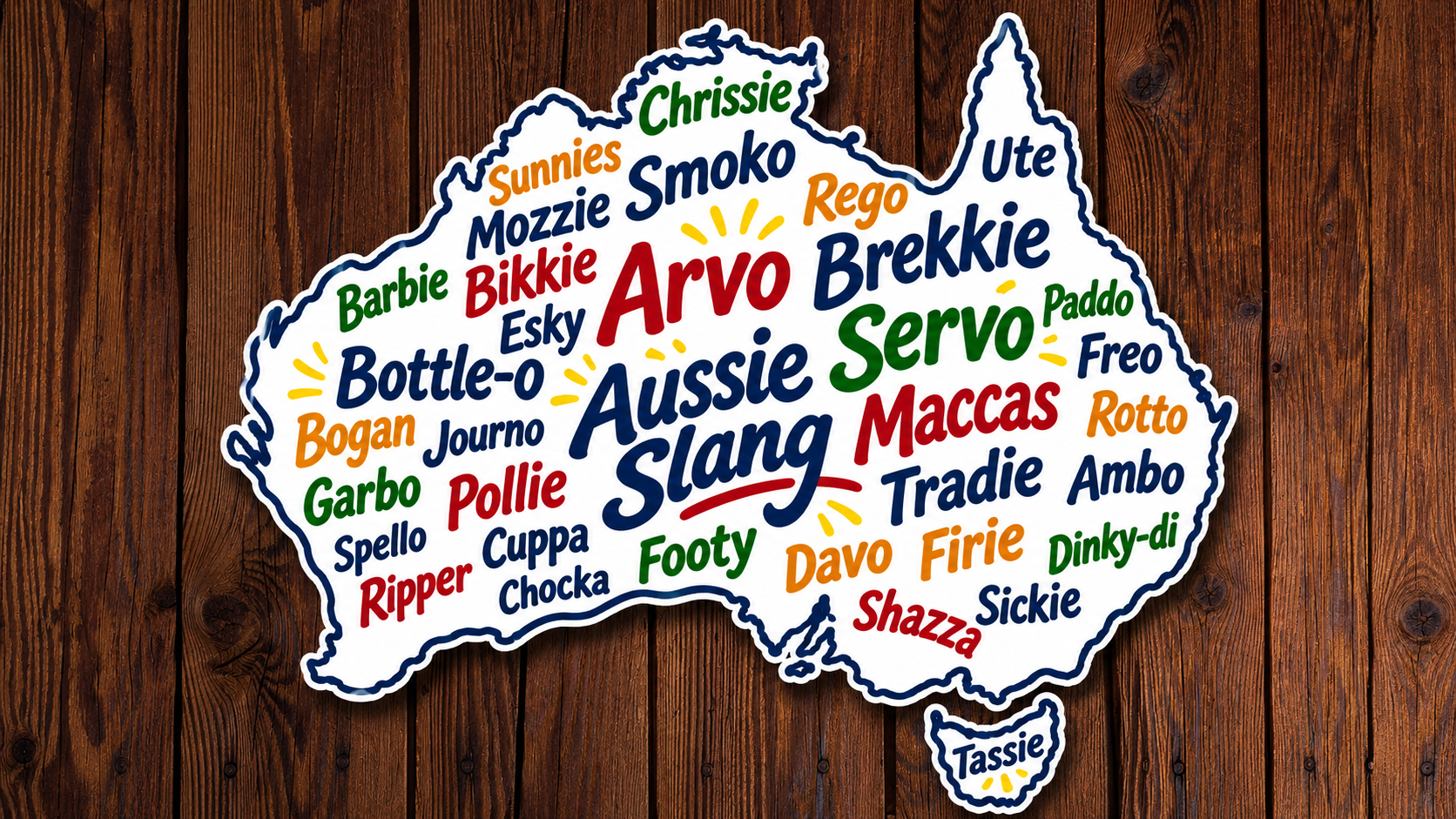
AUSTRALIA EXPLAINED
Even after eight years of live in the United States, I still have to translate Australian into English before opening my mouth.
Not because Americans don’t speak English. They do. Apparently, so do I. But if I tell someone I’ll see them this arvo, they’ll look at me as though I’ve just sneezed halfway through a sentence.
“Sorry, what?”
“This afternoon.”
“Oh.”
And there it is. Another successful international communication.
When I first moved to America, I constantly had to stop myself from saying things like brekkie, servo, bottle-o, tradie, firie, smoko and Maccas.
All perfectly normal words where I come from.
In Australia, you might grab some brekkie, stop at the servo, chat to a tradie having smoko, pick up Maccas in the arvo, then head to the bottle-o.
In America, that sounds less like a typical Saturday and more like someone suffering a stroke.
These days, I say gas station instead of servo. Brekkie has survived, though, and in my head, the Australian words are still there. I’ve just learned to replace them before they come out.
Which raises a question I’ve never really thought about until living overseas.
Why on earth do Australians shorten absolutely everything?
As it turns out, there’s a surprisingly long history behind it, some fascinating linguistic research, and a pretty good explanation for why we do it.
And no, it’s not simply because we’re lazy.
Although I wouldn’t entirely rule that out either.

Australians Have Been Doing This Since the 1800s
Believe it or not, Australians were chopping bits off words long before anyone had heard of Maccas.
The habit can be traced back to colonial Australia in the nineteenth century, when our uniqie version of English was beginning to take shape.
And some of the earliest recorded expressions are absolute beauties.
Take spell-o, for example.
I’d never heard this one before researching the article, but it was an early Australian call signalling that it was time to take a break from work.
A spell-o.
Eventually, another familiar expression, smoko, became more common.
Then there was schoolie, an early recorded Australian term for a schoolteacher.
And there were the occupational nicknames: milko for someone delivering milk, bottle-o for someone collecting bottles, and rabbito for someone selling rabbits.
Yes, rabbits.
In nineteenth-century Australia, rabbit sellers were a familiar sight in some cities, calling out to customers as they made their way through the streets.
And if you’re an Australian rugby league supporter, that last word might sound familiar.
The Rabbitohs Were Real People

South Sydney’s famous rugby league team, the Rabbitohs, takes its nickname from the rabbit sellers who once worked the streets of Sydney.
The vendors became known as rabbitohs, and the name eventually became associated with the football club.
So every time South Sydney runs onto the field, they’re carrying a little piece of nineteenth-century Australian street culture with them.
I knew the Rabbitohs as a football team, of course. What I hadn’t appreciated was how neatly their name fitted into this much older linguistic tradition.
It’s amazing that a street vendor’s nickname has survived into modern professional sport.
Although I reckon the original rabbit sellers would be surprised to learn what professional footballers earn these days.

We Didn’t Invent Shortening Words, But We Certainly Ran With It
Australians didn’t invent the idea of chopping up the English language.
British and Irish speakers were doing similar things long before European settlement in Australia.
The old street cries of British vendors sometimes ended with an extended “oh” sound, and linguists have suggested that Irish English may also have influenced Australia’s passion for the O ending.
But Australians took these inherited habits and turned them into something much more widespread.
Place names like Fremantle became Freo. Paddington became Paddo. Rottnest Island became Rotto.

An ambulance officer became an ambo. A journalist became a journo. A politician became a pollie.
And somewhere along the way, we decided Christmas was too much effort and started calling it Chrissie.
What makes Australian English distinctive isn’t simply that we shorten words.
It’s how extensively we do it, and how completely ordinary those shortened words have become.
An Australian asking where the nearest servo is isn’t deliberately using colourful slang.
He’s asking where the servo is.
That’s what it’s called.
And until you move overseas, you might never realise there’s anything unusual about it.
Linguists Have Actually Studied This
This is where things get interesting.
Apparently, Australia’s obsession with shortening words is sufficiently widespread that academics have devoted serious research to it.
There’s even a technical name for many of these expressions.
Hypocoristics.
Which is a fancy word for a linguistic habit based on making words shorter.
I’m surprised we haven’t shortened it to hypoccos.
In a 2011 study published in the academic journal Language Sciences, researchers Evan Kidd, Nenagh Kemp and Sara Quinn examined the use of these expressions among 115 Australian adults aged between 17 and 84.
Participants were asked to write down as many Australian shortened words as they could remember in ten minutes.
The researchers also discussed earlier linguistic collections, including one by Roland Sussex containing approximately 4,300 different Australian shortened or modified forms.

That’s not 4,300 words used by every Australian, and it doesn’t mean 4% of everything we say is abbreviated. It’s an estimate of the number of different word forms in the vocabulary collected by researchers.
Still, 4,300 is a huge number.
Imagine how much effort we have put in to avoiding effort.
The study also confirmed something important. These expressions aren’t simply the language of uneducated people or a particular social class.
They’re widely recognised and used across Australian society.
If you fancy testing just how much Australian slang you actually know, Australian Idioms – The Ultimate Guide to Aussie Phrases, Slang and Expressions is one place to start. I reckon most Australians would discover a few expressions they’d never heard before.
You can hear them in workplaces, on television, in politics and around the family dinner table.
And the researchers’ findings lead us to the most interesting question of all.
If we aren’t simply trying to save time by shortening these words, why are we doing it?
It’s Not Really About Saving Time
The strongest explanation is that we use these expressions to make language sound more informal, familiar and socially connected.
Linguists Kate Burridge and Howard Manns from Monash University have explored how Australian shortened words communicate familiarity and reinforce social bonds.
They also discuss the work of Australian National University linguist Anna Wierzbicka, who connected these expressions with Australia’s traditions of informality and social solidarity.
You can read their explanation in Brekkies, Barbies, Mozzies: Why Do Aussies Shorten So Many Words?.
And when you think about it, that makes sense.
Australians have traditionally had a fairly relaxed attitude towards formality.
We don’t really enjoy people putting on airs. We like things straightforward, and we tend to be almost suspicious of anyone who seems a bit too impressed with themselves.
Our language reflects some of that.
A journalist is a journo.
A politician is a pollie.
A firefighter is a firie.
It doesn’t mean we don’t respect these professions. It’s simply a more familiar way of talking about them.
There’s something rather Australian about giving a politician essentially the same linguistic treatment as the bloke who collects your rubbish.
And importantly, it’s not just about shortening a word.
It’s about making the word feel like it belongs in an everyday conversation.

Sometimes We Make Words Longer, Which Defeats the Entire Purpose
Of course, if shortening words were genuinely about efficiency, Australians would have some explaining to do.
Take nicknames.
David becomes Davo. John becomes Johno. Gary becomes Gazza. Sharon becomes Shazza.
We’ve taken perfectly serviceable names and added syllables.
Growing up in Australia, nicknames like these were everywhere.
I was Mick.
But during my school years, I also had another nickname.
Battered Sav.

My surname is Saville, and I played cricket.
Somewhere along the way, someone made the connection with a battered saveloy, and that was that.
Battered Sav.
Not exactly a flattering comparison, but I guess there are worse things to be named after than a deep-fried sausage.
These days in America, I’m Mike.
Maybe a tad boring by comparison.
Australian nicknames are often affectionate, sometimes ridiculous, and occasionally make absolutely no sense to anyone outside the group.
But that’s part of their appeal.
And the same thing happens with everyday words.
We don’t call a garbage collector a garbie. They’re a garbo.
A truck driver is a truckie, not a trucko.
A musician is a muso, not a musie.
There are patterns behind some of these endings, but linguists acknowledge that the choices can be complicated and inconsistent.
Apparently, even academics haven’t entirely worked out why we prefer one ending over another.
Which is comforting, because neither have the rest of us.

Americans Shorten Words Too, Just Not Quite Like Us
Now, before Americans start feeling too superior, you’re not entirely innocent either.
Americans say gym instead of gymnasium, fridge instead of refrigerator, and info instead of information.
You’ll hear words like vacay for vacation and veggies for vegetables.
So shortening words certainly isn’t uniquely Australian.
The difference is how extensively Australians use these particular O and IE endings, and how naturally they fit into everyday adult conversation.

In Australia, brekkie isn’t necessarily a cute word you’d use when talking to a small child.
It’s breakfast.
Maccas isn’t something you say ironically.
It’s McDonald’s.
And if someone says they’re stopping at the bottle-o on the way home, nobody needs to ask for clarification.
When I first arrived in America, this caused endless little moments of confusion.
I’d say something completely normal, get a blank stare, and then have to explain myself.
Eventually, I started catching the words before they came out.
Servo became gas station.
Arvo became afternoon.
But brekkie has managed to survive.
My two daughters are growing up American. They go to school here, their friends are American, and the language they hear every day is American English.
So they generally use the American expressions although funnily enough they do know what a chockie bikkie is.
Meanwhile, I’m still running a little Australian-to-American translation service inside my head.
It’s been eight years, and apparently the software hasn’t finished updating.
The Strange Thing That Happens When Two Australians Meet Overseas
Here’s something I’ve noticed living in America.
I can spend months carefully adjusting my vocabulary so everyone understands me.
Then I’ll meet another Australian.
Suddenly, the accent becomes broader, the words become shorter, and it’s like meeting a long-lost cousin.
All those expressions I’ve been quietly replacing come straight back.
The servo is a servo again.
The arvo is an arvo.
And I don’t have to stop halfway through a sentence to explain what I mean.
Neither of us is consciously doing it.
It just happens.
If you’re an American trying to get your head around Australian English, Aussie Lingo: Australian Expressions is a handy little guide to the words and phrases you’re likely to encounter Down Under.
Linguists describe the broader process of adjusting how we speak in different social settings as style-shifting.
But there’s something else happening too.
Those familiar Australian words create an immediate sense of belonging.
We might be thousands of miles from home, but suddenly we’re speaking the same language again.
Quite literally.
And maybe that’s the real reason these expressions have lasted so long.
They’re not just shortcuts.
They’re little signals that tell another Australian we’re from the same place, understand the same references and share something familiar.
Even if we’ve never met before.
Is Australian Slang Slowly Disappearing?
This is one part of the story I find particularly interesting.
When I returned to Australia last year, I noticed how much the country had changed since we left in 2018.
The population, the shops, the people working in them, and the general atmosphere in some places felt different from what I remembered.
Of course, countries change. They always have.
And language changes with them.
But I would hate to see this particular part of Australian culture disappear.
Fortunately, the research suggests the picture is more complicated than simply saying younger Australians are abandoning traditional slang.
The 2011 study found some differences between generations in the types of shortened words participants recalled.
And Burridge and Manns have noted that while some older expressions fade, Australians continue inventing new ones.
The IE ending in particular remains common.
So while individual words might disappear, the habit itself appears to be remarkably resilient.
There’s also an Australian word that has become an international success story.
Selfie.
Yes, the word that now appears on millions of phones around the world has Australian origins.
It became so widely recognised that Oxford Dictionaries selected it as its Word of the Year in 2013.
After generations of Australians chopping up the English language, we finally managed to export one of our creations to the rest of the planet.
And everyone started using it.
Not bad for a country that apparently can’t be bothered finishing its words.

So Why Do Australians Really Shorten Every Word?
After looking at the history and the research, I think the answer is fairly simple.
We inherited some linguistic habits from Britain and Ireland, developed our own versions during the nineteenth century, and spent the following century turning them into a distinctive feature of Australian English.
But the reason they’ve lasted isn’t simply convenience.
It’s because they fit the way Australians have traditionally liked to communicate.
Informally, familiarly, and without making too much of a fuss.
These expressions make everyday conversation feel relaxed. They help establish familiarity. And they give Australian English a character that is recognisably our own.
Growing up, I never gave any of this a second thought.
Brekkie was brekkie. The servo was the servo. A chockie bikkie was delicious and yes, I’ll have two thanks Mum.
It took moving to America to realise just how unusual our language could sound to everyone else.
And while I’ve learned to adjust the way I speak, I haven’t stopped thinking in Australian.
The words are still there.
They always will be.
So if you’re American and you think words like arvo, brekkie and servo sound a bit ridiculous, that’s perfectly fine.
I’d probably laugh and agree with you.
Then I’d tell you the truth.
You’re just jealous you don’t have a secret code.
I’m an Australian who’s been living in Tennessee since 2018, trying to explain the differences between two countries that supposedly speak the same language. You can find more stories about Australian culture and life in America at From Down Under to Down South.
If you enjoy these stories about Australian language, culture, and the little things that make us who we are, you can support From Down Under to Down South through Buy Me a Coffee . Every bit of support helps keep the stories coming.
This article contains affiliate links. If you purchase through them, I may earn a small commission at no additional cost to you.