AUSTRALIAN EYES ON AMERICA
When I was in Year 5 at Bomaderry Primary School, on the south coast of New South Wales, Australia, I had a problem.
Someone kept stealing my lunch.
His name isn’t important. But he lived around the corner from me, and back then, his greatest sporting achievement, as far as I was concerned, was the speed at which he could make my sandwiches disappear.
Every morning, Mum would pack my lunch. I’d put it in my schoolbag, and at some point the sandwich thief would help himself.
Eventually, Mum had enough.
One morning, she made me a special sandwich. It contained meat, mustard, chilli, cayenne pepper, and just about every other hot ingredient she could find in the kitchen.
I don’t know exactly what went into it, but I’m fairly certain it would have breached several international treaties.
I took it to school, left it in my bag, and waited.
He took the bait.
Apparently, the sandwich was so hot that he spent much of the afternoon trying to wash the taste out of his mouth. He even got into trouble for not returning to class.
But it worked. He never stole my lunch again.
We actually ended up becoming mates for a while. We played on the same cricket team, which my dad coached, and my father would often pick him up and drive us both to matches.
He eventually went on to represent Australia in both rugby league and rugby union.
I like to think Mum’s sandwich played a small part in his sporting success.
Perhaps it improved his speed. Perhaps it developed his endurance. Or perhaps, after surviving that sandwich, running into a 110-kilogram forward didn’t seem particularly frightening.
Either way, that’s my strongest memory of Australian school lunches. Now, decades later, I’m raising two daughters in America, where school lunch is an entirely different operation.
The Great Australian School Lunchbox
Growing up in Australia, school lunch was fairly straightforward.
Your mum made it, you took it to school, and you ate it.
My lunches were pretty typical of an Australian kid growing up in the seventies and eighties.
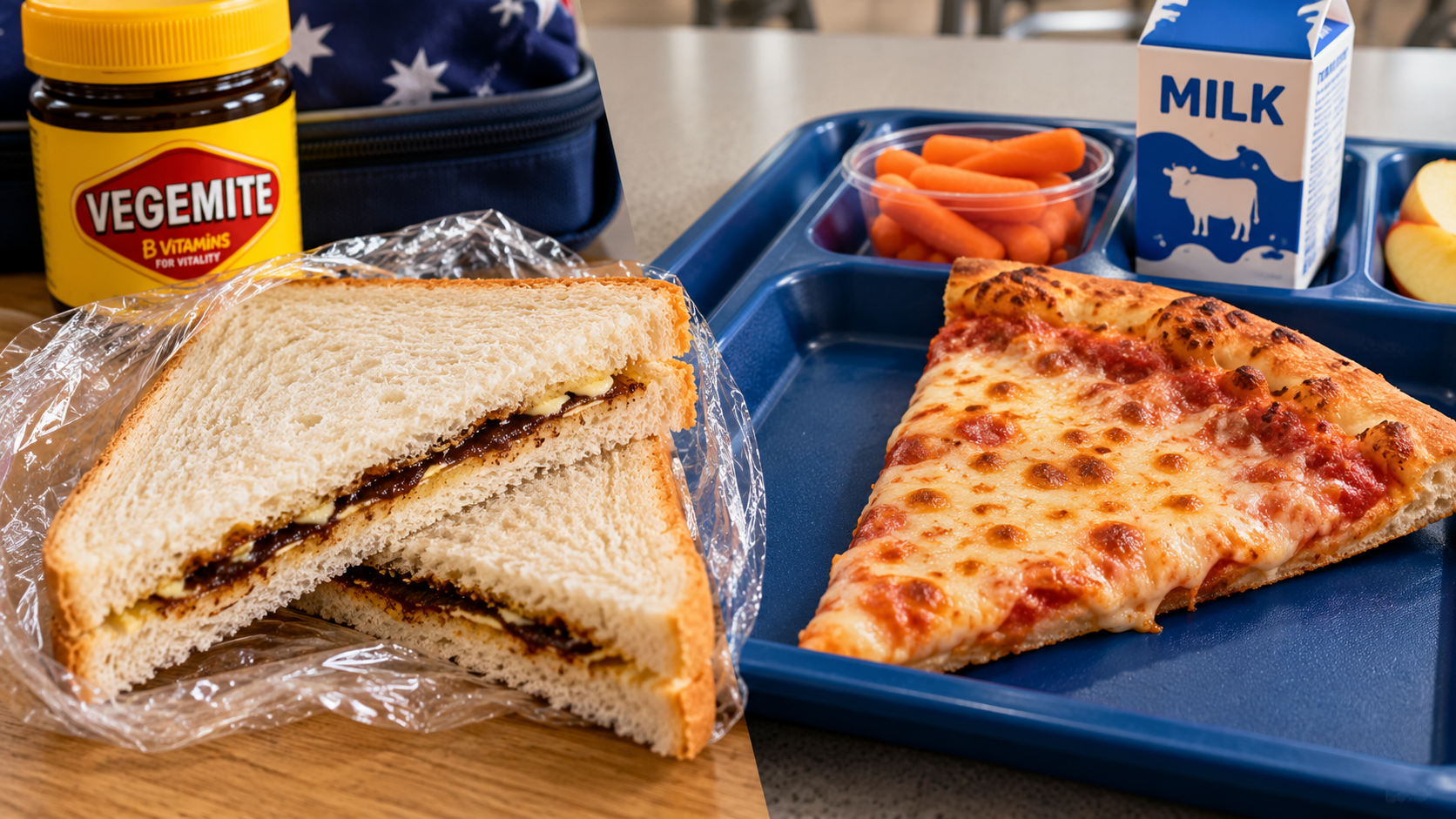
Vegemite and cheese sandwiches were a regular feature.
So were Devon and tomato sauce sanggas.

For Americans unfamiliar with Devon, it’s a processed luncheon meat, somewhat similar to bologna. We sliced it, put it between two pieces of bread, added tomato sauce, and considered the job done.
By tomato sauce, I mean what Americans call ketchup. Not the stuff you pour over pasta.
Ham and salad sandwiches were another favourite, complete with beetroot.
Yes, beetroot.
Australians put beetroot on sandwiches and hamburgers without giving it a second thought. I’m still not entirely sure why Americans find that so alarming.
There were egg sandwiches too, which were perfectly good when Mum made them, although after several hours sitting in a schoolbag on a hot Australian day, they could develop a personality of their own.
Sometimes, if we’d had roast chicken the night before, Mum would wrap up a leftover chicken wing or drumstick for my lunch.
No fancy container. Just a piece of chicken wrapped in Gladwrap from last night’s dinner.
Food safety wasn’t something we discussed much in those days.
If you opened your lunchbox and nothing tried to climb out, you were probably fine.
What Was Actually in My Lunchbox?
For snacks, I remember little packets of Ovaltinies, those chocolate malt tablets that were supposed to be a somewhat respectable snack but tasted suspiciously like sweets.
There were sultanas too.
Americans call them raisins, although the fruit terminology isn’t always an exact match.
And if you were particularly lucky, there might be something sweet tucked away.
Australian research suggests that around 90 percent of schoolchildren bring food from home, so the humble lunchbox remains a big part of school life. Although I suspect today’s parents are a little more concerned about refrigeration than ours were.
The School Canteen: Australia’s Answer to Fine Dining
Of course, we didn’t always have to eat whatever Mum had packed.
We had the school canteen.
And the canteen was a magnificent institution.
At my school, it was staffed by mums from the school community. I think they were volunteers, although I can’t say for certain.
What I do remember is the ordering system.
You wrote your lunch order on a paper bag, put the money inside, and handed it in.
That was it.
No apps or online accounts. No passwords to reset because you’d forgotten which email address you’d used to register for a meat pie.
Just a brown paper bag with some money rattling around inside.
And the food!

Meat pies, sausage rolls, cream buns, chocolate éclairs, vanilla slices.
Basically, everything you’d find in a decent Australian bakery.
If you were an American nutritionist visiting an Australian school canteen in those days, you’d probably have needed a lie-down.
I remember buying canteen food more often in high school than primary school, but getting a lunch order was always a bit of a treat.
There’s something special about sitting down with a hot meat pie while your mates are unwrapping Vegemite sandwiches.
Australian school canteens have changed quite a bit since then. Many now offer online ordering, and healthier food policies have influenced what’s available.
But the basic idea is much the same.
The canteen is still there when you fancy something different from whatever’s in your lunchbox. In America, though, school lunch has become a much bigger operation.
Welcome to the American School Cafeteria
When my daughters started school here in Tennessee, one of the things I noticed was the cafeteria.
A big room full of tables where children sit down to eat lunch.
Inside.
That might not sound particularly remarkable to Americans, but growing up in Australia, we always ate outside.
We’d sit at tables, eat our lunch, and then head off to the playing fields.
There was no great ceremony involved.
You ate your sandwich and got on with the important business of being a kid.
In America, the cafeteria is a proper operation.
At my daughters’ school, there’s a serving area with different foods available.

Hot dogs, chicken tenders, pizza, and plenty of other things that are unmistakably American.
And it’s not just our school.
According to preliminary US Department of Agriculture figures, the National School Lunch Program served around 4.9 billion lunches during the 2025 fiscal year, reaching roughly 30 million children on an average school day.
That’s more than the entire population of Australia!
American school lunches are part of a federally supported program, with nutritional standards and free or reduced-price meals available to eligible children. Some schools even provide free meals to every student.
It’s one of those differences that has made me realise how much school shapes American life beyond the classroom
Australia doesn’t have an equivalent nationwide system of school-provided lunches. So while Australian parents are packing Vegemite sandwiches and leftover chicken legs, American schools are running what amounts to a substantial daily catering operation.
Lunch at 10:30 in the Morning?
Here’s something else that surprised me about American schools.
The lunchtime schedule.
My daughters start school at 7:30 in the morning and finish at 2:30 in the afternoon.
Because the school can’t possibly fit every student into the cafeteria at once, different grades eat at different times.
Fair enough.
But some of those lunch periods start at around 10:30 in the morning.
Ten thirty! I’d still be digesting my Weet-Bix.
That’s not lunchtime. That’s barely past breakfast.
When I was growing up, 10:30 was about the time you might be having something for recess.
Not sitting down to a full cooked lunch.
I can just imagine being offered a full American school lunch at that hour when I was ten years old.
Now, obviously, schools have to work around timetables, and not every American school has lunch that early.
But it still strikes me as a very American solution to a logistical problem.
If you can’t fit everyone into the cafeteria at lunchtime, simply start lunchtime before lunch. Problem solved.
Whatever Happened to Playing Outside?
The other big difference I remember is what happened after we finished eating.
Cricket, soccer, footy, whatever we felt like playing.
We didn’t have particularly fancy equipment. We made our own entertainment.
Sometimes we’d play marbles.
Sometimes we’d play imaginary war games.
And sometimes we’d collect cicadas.
Yes, cicadas.
Not just collect them, mind you. We’d trade them.
Greengrocers, Blue Moons, Black Princes. Different varieties had different levels of desirability in the playground economy.

I have no idea what the exchange rate was between a Greengrocer and a Black Prince, but I’m fairly certain someone was getting ripped off.
You could spend an entire lunchtime negotiating a cicada trade and still have time for a game of cricket.
At my daughters’ American school, lunch is much more structured.
They eat inside the cafeteria, and the children have designated seating.
I can actually see a benefit to that. Having assigned places may help prevent children from being left sitting alone, although I don’t know whether that’s why the school does it.
The girls still have recess and a playground, although their snack breaks sometimes happen indoors.
It’s just a different arrangement from the one I remember.
Of course, childhood has changed in other ways too. I’ve written about how much of our family life now revolves around children’s activities
With lunch periods lasting around half an hour at the girls’ school, there’s not much opportunity to finish your sandwich and disappear onto the cricket pitch.
The US Centers for Disease Control and Prevention recommends that students have at least 20 minutes actually seated and eating lunch, excluding time spent collecting their food.
Twenty minutes would barely have been enough time for us to agree on the rules of a cricket match.
Having Lunch With Your Kids at an American School
One thing I do enjoy about the American system is that parents can sometimes visit their children for lunch.
I’ve done it a few times with both Georgia and Brianna, although never together.
Because, naturally, they have lunch at different times.
At their school, three families are allowed to visit during each lunch period.
You sign in, head to a designated table in the hallway, and wait for your child to arrive.
It’s all very organised.
When I was at school in Australia, I don’t remember parents turning up to have lunch with their children. Certainly not as part of a formal booking arrangement.
But here, it’s a nice opportunity to spend a bit of time with the girls during their school day.
There’s just one catch.
Whenever I go, the girls usually want me to bring Chick-fil-A.
Apparently, having Dad visit is lovely, but having Dad visit carrying a bag of chicken nuggets is considerably better.
So there I am, sitting at a table in a school hallway, eating Chick-fil-A with one of my daughters while the cafeteria serves lunch just around the corner.
The Vegemite Sandwich Lives On
Now, here’s the part I find particularly amusing.
Despite growing up in America, with access to a school cafeteria offering all sorts of lunchtime options, Georgia rarely eats the school lunch.
She doesn’t particularly like what’s on offer.
Instead, Nikki packs her lunch.
And what does Georgia take to school most days?
Vegemite sandwiches.
Of course she does.
I grew up in Bomaderry eating Vegemite sandwiches, and now my daughter is sitting in an American school cafeteria in Tennessee eating pretty much the same thing.
We’ve moved halfway around the world, changed countries, changed school systems, and gained an entirely new selection of lunchtime food.
And we’re still making Vegemite sanggas.
It’s a small reminder of something I’ve written about before: moving to America doesn’t mean leaving everything Australian behind

I recently asked Georgia whether any of the other children ever wanted to trade lunches with her.
She looked at me and explained that they don’t do that.
Apparently, lunch swapping isn’t part of her school experience.
Which did make me laugh.
When I was her age, I couldn’t stop someone from stealing my sandwiches.
Georgia can’t even find someone who wants to trade for hers.
Perhaps Vegemite is a more effective security system than my mum’s chilli sandwich ever was.
Although I suspect a certain former Australian rugby international would disagree.
Different Countries, Same Lunchtime Problems
After experiencing school lunches in both Australia and America, I can certainly appreciate the differences.
I loved those Australian school lunchtimes, particularly the freedom to head outside and play cricket or trade cicadas.
But I also enjoy being able to visit my girls at school and have lunch with them.
Even if it costs me a trip to Chick-fil-A.
Despite all the differences, the humble sandwich has somehow survived.
My mum made mine in Australia.
Nikki makes the girls’ lunches here in America.
Georgia still takes Vegemite sandwiches to school.
The only major improvement is that nobody seems particularly interested in stealing them.
As for that sandwich thief from my primary school days, I’d like to think the years of cricket training helped his sporting career.
But personally, I reckon Mum deserves at least some of the credit. After all, she was the one who taught him how to run for water.
If you enjoy these stories about Australian language, culture, and the little things that make us who we are, you can support From Down Under to Down South through Buy Me a Coffee . Every bit of support helps keep the stories coming.