AUSTRALIA EXPLAINED
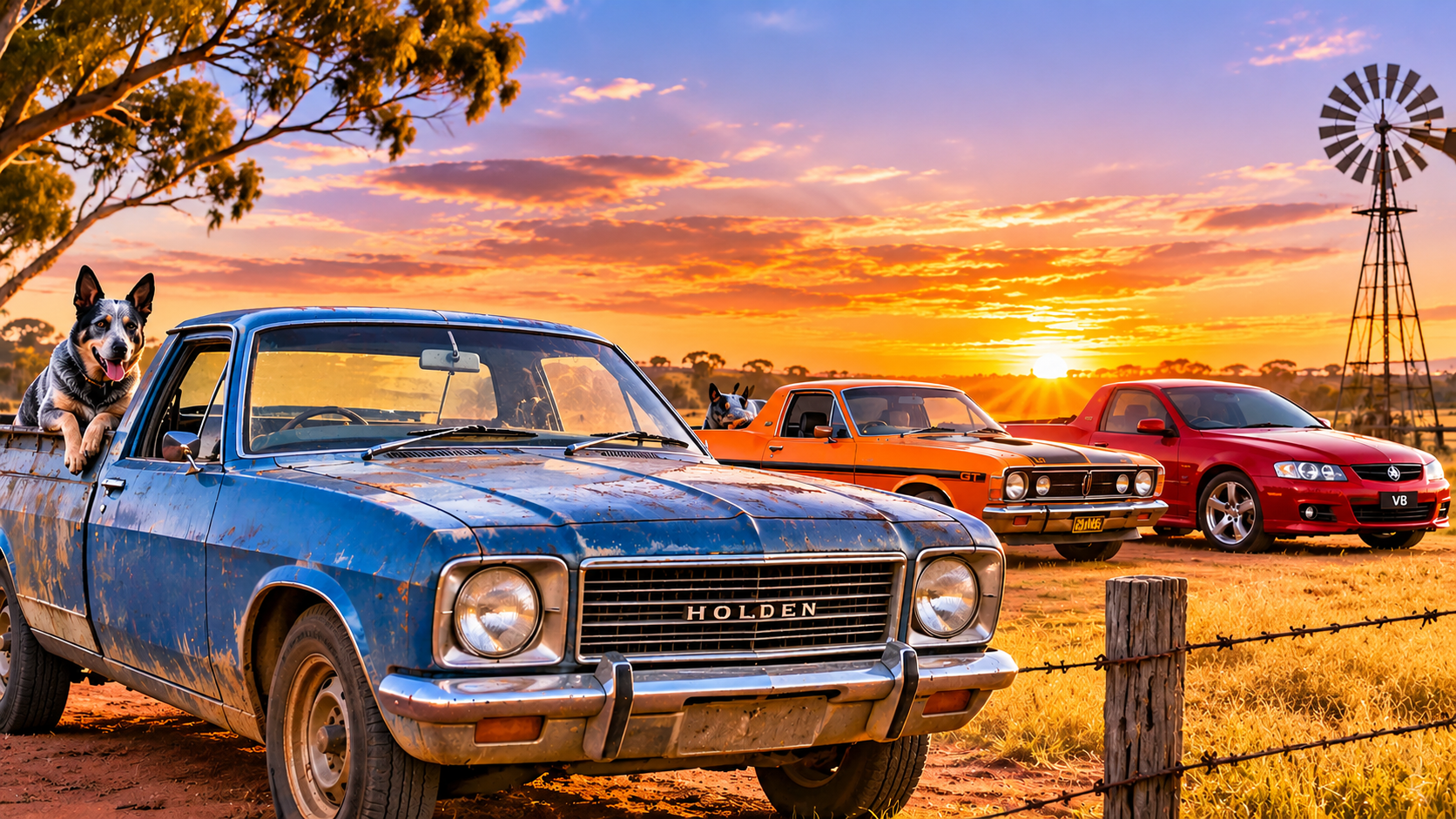
If you’ve ever wondered what Australians mean when they talk about a ute, let me introduce you to an old blue Holden that nearly gave me arms like Popeye.
It belongs to my father-in-law, although it was also my wife Nikki’s first car.
She learned to drive in it, took it to university, and was still driving it when I first met her.
It’s a 1976 Holden HJ ute with a bench seat, an automatic column shift on the steering wheel, and absolutely no power steering.

Turning that thing at low speed was less like driving a car and more like wrestling a stubborn cow.
I drove it plenty of times, including trips to the rubbish tip with Al. It wasn’t glamorous, but that was the beauty of it.
You could throw rubbish in the back, head off to the tip, and then drive home feeling like you’d accomplished something.
These days, that same old Holden is worth a fair bit of money as a classic.
Not bad for a vehicle that once spent its weekends hauling rubbish and drunk uni kids back to their dorms.
But that old Holden represents something much bigger than a practical way of getting rid of household junk.
It represents a uniquely Australian motoring culture.
So, What Exactly Is a Ute?
The word ute is short for utility vehicle.
In Australia, it’s the everyday name for a vehicle with a passenger cabin at the front and an open cargo area at the back.
Americans would generally call something similar a pickup truck.
But there’s an important difference.
When I think of a traditional Australian ute, I don’t picture an enormous Ford F-150 or a RAM that requires a small expedition to climb aboard.

I picture a Ford XB Falcon.
Long bonnet. Two doors. A relatively low body. A tub at the back.
Essentially, a regular Australian car that decided it needed to carry a lawnmower.
The Holden Commodore ute was another iconic example, and for decades, Holden and Ford produced vehicles that were as recognisably Australian as a meat pie at the footy.
Australians also call modern Toyota HiLuxes, Ford Rangers and other dual cab vehicles utes.
The term covers a large range of vehicles these days.
But for me, the classic Falcon and Commodore will always be the first things that come to mind.

Did Australia Invent the Ute?
Australians have a long history with the ute, and there’s a famous story behind its development.
In 1934, Ford Australia introduced a coupe utility designed by Lewis Bandt.
According to the well-known story, the idea came after a farmer’s wife requested a vehicle that could take the family to church on Sunday and carry pigs to market on Monday.
Whether every detail of that story is accurate has been debated, but the resulting vehicle became an important milestone in Australian motoring.
The concept was beautifully simple.
Why own a car and a truck when one vehicle could do both jobs?
Australia didn’t invent every form of pickup truck. Americans had been building light trucks and pickup-style vehicles well before 1934.
But the Australian coupe utility helped establish a certain kind of car-based work vehicle that became part of our national identity.
And we embraced it enthusiastically.

The Australian Ute Was Built to Work
Growing up in Australia, I associated utes with farmers and tradies.
A tradie, for my American readers, is a tradesperson. Builders, plumbers, electricians, carpenters and anyone else who spends their working day doing something more useful than sitting in an office discussing spreadsheets.
The ute was their mobile workshop.
Tools in the back. Building materials. Ladders. Equipment. Whatever needed transporting.

Later, when I lived in Griffith and Wagga Wagga in regional New South Wales, I saw plenty of working utes.
Hay bales, motorbikes, tools, rubbish, building materials and even sheep.
You name it, someone had probably tried to fit it in the back of a ute.
And, of course, dogs.
Particularly blue heelers.
There’s something very Australian about a dusty ute with a blue heeler sitting in the back, looking as though he’s the one who actually owns the vehicle.
Many farmers preferred the larger Toyota LandCruisers, particularly the trayback models with fold-down sides.
Those flat trays made loading and unloading hay much easier.
Rather than climbing into the back and dragging everything over the tailgate, you could simply drop the side and get on with the job.
Australians might distinguish between a ute with a traditional tub and a flat trayback, but they’re both still utes.
Nobody was standing around debating the terminology.
There was work to be done.

Then There Were the V8 Utes
Now, this is where the story gets interesting.
Because somewhere along the way, Australians decided that a practical work vehicle also needed enough horsepower to frighten the neighbours.
Enter the Holden Commodore and Ford Falcon performance utes.
These weren’t just vehicles for carrying bags of cement.

Some came with powerful V8 engines, sports suspension, aggressive styling and exhaust notes that could announce your arrival several suburbs away.
They were Australian muscle cars with somewhere to put your esky.
An esky, incidentally, is what Australians call a cooler.
When I was younger, I remember seeing hotted-up Commodore utes doing laps of the main street in Nowra, New South Wales.
Round and round they’d go.
Occasionally, two drivers would line up at the traffic lights and decide that the best way to settle an argument was to see who could get to the next set of lights first.
Just a part of the local car culture.
Loud exhausts, shiny wheels, powerful engines and young blokes who had apparently decided that petrol was a perfectly reasonable way to dispose of their weekly wages.
The ute had become more than a work vehicle.
It was a statement.

Pub Stickers, Bundy Rum and Country Ute Culture
If you spent much time in regional Australia, particularly during the 1980s, 1990s and 2000s, you’d have seen another distinctly Australian phenomenon.
The ute covered in stickers.
Not just one or two.
Dozens.

Pub stickers, Bundaberg Rum stickers, country town stickers and various other declarations of where the driver had been, what he drank and occasionally what he thought about the world.
Living in the Riverina, I saw plenty of them.
The Conargo Pub sticker was popular around that part of New South Wales.
You’d see it alongside Bundy stickers and all sorts of other memorabilia plastered across the back windows and bodywork.
It was almost like a travelling scrapbook.
Except instead of photographs of your holiday, you advertised which country pubs you’d visited.
This culture wasn’t limited to the country, but it was much more prominent in regional Australia.
And it was closely connected to another Australian institution.
The B&S ball.
B&S Balls: When the Ute Becomes a Bedroom
A B&S ball stands for Bachelor and Spinster Ball.
Despite the old-fashioned name, these are traditionally large social gatherings for young people in rural Australia.
People travel long distances to attend, often arriving in their utes.

There’s music, dancing, drinking, socialising and, depending on the crowd, a fair amount of behaviour that probably wasn’t discussed with Mum and Dad the following morning.
Sleeping arrangements are pretty simple.
Throw a swag in the back of the ute.
A swag is a traditional Australian portable bedroll, often with a mattress and weatherproof covering.
If you fancy experiencing a proper Aussie camping tradition, the 23ZERO Bandit Canvas Swag is a modern take on the classic swag, giving you a comfortable place to sleep without the fuss of a full-sized tent.
Think of it as camping without the inconvenience of having to assemble a tent.
Whether you actually get much sleep depends on how the evening unfolds and whether you manage to make a new friend.
The ute is not just transport.
It’s your accommodation for the weekend.
Possibly shared accommodation.
The Deniliquin Ute Muster
If you want to understand how deeply utes became embedded in Australian culture, look no further than the Deniliquin Ute Muster.
Held in Deniliquin, New South Wales, this event celebrates utes, country music and Australian rural life.

Thousands of people gather for a weekend of entertainment, competitions, camping and, naturally, an extraordinary number of utes.
And it makes perfect sense.
Where else would Australians turn a practical vehicle into the centrepiece of an entire festival?
Then again, this is a country that holds competitions for throwing gumboots, racing lawnmowers and seeing who can eat the most pies.
Celebrating a ute seems positively restrained.

Summernats: The Other Side of Ute Culture
Country utes aren’t the whole story.
Australia also has a thriving modified car culture, and one of its biggest celebrations is Summernats in Canberra.
I lived in Canberra for about fifteen years and saw the Summernats plenty of times.
The event attracts enthusiasts from across Australia, bringing heavily modified vehicles, custom paintwork, powerful engines and some truly extraordinary automotive creations.

Plenty of hotted-up utes are part of that scene.
Summernats is famous for its burnout competitions, where drivers deliberately spin their tyres until enormous clouds of smoke fill the air.
It’s a spectacular way to turn perfectly good rubber into something resembling a bushfire.
And the ute fits right in.
It could be a farm vehicle during the week and a fire-breathing V8 monster on the weekend.
Only in Australia would we look at a vehicle designed to carry hay and decide it needs more horsepower.
Didn’t America Have Utes Too?
Yes!
And this is something Americans have pointed out to me.
The United States had vehicles that were very similar to traditional Australian utes.

The Chevrolet El Camino and Ford Ranchero are probably the best-known examples.
Both combined passenger-car styling with an open cargo bed, creating vehicles that sat somewhere between a car and a pickup.
The El Camino was produced in several generations between 1959 and 1987, while the Ranchero ran from 1957 to 1979.
They shared much of the same appeal as Australia’s Falcon and Commodore utes.
Practical enough to carry things, but with the styling and driving characteristics of a car.
American enthusiasts still appreciate them, and I’ve found that quite a few Americans know about Australian performance utes too.
Particularly the V8 versions.
Mention a Holden ute with a big V8 engine and suddenly you’ve got someone’s attention.
It’s a pity that Australia no longer makes them, because there’s clearly an audience for that sort of vehicle.

Why Are American Pickup Trucks So Enormous?
When I first moved to America, one of the things that struck me was the sheer size of the pickup trucks.
Some of them look as though you need a stepladder to climb into the driver’s seat.
Ford F-150s, Chevrolet Silverados and RAM pickups are everywhere, particularly here in Tennessee.
And they’re not necessarily being used for farming or construction.
Plenty are everyday family vehicles.
I owned a Ford F-150 for a few years.
At the time, I was renovating a house, and having that enormous cargo bed was genuinely useful.
I could load it with building materials, tools and whatever else the renovation required.
So I certainly understand the appeal.
Eventually, though, I sold it and bought a Jeep Wrangler.
The Wrangler is much more me.

And although some Americans might describe an F-150 as a ute, I don’t.
To me, it’s a truck.
A traditional Australian Falcon or Commodore is a ute.
There’s a difference, even if the terminology overlaps.
Interestingly, American fuel economy regulations have also played a role in shaping vehicle design.
Under the footprint-based fuel economy system, larger light trucks can face less demanding efficiency targets than smaller ones.
I’ve even had Americans tell me that Barack Obama changed the rules and effectively forced manufacturers to make bigger pickups.
That’s not quite accurate.
The footprint-based approach began before Obama’s presidency, and there was no requirement that pickups had to become larger.
But the regulations have created incentives that can favour larger vehicles, alongside consumer preferences and other market forces.
Whatever the reasons, American pickups have certainly become enormous compared with the old Australian car-based ute.
What Happened to the Australian Holden and Ford Utes?
Unfortunately, the traditional Australian-built ute is now part of motoring history.
Ford ended Australian vehicle manufacturing in 2016, including production of the Falcon ute.
Holden followed in 2017, closing its Australian manufacturing operations and ending local production of the Commodore ute.
For me, that’s a genuine shame.
And not simply because I liked the vehicles.
Holden and Ford were enormously important parts of Australian culture.
The rivalry between the two brands was legendary.

Bathurst, Peter Brock, the V8 engines, the family sedans, the performance cars and the utes.
I followed Peter Brock, although I’ve always been more of a Formula One fan than a dedicated Holden or Ford supporter.
Still, those brands represented something important.
Australia made its own cars.
Vehicles designed for Australian conditions, Australian roads and Australian lifestyles.
Today, modern dual cab utes such as the Ford Ranger and Toyota HiLux remain hugely popular in Australia.
They’re practical, capable and perfectly suited to many of the jobs Australians need them to do.
But something has been lost.
Not necessarily because the modern vehicles are worse.
It’s because they’re no longer part of a thriving Australian car manufacturing industry.
If Holden announced tomorrow that it was bringing back the classic Commodore ute, I’d be delighted.
But what would excite me most wouldn’t be the V8 engine or the styling.
It would be knowing that it was being built in Australia.
That’s what I miss.
More Than Just a Pickup Truck
When Americans ask me what a ute is, the easy answer is that it’s the Australian version of a pickup truck.
And technically, that’s a reasonable place to start.
But it doesn’t really tell the whole story.
A ute could be a farmer’s workhorse, carrying hay and a blue heeler across a dusty paddock.
It could be a tradie’s mobile workshop.
A hotted-up Commodore doing laps of Nowra on a Saturday night.
It could be covered in Conargo Pub and Bundy stickers, parked at a B&S ball with a swag rolled out in the back.
Or it could be an immaculate V8 show car rolling through Canberra during Summernats.
For me, though, the ute I’ll always remember is that old blue Holden.
The one Nikki learned to drive in and took to university.
The one I drove to the tip with her dad, wrestling with the steering wheel every time I needed to turn a corner.
While the traditional Australian ute might have started life as a practical way of carrying things, somewhere along the road it became something much more.
A little piece of Australia on four wheels.

I’m an Australian who’s been living in Tennessee since 2018, trying to explain the differences between two countries that supposedly speak the same language. You can find more stories about Australian culture and life in America at From Down Under to Down South.
If you enjoy these stories about Australian language, culture, and the little things that make us who we are, you can support From Down Under to Down South through Buy Me a Coffee . Every bit of support helps keep the stories coming.
This article contains affiliate links. If you purchase through them, I may earn a small commission at no additional cost to you.