THIS WEEK IN AMERICA
I recently discovered that I have failed to join the dance dads.
Apparently there is a group.
There may be a committee.
There could be membership requirements.
I wouldn’t know.
Nobody sent me the paperwork.
My daughter Georgia has been dancing at the same studio for six years now, including four years on the competition team.
I know most of the teachers. I know many of the parents. I know the kids. I know which competition venues have decent coffee, which ones have terrible parking and roughly how many rhinestones can fall off a costume before somebody declares an emergency.
But somehow, after all these years, I remain an independent contractor. A freelance dance dad.
I should have noticed the dance dads years ago
The evidence was there from the beginning.
At competitions, a group of dads would help build the sets. They’d carry everything onto the stage, assemble whatever needed assembling and then, when the job was done, take a little bow before running offstage to applause.
It was like a very specialised Broadway production where nobody actually danced.
I was never asked to join them.
I wasn’t offended.
At first I didn’t think much about it.
But over the years, I started noticing the same dads together elsewhere.
At practices, they’d stand around talking in a circle.
At competitions, they’d sit together.
Sometimes they’d go out for dinner afterwards.
There was clearly a social structure here that I had somehow missed.
The dance mums had their groups too, of course. I’d noticed those.
I just assumed the dads operated differently.
Turn up.
Find somewhere to sit.
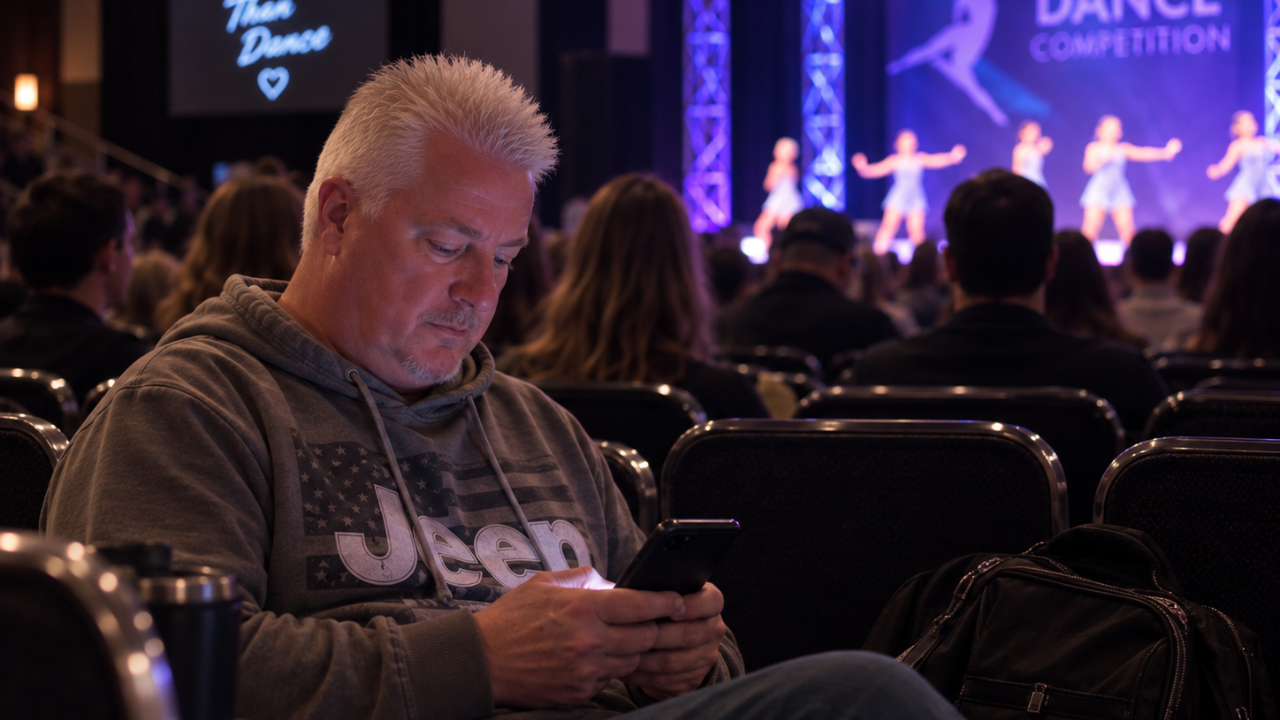
Look at phone.
Move costume bag when instructed.
Ask when we’re leaving. Apparently I had underestimated the complexity of dance fatherhood.

Then one of the dads confirmed my suspicions
Recently, I was standing outside the studio waiting for Georgia.
One of the dance dads walked out.
I’ve known him for several years. Not well, but certainly well enough that we’re not strangers.
He looked straight at me.
I said hello and asked how he was.
I got a quick good, how are you?
Then he proceeded to enthusiastically talk to seemingly everyone else within a fifty metre radius.
People walking past.
Other parents.
People sitting in their cars.
Had somebody driven past slowly enough, I suspect he would have leaned through the passenger window.
It was like watching a politician work a rope line.
And I stood there thinking:
Well.
Nice catching up.
To be fair, perhaps I’m being unfair.
Because there is another possibility I have been forced to consider. Maybe they think I’m the snob.
This is where my argument begins to fall apart
I don’t approach groups.
Ever.
If I walk into the dance studio and six dads are standing in a closed circle talking, there is absolutely no chance I am walking over and inserting myself into the middle.
None.
They could be discussing how to divide a winning Powerball ticket and I’d probably stand twenty feet away looking at my phone.
Part of it is probably shyness.
I’m much better one on one than I am in groups, particularly with people I don’t know well.
Part of it may simply be habit.
And part of it is that I often walk into the studio without my glasses and can’t actually tell who anybody is.
It’s difficult to confidently greet someone when there’s a reasonable possibility you’re about to introduce yourself to a coat rack.
So I sit down.
I pull out my phone.
I answer emails.
I work on the website.
I check YouTube.
I watch Georgia or Brianna through the window.
From my perspective, I’m giving everyone else their space.
- Somewhere along the way I’ve also learned that a portable phone charger is less an accessory at a dance competition and more emergency equipment. These things can run all day.
From their perspective, perhaps there’s an Australian bloke sitting in the corner staring at his phone who never comes over and talks to anyone. This investigation is becoming increasingly inconvenient.
I don’t actually dislike talking to people
That’s the strange part.
If one of the dads comes over and talks to me, I’m perfectly happy.
It has happened occasionally.
At Nationals over the summer, I ended up having a great conversation with another dad about soccer and the World Cup.
He’d had a couple of drinks, which may have assisted international diplomacy.
But it was easy.
Natural.
Two dads talking about football.
- I first mentioned my discovery of the dance dad clique on This Week in America. You can hear the full episode here on Spotify
I’ve had similar conversations with other parents over the years.
The confusing part comes afterwards.
Sometimes you’ll have a really good one on one conversation with somebody. You think you’ve finally broken through that awkward stage.
Then the next time you see them, they’re back with their usual group and it’s as though the conversation never happened.
Hello again, coat rack.
That’s when the whole thing can start to feel slightly performative.
Warm and friendly when you’re one on one.
Different when the group reappears. And that’s probably why I’ve become even less inclined to push myself into it.

The kids may actually be better at this than we are
Georgia has her best friend at dance.
Like most childhood best friendships, it can occasionally resemble Days of Our Lives.
They’re inseparable.
Then they’re not.
Then they are again.
The other girls her age seem to operate similarly. They have close friendships and often pair off rather than moving around as one enormous group.
Meanwhile, some of us adults seem to have recreated high school in the lobby.
The children are learning choreography.
We’re apparently still working out where we’re allowed to sit at lunch.
And that, I’ve realised, might be part of why I find these situations uncomfortable.
Just tell me where I’m supposed to sit
At competitions, we’re often sitting by ourselves or with Georgia’s best friend’s mum and another parent we know.
I’ve watched other dance studios arrive and seemingly have this sorted.
Their families sit together.
They have a section.
They cheer together.
Some even have team chants.
You can see immediately that they’re there as a studio.
I actually think I’d enjoy that.
Which surprised me when I thought about it.
Because my problem isn’t necessarily being around everybody.
My problem is the bit beforehand.
Walking into a room and trying to work out where you belong.
I don’t want to walk up to a row of people and ask whether a seat is free, only to hear:
Sorry, someone’s sitting there.
Suddenly I’m back on the school bus trying to work out where I’m allowed to sit.
I’m 52.
I don’t need that kind of pressure.
Give me assigned seating.
Put my name on a chair. I will happily participate.
- I’ve spent enough hours in dance venues now that I’m beginning to think a decent stadium seat cushion should be issued when your child joins the competition team.
Apparently I require organised socialising
There was an awards night at Nationals over the summer.
Families were invited.
I didn’t go.
I stayed with Brianna in the hotel room instead.
Maybe I should have gone.
But I could already picture myself walking into the area, looking around at all the established groups and trying to work out where to stand.
No thanks.
Yet if the studio announced tomorrow that all the families were sitting together at the next competition, I’d genuinely look forward to it.
So apparently my social requirements are:
I would like to be included.
I do not wish to ask to be included.
Please provide clear instructions.
Assigned seating preferred. Refreshments appreciated.

The really annoying part is that I’m perfectly sociable elsewhere
I dance too.
Ballroom.
And at my ballroom studio, I feel completely at home.
From the beginning, people said hello when I walked through the door.
They remembered my name.
They talked to me.
It was welcoming.
Now I can walk in and feel like I belong there.
Same bloke.
Same personality.
Same reluctance to charge into a group of strangers.
The difference is that somewhere along the way, I was given enough little signals that said:
You’re part of this place.
That’s all it took.
At Georgia’s studio, after five or six years, I know almost everybody.
I always say hello to the teachers by name.
Sometimes I wonder whether they know mine.
Although, in fairness, it is a children’s dance studio.
They’re there for Georgia.
I’m essentially transport. Transport with a credit card.
Put me in my own house and I’m completely different
Here’s another piece of evidence against my claim that everyone else is responsible.
We’ve hosted plenty of birthday parties for the girls.
When people come into my house, I’m a host.
I talk to them.
I make them feel welcome.
If I see another dad standing by himself, I’ll go over and talk to him.
I don’t want someone standing alone wondering whether anybody wants them there.
Because I know exactly what that feels like.
Once I’ve spent time with someone, things become much easier.
There are dads I’ve got to know through the girls’ friendships, birthday parties and school events. I can walk up to them now, say hello, sit down and have a chat.
It just takes me time.
Apparently quite a lot of time. Possibly several financial years.
Phones probably aren’t helping any of us
There is also a modern complication.
The phone.
If I’m sitting alone at dance, my phone gives me somewhere to go.
I can work.
I can read something.
I can scroll.
I can look extremely busy while accomplishing absolutely nothing.
Twenty years ago, if you were sitting alone waiting for your child to finish an activity, eventually you probably had to look up.
Someone else looked up.
You talked.
Now we can spend two hours sitting six feet apart without ever acknowledging that another human being exists.
The phone makes being alone easier.
It also makes being alone look intentional.
Someone might look at me and think:
He’s busy. I’ll leave him alone.
Meanwhile I’m looking at the group across the room thinking:
They obviously don’t want me over there.
Excellent.
Everybody has successfully respected everybody else’s desire to do something none of us actually wanted.

Maybe I’ve been watching the wrong people
This is the part I hadn’t really considered until recently.
I’ve spent years noticing the group.
Dads standing together.
Parents sitting together.
People going out afterwards.
Maybe I should start looking for the other person.
The dad sitting twenty feet away on his phone.
The mum standing by herself waiting for rehearsal to finish.
The parent who walked into the room, saw the established groups and quietly found a chair.
Because maybe they’re not antisocial either.
Maybe they’re doing exactly what I’m doing.
Waiting for someone else to go first.
I’m still not walking into the middle of that closed circle.
Let’s not get ridiculous.
But perhaps next time I see another parent sitting alone, I’ll say hello.
One person I can handle.
Give me another five or six years and I may even help build a set.
Just don’t expect me to take a bow.
Actually, that’s not true.
I’m a ballroom dancer. Of course I’ll take the bow.
If you enjoy these stories about family, dance and the strange little things I notice while living in America, you can support From Down Under to Down South through Buy Me a Coffee.
It helps me keep writing, filming and podcasting. And, apparently, gives me something productive to do on my phone while all the other dance dads are talking to each other.
