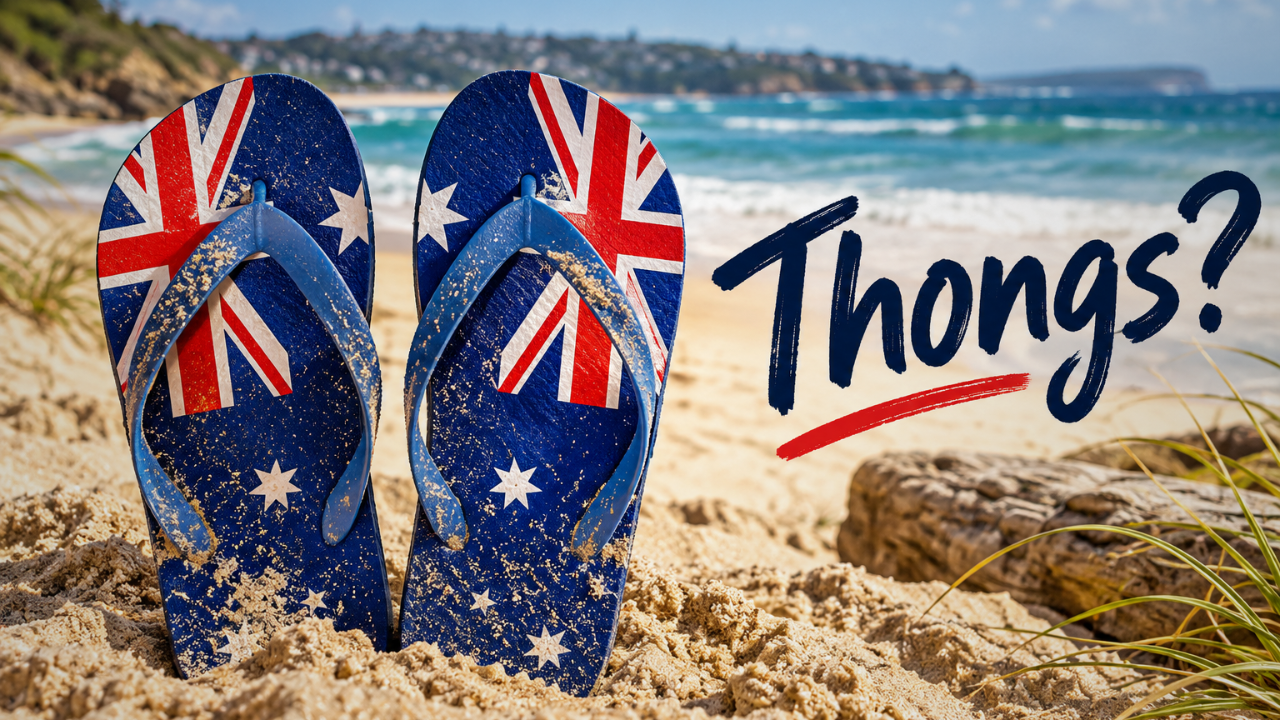
There are certain Aussie words that you don’t realize are particularly Australian until you leave.
“Thongs” is one of them.
Growing up in Australia, there was absolutely nothing unusual about somebody saying:
“I’m just putting my thongs on.”
Nobody gasped or looked concerned.
Nobody wondered why you were discussing your underwear before going to the shops.
You were simply putting a pair of rubber shoes on your feet.
Then you move to America.
Suddenly, announcing that you need to find your thongs before leaving the house creates an entirely different mental picture.
Because in the United States, a thong is generally underwear.
In Australia, it’s footwear.
So how did Australians end up calling flip-flops “thongs”?
The funny thing is, Australians aren’t actually being as weird as Americans might think.
In fact, there’s a perfectly sensible reason we call them thongs. We’ve even got history on our side.
Thongs to an Australian. Flip-flops to an American.
The Name Comes From the Strap
The Australian use of the word “thong” makes a lot more sense when you look at how the footwear is constructed.
A thong was originally a narrow strip or strap of leather.
The word had been used in English for centuries, long before anyone was using it to describe a certain style of underwear.
The classic Aussie thong has a sole with a Y-shaped strap that passes between the big toe and second toe.
That strap is the thong.
Eventually, the name of the strap became the name we commonly use for the entire piece of footwear.
So technically, Australians didn’t randomly look at a pair of flip-flops one afternoon and decide to give them the same name as skimpy underwear.
The footwear meaning has much older linguistic roots. Which is slightly disappointing, because that would have been a much better story.
Americans Used to Call Them Thongs Too
Here’s where things get interesting.
Americans did too.
In fact, “thong” was once a perfectly normal American name for the sandal, and American dictionaries still recognize that meaning today. The modern rubber version became more popular in the United States after World War II, influenced by the traditional Japanese zōri sandal.
The modern rubber flip-flop was influenced by traditional Japanese zōri sandals
By the 1960s, another name was becoming popular.
The flip-flop.
The origin of that name appears to be really simple.
It’s the sound they make when you walk.
Flip.
Flop.
Flip.
Flop.
For a while, Americans used both “thong” and “flip-flop” for the footwear. Over time, though, flip-flop increasingly won out.
At roughly the same time, “thong” was developing another meaning in American English, referring to increasingly revealing swimwear and eventually the style of underwear most Americans associate with the word today.
Exactly when Americans stopped calling their footwear thongs seems to have varied by place and generation. There are Americans who remember using the word for their shoes through the 1960s, 70s and even into the 80s.
Australia simply never made the switch.
Which means when an American laughs because an Australian calls a flip-flop a thong, there’s a perfectly reasonable response.
You used to call them thongs too.
Thongs Are Almost an Australian Uniform
The more interesting part isn’t really what Australians call them.
It’s how completely normal they are. Growing up on the coast in Australia, I essentially lived in thongs from spring through autumn.
Walking across pavement approximately three degrees below the melting point of human skin?
Still thongs.
There are limits, obviously. Australians don’t actually wear thongs everywhere, despite what some stereotypes might suggest.
But they occupy a particular place in Australian life that’s difficult to explain until you’ve lived somewhere else. They’re cheap, practical, easy to kick off and perfectly suited to a country where beaches, heat and casual clothing are part of everyday life.
The name comes from those little rubber plugs underneath the sole that hold the straps in place. Which also gives us the wonderfully Australian phrase:
“I’ve busted me plugga!”
Every Australian knows exactly what has happened.
One second you’re walking normally.
The next, the plug has pulled through the sole and you’re stranded with a piece of rubber attached to absolutely nothing.
Fortunately, Australians have developed sophisticated technology to deal with this emergency. A bread tie.
The Australian emergency thong repair kit: one bread tie
Push the strap back through the hole, wrap a bread tie around the bottom to stop it pulling through again, and you’re back in business.
It works surprisingly well.
It isn’t pretty. But neither are the thongs you’ve probably been wearing for the last three summers.
I Never Thought Twice About the Word Until I Lived in America
This is one of my favorite things about living between two countries.
You discover that words you’ve used your entire life aren’t necessarily universal.
They’re just normal to you.
I never grew up thinking Australians had a quirky word for flip-flops.
They weren’t flip-flops.
They were thongs.
That’s what they were called.
It’s only after living in the United States that I’ve become conscious of how funny some perfectly ordinary Australian sentences can sound to American ears.
The same thing happens in reverse.
There are American words and expressions that barely register with me anymore, but sounded completely foreign when I first moved here. After a while, you almost develop two versions of English in your head. You know which word you’d use in Australia and which one will save you an explanation in America.
We’ve simply taken the same language and spent a couple of centuries tinkering with it. Occasionally with hilarious results.
So, Are They Thongs or Flip-Flops?
Thongs.
Obviously.
I’m Australian. What did you expect me to say?
But after years of living in America, I’ve learned that context matters.
If I’m talking to Australians, they’re thongs.
If I’m talking to Americans, there’s a small part of my brain that now considers whether saying “thongs” is about to derail the entire conversation.
Sometimes I’ll say flip-flops.
Sometimes I’ll still say thongs.
But sometimes it’s much more entertaining not to explain myself and wait for the American in the room to work out why an Australian man just announced that he left his thongs by the front door.
That’s one Australian word I’m not quite ready to give up.
Enjoying From Down Under to Down South?
If you enjoy seeing Australia and America through my slightly confused eyes, you can help support the stories, articles and podcast by buying me a coffee.
It helps keep From Down Under to Down South going, and unlike a busted plugga, I can’t fix the website with a bread tie.
Buy Me a Coffee and support From Down Under to Down South
There is a strange assumption that sometimes follows you when you move to another country.
At some point, apparently, you are supposed to choose.
If you say too many nice things about the country you left, someone wonders why you left it.
If you say too many nice things about the country you moved to, someone wonders whether you’ve forgotten where you came from.
I’ve come across versions of both.
After eight years living in the United States, I’ve become very comfortable saying that I love America.
I chose to live here. I became an American citizen. I’m raising my children here. I’ve built a life here. There are things about American culture that I’ve genuinely come to admire, and many of them have become the subjects of the videos and articles I make.
None of that has made me less Australian.
That’s the part I think people sometimes misunderstand. Loving one country doesn’t mean you have to love the other one less.
I Didn’t Exchange Australia for America
When you immigrate, there is a tendency for people to think about the move as a replacement.
Old country out. New country in.
But that isn’t how it has felt to me.
Australia is still there in so much of who I am.
It’s in my accent, despite whatever America has been doing to it lately. My sense of humour, the food I occasionally find myself desperately searching for. The expressions that come out of my mouth without me even noticing them.
The experiences that shaped me long before I ever imagined living in Tennessee.
America didn’t erase any of that.
It added to it. I think that distinction matters.
Australia is still part of who I am, even after eight years of building a life in America
Psychologists actually have language for this.
In research on immigration, assimilation generally means adopting the new culture while gradually letting go of your attachment to the culture you came from.
Integration is different. It means becoming part of your new culture while still maintaining your connection to the old one.
Research from the American Psychological Association suggests the two identities don’t have to compete. Immigrants can adapt to life in a new country while maintaining a strong connection to their heritage, and research has found benefits to being able to maintain both.
In other words, the science doesn’t require me to hand in my Vegemite before I’m allowed to enjoy biscuits and gravy. Which is quietly reassuring.
Somewhere Along the Way, America Became Home Too
This is where things become more complicated than simply saying, “I’m an Australian who lives in America.”
Because America isn’t just where I live anymore.
It’s home.
That’s a surprisingly significant word for an immigrant.
Home used to have a very obvious answer. Australia was home because Australia was where I came from.
Then you spend years somewhere else. You work there. Make friends there. Raise your kids there.
You stop having to think about where things are or how things work. The supermarket becomes your supermarket. The roads become familiar. Places that once felt foreign become completely ordinary.
Eventually you return from a trip, walk through your own front door and think:
It’s good to be home.
Except you’re not in the country you once meant when you used that word.
You’re in the other one.
That has been one of the strangest changes for me.
I don’t feel 50 percent Australian and 50 percent American.
Identity isn’t a pie chart.
I feel Australian.
I also feel American. Those statements stopped contradicting each other a long time ago.
Becoming American Didn’t Feel Like Rejecting Australia
I remember standing in the courthouse on the day I became an American citizen.
There were about 40 of us, from all over the world, standing together and taking the Oath of Allegiance to the United States.
It was a proud moment for me.
But there was one part of the oath that felt strange.
I had to declare that I “absolutely and entirely renounce and abjure all allegiance and fidelity” to any foreign state of which I had previously been a citizen.
In my case, Australia.
I understood what the oath meant. I was choosing to become an American citizen and accepting the responsibilities that came with that.
But standing there saying those words, I didn’t feel as though I was renouncing Australia.
I certainly didn’t feel any less Australian when I walked out of the courthouse than I had when I walked in.
Becoming an American citizen didn’t make me feel any less Australian. It simply gave me another country to call home.
If anything, becoming an American citizen felt like formal recognition of something that had already happened.
America had become part of my life.
I had a stake in this country.
Its future mattered to me because my future was here too.
So was my family’s.
None of that required Australia to become less important.
There is an interesting contradiction in the language of citizenship itself. For much of history, dual nationality was viewed with suspicion because governments worried about divided loyalties. Today, dual citizenship is far more widely accepted around the world, and both Australia and the United States allow people to hold more than one nationality.
So I walked into that courthouse as an Australian.
I walked out as an American.
But I also walked out as an Australian.
Maybe that’s the point. Becoming one didn’t require me to stop being the other.
Sometimes Other People Want the Choice More Than You Do
One of the interesting things about living between countries is how often identity gets defined from the outside.
People like neat categories.
Australian.
American.
Immigrant.
Expat.
Pick one.
But people don’t necessarily work that way.
Research into immigrant belonging suggests that the way newcomers are treated by the society around them can have a significant effect on whether they feel accepted as part of their new country. Research summarized by the Migration Policy Institute has found that public attitudes and political rhetoric can influence an immigrant’s sense of national belonging.
That makes sense to me.
Belonging isn’t only about deciding that a country is yours.
Sometimes it is also about feeling that the country has decided you are one of its people.
I’ve noticed something interesting when Americans meet me.
Obviously, the accent usually gives me away pretty quickly. People ask where I’m from, how long I’ve been here and, occasionally, something involving kangaroos.
But when they learn that I’m also an American citizen, something subtly changes.
It’s difficult to describe because nobody announces it.
The conversation just feels slightly different.
There’s a sense of, Oh, you’re one of us.
Maybe I’m imagining some of it. Human interactions aren’t exactly easy things to measure while you’re standing in the supermarket talking to a stranger.
But I’ve noticed it enough times to believe there’s something there.
My Australian accent still makes me interestingly foreign.
My American citizenship seems to make me belong.
The funny thing is, I don’t need one of those things to cancel out the other. I can be the Australian in the conversation and still be one of the Americans in the room.
Loving America Doesn’t Require Pretending It’s Perfect
There is another part of this that I think is important.
Loving your adopted country doesn’t mean pretending everything about it is sunshine, roses and butterflies.
I don’t believe that about America.
I didn’t believe it about Australia either.
No country gets everything right.
You can love a country and still criticize it.
Admire another country without declaring it superior in every possible way.
You can even prefer different things about different places.
There are things Australia does that I wish America would copy tomorrow. There are things about American life that I now genuinely prefer.
In fact, one of the unexpected gifts of immigration is that you begin seeing both countries differently.
Distance makes you notice things about the country you left that you once took for granted.
Living somewhere new makes you question things you once assumed were universal.
Then you go back to the country you came from and discover that you’re looking at that differently too.
I’ve experienced that with Australia.
Things that were completely unremarkable to me when I lived there suddenly stand out. Some make me appreciate Australia more. Others make me wonder how I never noticed them before.
You haven’t stopped being an insider.
But you’re not entirely looking at it through an insider’s eyes anymore either.
Somehow, you become both.
It’s occasionally confusing.
But it’s also fascinating.
Maybe Belonging Doesn’t Have to Be Exclusive
In some ways, none of this should be particularly unusual in America.
Americans have been combining identities for generations.
Irish American. Italian American. Mexican American. German American.
For some people, the connection to the first country goes back generations. They may never have lived there, or perhaps never even visited, but their heritage can still be an important part of how they understand who they are.
My version is obviously a little different.
Australia isn’t where my ancestors came from several generations ago.
It’s where I came from.
It’s where I grew up and spent most of my life before moving to the United States.
But maybe the principle isn’t so different.
Becoming American doesn’t require everything that came before it to disappear.
Researchers studying bicultural identity have found that people can identify strongly with both their heritage culture and their national culture. Research also suggests that seeing those identities as compatible, rather than in conflict with each other, can help people feel more connected to the society around them.
That feels much closer to my experience than the idea that I must gradually become less Australian in order to become more American. America didn’t replace Australia.
Our family has built its life in America, but Australia remains part of our story.
It joined it.
I Still Know Where I Came From
There are moments when the distance from Australia hits harder than others.
One of the biggest for me came during the Black Summer bushfires of 2019 and 2020.
I was thousands of miles away in America while fires burned up and down the New South Wales coast and surrounded the area where I grew up.
Glued to Australian news reports. I listened to Australian radio from America trying to find out what was happening.
These weren’t just names of towns appearing on a news report.
I knew these places.
Knew the roads.
I knew the countryside.
I was watching places I knew like the back of my hand burn. At one point, I watched as fire roared across paddocks towards a house I had once lived in and came frighteningly close to engulfing it.
During the Black Summer bushfires, I watched from America as fires tore through parts of New South Wales I knew intimately.
Being in America didn’t make any of that feel distant.
If anything, being unable to physically be there made the distance feel enormous. The COVID years brought a different version of the same feeling. Australia suddenly seemed much further away than the number of miles between us.
Those experiences reminded me that moving overseas doesn’t sever your connection to the place you came from.
But neither does missing Australia mean I’m secretly waiting to leave America.
That’s the false choice.
I can miss one place while being happy in another.
Be proud of where I came from while being grateful for where I ended up.
Care about what happens to Australia and care deeply about what happens to America.
I can watch Australia play sport and know exactly which side I’m supporting.
Okay, some loyalties apparently do have limits.
But for everything else, I’ve stopped feeling any need to choose.
I’ve lived in America long enough now to understand that moving countries didn’t divide my identity.
It expanded it.
Australia gave me the foundations of who I am.
America has shaped who I’ve become since.
One doesn’t diminish the other.
So can you love your new country without loving your old one less?
After eight years of trying it, I think the answer is pretty simple.
Yes. You just end up with more than one place in the world that feels like yours.
Enjoyed this article?
From Down Under to Down South is independently created and supported by readers like you. If you’d like to help me keep making articles, videos and podcasts about life between Australia and America, you can support the work through Buy Me a Coffee.
You can make a one off contribution or become a monthly supporter for $5 a month. Either way, it helps me keep building the brand and creating more of the stories you enjoy.
Sources and further reading
The American Psychological Association’s work on immigration and acculturation explains the distinction between assimilation and integration, including the ability to participate in a new culture while maintaining attachment to one’s heritage culture.
The APA’s more recent review of immigration research discusses evidence supporting bicultural integration and the psychological and sociocultural benefits associated with maintaining connections to both heritage and destination cultures.
The Migration Policy Institute has examined both dual citizenship and immigrant belonging, including the historical shift away from treating dual nationality as inherently incompatible with integration. Research published in Cultural Diversity and Ethnic Minority Psychology has also examined dual identity among immigrants and the relationship between identification with both heritage and national cultures, belonging and psychological outcomes.
There are moments when I realise Australian English makes absolutely no sense.
“Yeah nah” is one of them.
To an Australian, there is nothing particularly complicated about those two words. Someone asks us a question, we say “yeah nah,” and everybody just gets on with their day.
To someone unfamiliar with Australian English, however, we have just answered yes and no at exactly the same time.
Which when you think about it seems less like a useful response and more like something a politician at Parliament House might say when trapped in an interview.
The strange thing is that Australians generally know exactly what it means.
Even stranger?
Change the order and the answer changes.
“Yeah nah” usually means no.
“Nah yeah” usually means yes.
And if an Australian starts adding additional yeahs and nahs, you may simply have to trust us.
Australian English: where “yes, no” means no and “no, yes” means yes.
So What Does “Yeah Nah” Actually Mean?
The simplest answer is:
“Yeah nah” usually means no.
But that explanation misses most of what is happening.
The “yeah” isn’t necessarily an affirmative answer. It can be an acknowledgement.
You might think of it as:
“I hear what you’re saying.”
“I understand.”
“I’ve considered that.”
“Fair enough.”
Then comes the actual answer.
Nah.
For example:
“Do you want to get up at five tomorrow morning and go for a run?”
“Yeah nah.”
There is no ambiguity here.
I have heard what you asked me.
I have thought about it.
I have also concluded that your proposal is ridiculous.
The answer is no.
That distinction is important because “yeah nah” isn’t simply Australians being deliberately confusing. Researchers studying Australian English have found that “yeah-no” performs several conversational jobs, including softening disagreement, maintaining conversational flow and helping speakers save face.
In other words, there is considerably more going on inside those two tiny words than it first appears.
Imagine someone suggests something you don’t really like.
“We should paint the living room bright orange.”
You could simply respond:
“No.”
Perfectly clear.
Also slightly brutal.
“Yeah nah, I’m not sure about that.”
Now you’ve done something different.
The “yeah” has acknowledged the other person’s idea before the “nah” gently drives a truck through it.
That softening effect is one reason the expression works so well in conversation. SBS’s Cultural Atlas describes the opening “yeah” as acknowledging the other person’s point before the “nah” introduces disagreement, helping keep the exchange relaxed and less confrontational.
Aussues have a reputation for being direct, but Australian conversation can also contain an enormous amount of understatement, hedging and meaning hidden in tone.
We don’t always say exactly what the words appear to mean.
“This should be interesting” may not mean the person is looking forward to it.
“Not bad” can be extremely high praise.
“Good on ya” can be amazingly supportive.
It can also mean something very different.
And “yeah nah” fits right into that world.
The dictionary definition is almost the least interesting part.
The real meaning lives in the conversation.
You don’t really notice the strange little things about the way you speak until someone else points them out.
Then There Is “Nah Yeah”
This is where things become fun.
If:
Yeah nah = no
then:
Nah yeah = yes.
Again, the final part generally tells you where we’ve landed.
“Did you end up liking that restaurant?”
“Nah yeah, it was really good.”
Translation:
I had doubts.
I wasn’t expecting much.
I’m responding to something said earlier.
Whatever happened inside my head, I have now arrived at yes.
The University of Technology Sydney even includes the wonderfully concise formula in its guide to Australian slang:
Nah yeah = yes.
Yeah nah = no.
Yeah nah yeah = yes.
At this point, international readers may reasonably wonder whether Australia couldn’t simply have adopted a more efficient system.
We could have.
But, we chose not to.
But “Yeah Nah” Doesn’t Always Mean Exactly the Same Thing
This is the part that lists of Australian slang often miss.
Language isn’t mathematics.
You can’t simply memorize:
YEAH + NAH = NO
and assume you’ve cracked the Australian code.
Listen to this:
“Was the concert any good?”
“Yeah nah, it was fantastic.”
That’s clearly positive.
Now:
“Was the concert any good?”
“Yeah nah, wouldn’t bother.”
Definitely negative.
Same opening words.
Completely different destination.
Australian listeners aren’t sitting there consciously decoding a linguistic formula. We’re listening to tone, emphasis, context and, crucially, what comes next.
That’s why trying to learn Australian English from a list of slang words only gets you so far.
Some Australian expressions are much easier to translate. A “servo,” for example, is simply what Australians commonly call a service station, although the experience itself can be surprisingly different from an American gas station.
Americans Say Something Similar
Living in the United States has made me much more conscious of expressions I used for years without thinking about them.
You don’t normally analyse your own language while you’re surrounded by people who speak exactly the same way.
Move 9,000 miles away and suddenly you hear yourself.
Americans say “yeah, no” too, so I’m not going to pretend we’ve got exclusive ownership of it.
But when I hear an Australian say “yeah nah,” there’s something about the way we use it that just sounds Australian to me.
Maybe it’s the tone. Maybe it’s the timing. Maybe it’s because I grew up hearing it.
Whatever it is, I don’t have to stop and work out whether they mean yes or no.
I just know.
Which is handy, because trying to explain why I know is where this whole thing starts falling apart.
You Can Say an Awful Lot With Two Words
“Yeah nah” can be a refusal.
“Want another beer?”
“Yeah nah, I’m right.”
It can be disagreement.
“I reckon that’s the best way to do it.”
“Yeah nah, I don’t think so.”
It can acknowledge something before changing direction.
“He had a pretty good game.”
“Yeah nah, he did alright, but he missed a couple he should’ve had.”
It can soften criticism.
“Did you like the movie?”
“Yeah nah, wasn’t really my thing.”
It can even help deflect a compliment.
“You were brilliant out there today.”
“Yeah nah, everyone played well.”
That feels especially Australian to me.
Someone gives you a compliment and instead of just accepting it like a normal person, you immediately start trying to give the credit to everyone else.
We somehow managed to turn yes and no into a way of saying thank you.
Which, now that I think about it, is probably about as Australian as it gets.
Sometimes the words themselves matter less than the social message underneath them:
Don’t make too much fuss.
Don’t make this awkward.
I hear you.
We’re good.
Now here’s what I actually think.
“Yeah nah.”
Two words.
Job done.
The meaning of “yeah nah” depends on much more than the literal words.
Can You Use “Yeah Nah” If You’re Not Australian?
Of course.
There is no Australian slang enforcement squad waiting at Sydney Airport, at least that I know of!
But I wouldn’t try too hard.
The quickest way to make Australian slang sound unnatural is to assemble every Australian expression you’ve learned into one terrifying sentence.
“G’day mate, yeah nah, chuck another shrimp on the barbie this arvo.”
Please don’t.
Especially the shrimp.
We call them prawns.
“Yeah nah” works because for many speakers it isn’t a performance. It’s just conversation. It slips into a sentence without announcing itself.
If you’re visiting Australia, you don’t really need to practise saying it.
Just listen for it.
Eventually you’ll hear somebody say “yeah nah,” immediately understand what they mean and not even notice that they technically just told you yes and no.
If you enjoy seeing Australia and America through slightly different eyes, you can support From Down Under to Down South through Buy Me a Coffee. It helps me keep creating independent stories about Australian culture, American life and the strange little things you only notice when you’ve lived in both.
One of the things I’ve come to appreciate most after eight years in the United States is American encouragement. There are obvious ways living in another country changes you, but this was one change I didn’t notice happening.
Your vocabulary changes. Your tastes change. You learn new customs and eventually stop noticing things that once seemed strange.
Then there are the changes you don’t notice happening.
It took me years to realize America had changed the way I respond when someone tells me they want to do something with their life.
These days, my first instinct is usually to encourage them.
That might not sound particularly remarkable. Surely people encourage each other everywhere right?
Of course they do.
But there is a particular kind of optimism I’ve encountered in America that feels different from the culture I grew up with in Australia. It’s an optimism that seems willing to give an idea the benefit of the doubt before demanding evidence that it will work.
Someone wants to start a business.
Someone wants to go back to college in middle age.
Someone wants to make a living doing something they’ve only ever done as a hobby.
The American response I’ve heard countless times is remarkably simple.
Australians aren’t inherently pessimistic, despite what Americans might conclude after spending enough time with us.
We can, however, be very good at keeping each other grounded.
I think there is value in that.
A friend announces an ambitious plan and the questions begin. Have you thought about the money? What happens if it doesn’t work? Do you know what you’re getting yourself into?
Often those questions are an expression of care.
You don’t want someone you love making an enormous mistake, so you start looking for the holes in the plan.
I’ve done it plenty of times myself.
What I’ve found interesting about America is that many people ask those questions too. They just don’t necessarily ask them first.
First comes the encouragement.
Then comes reality.
It seems like a small distinction, but I’m increasingly convinced it isn’t.
The first response someone receives to an idea can determine whether the conversation that follows is about making it happen or explaining why it can’t.
America Has a High Tolerance for Reinvention
Maybe one reason encouragement feels so natural here is that reinvention is everywhere.
I’ve met people who have changed careers several times. People who went back to school decades after leaving it. People who moved hundreds of miles to take an opportunity. People who turned side projects into businesses.
In a country this large and mobile, starting again doesn’t always carry the sense that something has gone wrong.
Sometimes starting again is the plan.
That matters.
If you’ve grown up surrounded by stories of people changing direction, somebody announcing a new ambition doesn’t necessarily sound ridiculous. It sounds familiar.
America’s national mythology probably plays a part too.
The country’s stories are filled with reinvention, invention and improbable ambition. Some of those stories have been polished considerably in the retelling, of course. Opportunity has never been distributed equally, and wanting something badly enough certainly doesn’t guarantee you’ll get it.
Still, cultural stories matter.
A society that spends generations telling itself that people can build, move, invent, create and begin again is probably going to produce a lot of people whose instinctive response to a new idea is:
Having children in America has made the difference much more noticeable to me.
When a child expresses an ambition here, adults often take it surprisingly seriously.
Not seriously in the sense that every childhood dream is treated as a future certainty.
Seriously enough to ask what the next step might be.
My daughter Georgia is ten and loves dance. She already has ideas about where that might take her years from now.
What has struck me isn’t whether those dreams eventually happen. Nobody knows that.
It’s the response from the adults around her.
The dream isn’t immediately reduced to something more “realistic.”
Instead, people help her learn.
They expose her to people further along the path.
They allow her to imagine herself doing it.
Eventually life will provide plenty of reality. There will be auditions, competition, disappointment, money, ability, timing and all the other things that determine where a dream ultimately goes.
She doesn’t need adults manufacturing those obstacles years in advance.
I’ve come to appreciate that enormously.
Encouraging a child to pursue something isn’t the same as promising she’ll achieve it.
It’s telling her the possibility is worth exploring.
Watching my daughter grow up in America has made me notice how readily people here encourage a child’s ambitions.
The Internet Made the Difference Even More Obvious
Becoming a creator gave me another perspective on this.
Putting something you’ve made in front of strangers is an excellent way to discover just how vulnerable ambition can make you feel.
You’re effectively announcing:
I made this.
I think it’s worth your time.
I’d like to make more of it.
There are countless reasons to convince yourself not to do that.
Yet some of the most encouraging messages I’ve received since starting From Down Under to Down South have come from Americans who have absolutely no reason to care whether I succeed.
They don’t know me personally.
Many stumbled across one video by accident.
Yet they’ll leave a comment telling me to keep going, congratulate me on a milestone or tell me they hope the channel becomes much bigger.
Success can sometimes be treated as a limited resource. If someone else is doing well, there must somehow be less available for everyone else.
Encouragement operates on the opposite assumption.
Your success doesn’t diminish mine.
I can want something good to happen for you without losing anything myself.
That may be one of the healthiest ideas I’ve absorbed from living here.
Somewhere Along the Way, America Rubbed Off on Me
I only noticed the change when I began catching myself doing the same thing.
Someone tells me they’re considering a career change and my brain doesn’t immediately produce a spreadsheet of potential disasters anymore.
I want to know what they’re thinking.
Someone talks about creating something and I’m interested in how they might start.
Someone mentions an ambition that sounds a little unlikely and I don’t feel the same urge to bring it back down to earth.
There will be time for practical questions.
What I’ve lost is the assumption that practical and encouraging have to be opposites.
You can tell someone their idea will require enormous work and still hope they succeed.
You can point out a risk without making the risk the entire conversation.
You can think someone’s chances are uncertain and still help improve them.
Most importantly, you don’t have to believe someone will succeed to believe they deserve the opportunity to try.
That distinction took me a surprisingly long time to understand.
I explored this idea from a slightly different angle in this video:
Maybe Encouragement Is More Important Than We Think
There is an obvious danger in romanticizing American optimism.
“Believe in yourself” doesn’t pay the mortgage.
Not every business should be started. Not every career change is sensible. Sometimes the cautious friend asking uncomfortable questions is exactly the person you need.
But pessimism has its own cost.
Ideas can be killed long before reality ever gets the chance.
People talk themselves out of applying for jobs because they assume somebody better will get them.
They don’t create something because somebody else already does it.
They don’t return to school because they think they’re too old.
They don’t pursue an opportunity because failure would be embarrassing.
Most adults don’t suffer from a shortage of reasons to doubt themselves.
We’re remarkably good at producing those on our own.
Perhaps that’s why I’ve come to value the American instinct to add something different to the conversation.
Possibility.
Living in the United States hasn’t made me believe anything is possible.
Eight years here has taught me enough about America to know that isn’t true.
What it has changed is my willingness to decide what’s impossible before somebody has even tried.
These days, when someone tells me about the thing they’d love to do, I’m much less interested in being the first person to explain why it might fail.
There will be plenty of people available for that job.
I’d rather be the person who asks:
Why not you?
Enjoy From Down Under to Down South?
If you enjoy seeing America through an Australian’s eyes, you can support my work by buying me a coffee. Every bit of support helps me keep making the videos, podcasts and stories you find here.
Why do Australians call McDonald’s “Macca’s”? Because we shorten everything. It’s just what we do. Afternoon becomes arvo, a service station becomes a servo, David becomes Davo and somewhere along the way McDonald’s became Macca’s. These days even McDonald’s Australia uses the name.
If you go anywhere in Australia and ask someone where the nearest Macca’s is, almost everybody will know exactly what you’re talking about.
McDonald’s.
The strange thing for me is that I don’t remember it always being that way.
I grew up in Australia in the 1970s and 80s, and in my childhood memories it was McDonald’s.
Not Macca’s.
McDonald’s.
And going there was a treat.
When McDonald’s Was Still McDonald’s
One of my strongest childhood McDonald’s memories involves Sydney Airport.
When relatives were visiting and we had to take them back to the airport, we’d sometimes stop at the McDonald’s at Sans Souci on the way home.
I remember the foam containers the burgers came in. I remember the character pens and the promotions. I remember another McDonald’s at Figtree near Wollongong.
Strangely, I don’t have the same childhood memories of McDonald’s in Nowra, where I grew up.
The restaurants that stuck in my memory were the ones associated with going somewhere.
McDonald’s wasn’t simply somewhere you stopped because you couldn’t be bothered cooking dinner.
It was a treat.
McDonald’s had only arrived in Australia in 1971, when its first Australian restaurant opened at Yagoona in western Sydney. From there, those Golden Arches gradually became part of the Australian landscape.
There are linguistic explanations for the Australian obsession with abbreviations, but I think there’s something cultural going on as well.
Australians are generally pretty informal.
There’s a laid back attitude to language and perhaps a little bit of cheekiness in taking the proper name for something and deciding we’re going to call it something else.
Maybe there’s even a touch of our reluctance to conform.
You can tell us the restaurant is called McDonald’s.
That’s lovely.
We’re calling it Macca’s.
There’s also something strangely affectionate about an Australian nickname.
We do it to our friends.
We do it to our towns.
We do it to occupations.
We do it to everyday objects.
So perhaps one of the signs that McDonald’s had truly embedded itself into Australian culture was that we stopped bothering to use its proper name.
We gave it a nickname instead.
McDonald’s Eventually Gave In
This is my favourite part of the story.
McDonald’s didn’t try to correct Australians.
Eventually, it embraced the name.
By 2012, research commissioned by McDonald’s found that 55 percent of Australians surveyed called the company Macca’s. The nickname was so recognizable that it ranked just behind “footy” among the Australian abbreviations included in the research.
McDonald’s even pushed for Macca’s to be included in the Macquarie Dictionary.
Then, in January 2013, it went considerably further.
As part of an Australia Day campaign, 13 McDonald’s restaurants around Australia temporarily replaced their regular McDonald’s signage with signs saying Macca’s.
Not just in an advertisement.
On the actual restaurants.
Locations including Bondi Beach, Engadine and other stores around the country suddenly had Macca’s written where one of the world’s most recognizable corporate names would normally be.
The signs eventually changed back.
The nickname didn’t.
Today, McDonald’s Australia doesn’t merely tolerate Macca’s. It routinely uses the name itself.
Its app is called MyMacca’s.
Its Australian website has a section called Macca’s Story.
Official press releases tell Australians to head into their local Macca’s.
An Australian nickname for an American company effectively became part of the company’s Australian identity.
Macca’s in Australia Isn’t Quite McDonald’s in America
Living in America has made me notice something else.
Macca’s doesn’t just have a different name.
It tastes different.
I find the Australian beef nicer, and overall the Australian product has always seemed fresher to me.
There’s some substance behind the Australian ingredient difference too. McDonald’s Australia says its beef is Australian, and during its 50th anniversary celebrations the company said its beef, chicken, potatoes, wheat flour, lettuce and tomatoes were locally sourced.
Australia has also had menu items Americans don’t necessarily recognize.
The McOz, for example, arrived on the Australian menu in 1999. It’s the sort of burger that immediately announces where it comes from, most famously through that very Australian hamburger ingredient: beetroot.
Breakfast is broadly familiar on both sides of the Pacific, although living in the American South has introduced me to something you won’t find on a normal Australian Macca’s breakfast menu:
Biscuits.
Not Australian biscuits.
American biscuits.
That’s an entirely different article.
Some things, however, apparently transcend international borders.
The ice cream machines break in Australia too.
Humanity remains united.
Try Calling It Macca’s in America
Of course, the problem with Australian slang is that you don’t always realize something is Australian slang until you leave Australia.
I remember Nikki and I talking about Macca’s in front of someone here in America once.
We were happily having a conversation.
The other person was looking at us blankly.
Macca’s?
What on earth were we talking about?
That was one of those little expat moments when you suddenly realize a word that requires absolutely no explanation in one country can be almost meaningless in another.
These days, living in America, I obviously hear “McDonald’s” far more than I hear Macca’s.
My kids call it McDonald’s.
They know perfectly well what Macca’s means because they’ve heard us use it, but it isn’t naturally the word they reach for.
For me, it’s the opposite.
In my head, it’s still Macca’s.
The Funny Thing Is, Australians Barely Notice It
When I go back to Australia now, hearing the word Macca’s doesn’t jump out at me.
Neither does seeing it in advertising.
It’s simply part of the scenery.
That’s probably the best indication of how deeply the nickname has embedded itself into Australian English.
It doesn’t feel like slang.
It doesn’t feel like someone trying to sound Australian.
It certainly doesn’t need translating.
It’s just Macca’s.
And I like that McDonald’s embraced it.
One of the world’s biggest American brands arrived in Australia in 1971. Australians adopted it, grew up with it and eventually decided its name was too formal.
So we gave it a nickname.
McDonald’s could have spent millions insisting on consistent global branding.
Instead, eventually, it effectively said:
Fair enough.
Macca’s it is.
Macca’s Is One of Those Little Pieces of Home
Living overseas changes your relationship with words like this.
When you’re in Australia, Macca’s isn’t special.
It’s a fast food restaurant.
It’s somewhere you stop on a road trip. Somewhere you grab breakfast. Somewhere you swing through on the way home from work.
It’s part of the background.
But once you live somewhere else, these tiny pieces of language start to mean a little more.
Macca’s reminds me of childhood trips home from Sydney Airport and stopping at Sans Souci.
It reminds me of foam burger containers and character pens.
Later, it became Macca’s runs after work.
Today, my American kids know exactly what I mean when I say Macca’s, even though they’ll answer me by calling it McDonald’s.
It’s a tiny difference.
But that’s often how home works when you live overseas.
Not through the enormous things you expect to miss.
Sometimes it’s just a word you’ve been saying for decades.
And somewhere in the back of my head, no matter how long I live in America, those Golden Arches will probably always be Macca’s.
Getting sick when you live overseas can make you realise just how much of your old support system you left behind. It’s not simply that your family lives far away. It’s that when something goes wrong, the people who would normally step in and help can’t physically be there.
Our family discovered that the hard way recently when all four of us got COVID.
At one point, my wife Nikki and I were both completely wiped out while our two daughters, aged ten and seven, were sick as well. When one parent gets sick, the other can usually pick up the slack. When both parents are sick at the same time, things get considerably more complicated.
The kids still needed feeding and looking after. There was washing to do, food to organise and a house that somehow continued producing dirty dishes despite nobody having the energy to do anything.
For the first time in eight years of living in America, I found myself seriously wondering: what are we actually supposed to do if we both get too sick to manage this?
At this point, our kitchen table was starting to look like a small pharmacy.
Sick Children Have a Remarkable Ability to Recover When There’s Something to Fight About
Thankfully, our girls are old enough to do some things for themselves. They can get a drink, find a snack and entertain themselves without constant supervision.
They are not, however, old enough to look after two very sick parents.
They also demonstrated a fascinating feature of childhood illness. One minute, one of them would be lying on the couch looking miserable and telling us how terrible she felt. Twenty minutes later, both girls would be running around like crazed squirrels fighting over the television remote.
Apparently COVID symptoms can temporarily disappear when your sister changes the channel.
Then the fight would end and one of them would return to the couch.
“Dad, I don’t feel well.”
Neither did I, but unlike them, I hadn’t just completed a 100 yard dash through the house.
At one point their continued demands inspired me to write a Shakespearean proclamation for the household:
A plague hath descended upon this house, and both Mother and Father lie stricken, weak of limb and weary of spirit. Yet the young heirs show no mercy.
If thou hungerest, seek thee the pantry. If thou thirstest, journey forth unto the kitchen.
Cry havoc, and let slip the children.
It summed up the week surprisingly well.
When Cooking Becomes Too Much Effort
Food was one of the first things to fall apart.
We relied on takeaway far more than we normally would because neither of us had the energy to cook. There’s a particular level of sickness where having ingredients in the fridge becomes irrelevant. Chicken and vegetables might technically constitute dinner, but only if someone has enough energy to turn them into dinner.
We didn’t.
Delivery drivers became our humanitarian aid workers. Leave the food at the front door, retreat to a safe distance and we’ll retrieve the supplies when able.
I also managed to place an Instacart grocery order while exhausted and sleep deprived. When it arrived, I started unpacking things I had absolutely no memory of ordering.
Scallion noodles?
Apparently so.
There were several other random purchases that made perfect sense to whichever version of me had been scrolling through Instacart at the time. It was like receiving a grocery order selected by a stranger, except the stranger was me.
Apparently COVID Michael decided we needed several packs of noodles. I have absolutely no memory of ordering them.
Sleep became another problem. I went an extraordinary amount of time without getting any meaningful rest because every time I started drifting off, I would cough or wake up uncomfortable.
Eventually I ordered sleep gummies from Amazon and paid extra for expedited same-day delivery.
This was no longer casual online shopping. I needed those gummies.
Amazon cancelled the delivery.
Of all the packages to cancel, this felt personal.
Eventually I remembered that we had some older sleep gummies in the house. They were out of date, which would normally have been enough for me to leave them alone. After that long without sleep, however, the expiration date started looking more like a suggestion.
They worked.
I slept for more than three hours in a row and woke up feeling as though I’d just returned from a two-week wellness retreat.
There wasn’t really a choice. Sending a child with COVID into a dance studio full of other children would have been a spectacularly bad idea.
I had to cancel my own ballroom dancing too. There was absolutely no chance I had enough energy for that. I could barely foxtrot to the bathroom.
Work became difficult for another reason: I had virtually no voice.
A large part of what I do involves YouTube, podcasting and recording. My computer was sitting there, scripts were ready and there were things I wanted to make, but I couldn’t talk without coughing.
It’s a strange frustration when you technically have everything you need to work except the physical ability to do it.
My microphone sat unused while COVID took away my voice and brought YouTube, podcasting and voice work to a temporary halt.
Who Do You Call When Both Parents Are Sick?
At the worst point, I found myself wondering whether there was some kind of government service for families in this situation.
I genuinely didn’t know.
What happens if both parents become too sick to properly care for their children? We weren’t at the point where we couldn’t look after ours, but lying there completely exhausted made me wonder what would happen if we got worse.
Then I realised that if we were living in Canberra, I probably wouldn’t have been thinking about government departments at all.
We would have called Nikki’s mum.
She doesn’t live in Canberra, but I know she would have got in the car and driven there to help us.
That one thought completely changed how I saw the week.
The Invisible Support System You Leave Behind
When people talk about emigrating, they usually understand that they’re leaving family and friends behind. You know you’ll miss birthdays and Christmases. You know you won’t be able to simply pop around for dinner.
What I don’t think I fully understood was that I was also leaving behind a practical support system.
It’s the person who can pick up your children when you can’t. Someone who brings dinner because they know you’re struggling. A grandparent who can watch the kids for a few hours while you sleep.
It doesn’t take much.
If Nikki’s mum had been able to come over, we wouldn’t have expected her to magically fix everything. Just having one healthy adult in the house would have made an enormous difference.
Someone could deal with the girls while we slept, make some food or simply say, “Go to bed. I’ve got this.”
After eight years in America, that was one of the rare occasions when the distance between here and Australia felt enormous.
Our family together in Australia — a reminder that although we’ve built our life in America, much of the family support network we left behind is still on the other side of the world.
Technology Can’t Replace Being There
Living overseas today is easier in many ways than it was a generation ago. We can video call family in Australia, send photos instantly and stay involved in each other’s lives from thousands of miles away.
But there are limits.
A video call can’t make dinner. It can’t collect your children from school, go to the shops or sit with the kids while both parents get some desperately needed sleep.
There are moments when emotional closeness isn’t enough. You need someone physically close enough to show up.
Friends can absolutely become part of that support network, but asking a friend to enter your COVID-infested house and take care of your sick children is quite an ask.
Family can be different. Sometimes all you have to say is, “We need help.”
Our Kids Miss That Proximity Too
This experience also made me think about something I rarely consider: our daughters are growing up without grandparents nearby.
They know their grandparents and love them, but they don’t have the everyday version of that relationship where you can simply go to Nan’s for the afternoon or a grandparent can unexpectedly pick you up from school.
To them, that’s completely normal because it’s the only life they’ve known.
During sickness though, I didn’t only wish someone could help Nikki and me. I wished there was another healthy adult nearby for the girls.
They were sick too, despite occasionally transforming into crazed squirrels, and they still needed their parents.
Unfortunately, their parents were operating at about four percent.
I Wasn’t Homesick. I Missed Having Backup.
That was probably the biggest realisation of the whole experience.
I wasn’t lying in bed wishing we could move back to Australia. I wasn’t dreaming about Canberra, Australian food or the places I used to know.
America is home. Our lives are here.
What I missed was having backup.
There’s a difference.
You can love the life you’ve built overseas while recognising that there are things you gave up to build it. You can feel completely at home in your new country and still occasionally wish the people who would drop everything to help you lived a little closer.
Most of the time, I don’t notice the 9,000 miles between us and Australia.
This time I did.
Getting sick reminded me that one of the hardest parts of living overseas isn’t necessarily missing home. Sometimes it’s discovering all the things you never realised home used to do for you.
And I learned one other valuable lesson.
Never place all your faith in same-day Amazon delivery during a plague.
One of the biggest surprises after moving from Australia to America wasn’t the supermarkets, the roads or even the accents.
It was Chinese food.
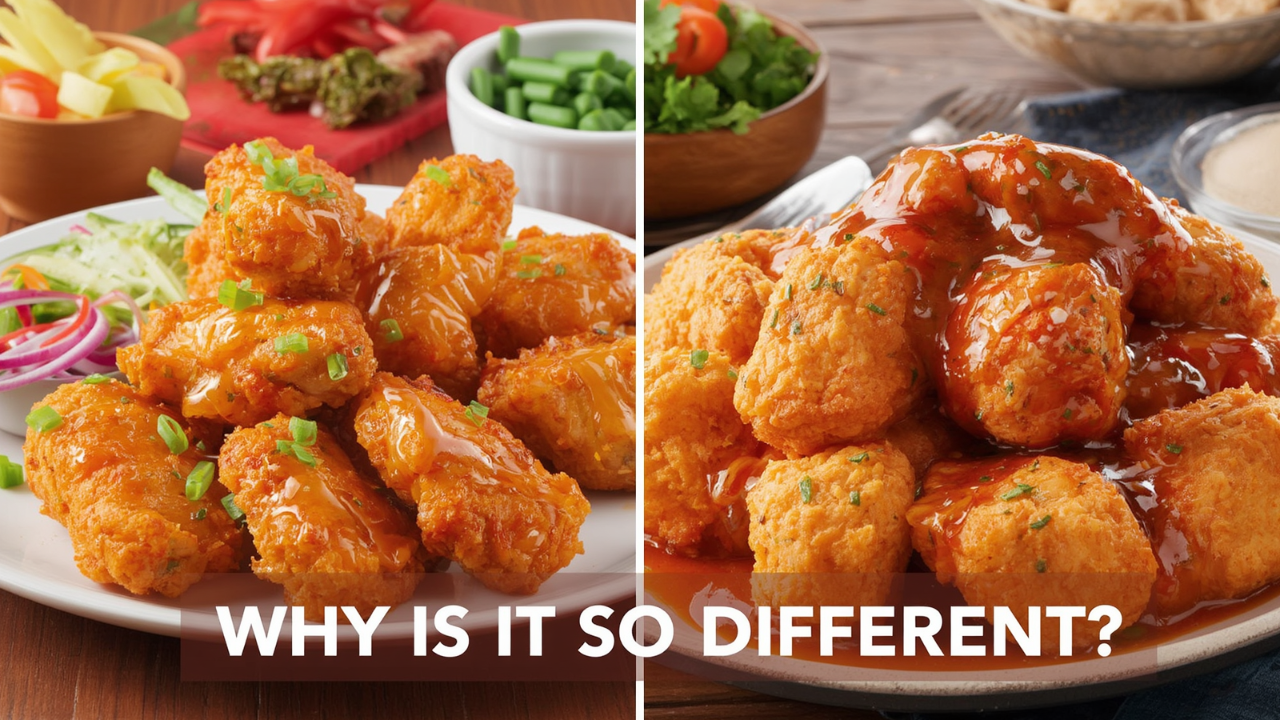
American Chinese food and Australian Chinese food share the same roots, but over more than a century they’ve evolved into two very different cuisines. The dishes, sauces, flavours and even the menus are often completely different.
After living in America for eight years—and growing up in Australia—I still notice those differences every time I order takeaway.
And perhaps the strangest part?
I didn’t expect Chinese food to be one of the things I’d miss most.
When I first arrived in America, I expected plenty of culture shock.
The supermarkets.
The enormous cars.
The accents.
The friendliness.
Chinese food never even crossed my mind.
Within my first few weeks, I ordered what I thought would be a familiar takeaway dinner.
Instead, I discovered something I hadn’t expected.
The flavours were completely different.
Not bad.
Just…different.
It was one of those moments that makes you realise you’ve carried assumptions halfway around the world without knowing it.
The interesting part is that neither version is more “correct.”
Both Australia and America were shaped by different waves of Chinese immigration.
Chinese cooks adapted recipes using local ingredients and local tastes.
Australia’s Chinese takeaway culture has deep roots in the Cantonese communities that arrived during the gold rush era. Over generations it became part of suburban Australia, often appearing alongside local pubs and RSL clubs.
America followed its own path.
Its Chinese restaurants created dishes specifically for American tastes, producing favourites like General Tso’s Chicken and Orange Chicken.
In other words…
Australia didn’t copy America.
America didn’t copy Australia.
Both countries created their own version of Chinese takeaway.
Leongs Chinese Restaurant in Nowra Australia
There’s Another Reason I Notice These Differences
My first job in high school was as a kitchen hand in a Chinese restaurant.
Looking back, it became an unexpected stepping stone towards eventually becoming a qualified chef.
So when I notice differences between Australian and American Chinese food, I’m not just comparing takeaway menus.
I’ve also spent time behind the scenes watching how one version of that cuisine was prepared.
Chinese Restaurant kitchens are fast paced
The Moment I Realised What I Actually Missed
Last year we travelled back to Australia.
Something funny happened.
We ate Chinese food more than almost anything else.
Not because we’d missed Chinese food.
We’d been eating Chinese food in America for years.
We’d missed Australian Chinese food.
The Honey Chicken.
The fried rice.
The familiar flavours.
It wasn’t until we’d been away for years that I realised those Friday-night takeaway dinners had quietly become part of what “home” tasted like.
Final Thoughts
Before moving overseas, I expected to miss beaches, family and Australian coffee.
I never imagined I’d spend years craving Honey Chicken.
Living in another country has taught me something surprising.
It’s often the smallest traditions that become the strongest reminders of home.
Sometimes that’s a favourite bakery.
Sometimes it’s a supermarket.
And sometimes…
It’s the particular way your local Chinese restaurant made fried rice.
FAQ
Is American Chinese food authentic?
American Chinese food is authentic to the Chinese-American communities that created it. Like Australian Chinese food, it evolved over generations using local ingredients and local tastes.
Why doesn’t American Chinese food taste the same as Australian Chinese food?
The recipes developed independently for different customers over many decades, resulting in different sauces, dishes and flavours.
Does Australia have General Tso’s Chicken?
It’s much less common than in America. Australian Chinese restaurants typically feature different signature dishes.
What Australian Chinese dishes can’t you usually find in America?
Honey Chicken, Chicken and Ham Rolls, Australian-style Lemon Chicken and some versions of fried rice are much harder to find.
Australians say mate because it’s more than just a word. It’s a greeting, a thank you, a sign of friendship, a warning, a term of affection, and sometimes all five at once.
Eight years after moving to America, I still say it dozens of times a day.
“Cheers, mate.”
“Thanks, mate.”
“No worries, mate.”
“See ya, mate.”
Now the people that know are plenty used to it by now but those that don’t always pause for a split second when they hear it. You can almost see them translating it in real time.
Then it clicks.
Oh right.
He’s Australian.
The funny thing is that I don’t even notice I’m saying it anymore.
It’s one of those habits that survived the move. My accent has softened a little over the years. I’ve learned to say gas station instead of servo. I’ve stopped confusing cashiers by handing over exact change and expecting them to appreciate it.
One of the biggest misconceptions is that Australians call everyone mate because we’re all best friends.
That’s not really how it works.
I’ve called complete strangers mate. Shop assistants have called me mate. Taxi drivers, tradies, neighbours, and random blokes I’ve met for thirty seconds have all used it.
It’s less about friendship and more about familiarity.
It’s a way of saying, “We’re alright. Let’s keep this simple.”
One of my closest friends here in Tennessee is Mexican.
Years ago she started saying mate back to me.
These days I call her matey and she calls me mate.
Neither of us are using it correctly anymore, but we’ve committed to it so heavily that there’s no turning back now.
In Australia, “mate” is often less about friendship and more about familiarity and connection.
Not Everyone Gets Called Mate
Despite what Hollywood might suggest, Australians don’t call absolutely everyone mate.
There are situations where it fits and situations where it doesn’t.
When I worked in banking, I wasn’t walking into meetings with ambassadors and saying, “G’day mate.”
That would have been a very short diplomatic meeting.
In Australia, mate is often a social leveler.
It works best when people are meeting as equals.
Tradies use it.
Country Australians use it.
Blokes leaning on fences use it.
People standing around a barbecue use it.
It strips away a bit of formality and makes the conversation feel more relaxed.
Watching them handle airports and travel on their own still catches me off guard.
America Shaped Them Too
When people move overseas, they expect the new country to shape them.
You learn different customs.
Different expressions.
Different social rules.
You learn that biscuits aren’t biscuits.
That football sometimes involves very little foot.
You learn that Americans consider a three-hour drive “close.”
But eventually I realized something else.
America wasn’t only shaping me.
It was shaping my daughters too.
Georgia Carries Two Homes
Georgia was born in Australia.
She still feels connected to that part of her story.
She knows where she was born.
Knows where her parents came from.
She still spells “Mum” correctly, which I consider one of my greatest parenting achievements.
But she has grown up here.
Her school is here.
Her friends are here.
Dance life is here.
And recently she started talking about her dream college.
USC.
The University of South Carolina.
She’s only ten years old, so there is every chance she’ll change her mind another twenty times.
But that’s not really the point.
When she imagines her future, she imagines it here.
Brianna Doesn’t Have The Same Question
Brianna was born in America.
And in many ways, America simply feels like home.
Recently we watched Australia versus the USA on TV at the 2026 World Cup.
When the Australian anthem played, Georgia and I stood up and sang along, hand over our hearts.
When the American anthem played we did too, but Brianna absolutely lit up.
She sang every word.
Then started chanting “USA! USA!”
Meanwhile I stood there having the complicated emotional experience of an Australian father watching his daughter enthusiastically support the opposition.
That was probably the moment I should have figured it out.
There has never been much doubt about where Brianna feels at home.
Going Back Changed Something
Last year we took the girls back to Australia.
For Georgia especially, I think that trip changed something.
She saw old friends.
Old places.
Parts of her earlier life.
But she also discovered something many adults discover when they move away.
Life doesn’t pause while you’re gone.
People move on.
Friendships evolve.
Places change.
And sometimes you realize the version of home you carried in your head no longer exists exactly the way you remember it.
I think that trip made America feel even more like home for her.
Not because Australia stopped mattering.
But because she realized where her actual life was happening.
What is a servo in Australia? A servo is the Australian word for a gas station or petrol station. It’s one of those everyday Australian terms that can completely confuse Americans the first time they hear it.
When I first moved to America, I quickly learned that what Australians call a servo, Americans call a gas station.
The funny thing is that Australians use the word so casually that we often forget it’s slang.
“Just pulling into the servo.”
“Need anything from the servo?”
“The servo down the road has cheaper fuel.”
To an Australian, those sentences sound completely normal. To an American, they can sound like we’re talking about some mysterious piece of machinery.
Why Do Australians Call It a Servo?
The word servo is simply a shortened version of service station.
Australians love shortening words. In fact, it’s almost a national hobby.
We don’t just have:
Servo (service station)
Arvo (afternoon)
Bottle-o (liquor store)
Macca’s (McDonald’s)
Rego (vehicle registration)
We shorten so many words that sometimes visitors feel like they’re learning a second language.
A service station became a servo, and the name stuck.
What Happens at a Servo?
Traditionally, a servo was a place to buy petrol and maybe get basic vehicle services.
Today, Australian servos are much more like American gas stations.
Most have:
Fuel pumps
Convenience stores
Soft drinks and snacks
Coffee machines
Ice
Toilets
Basic automotive supplies
Some larger servos have surprisingly good food.
On long road trips across Australia, stopping at a servo is often part of the journey. You fill the tank, grab a meat pie, buy a drink, and stretch your legs before heading back onto the highway.
Buying meat pies in the US is so difficult! Here’s a bumper sticker for those of you who want to start spreading the word here on how good they are!
Servo vs Gas Station
Although they serve the same purpose, there are a few language differences between Australia and America.
Australia
United States
Servo
Gas station
Petrol
Gas
Fill up the tank
Fill up the tank
Unleaded petrol
Regular gas
Service station
Gas station
The first time someone in America asked me where I got gas, I nearly answered, “At the servo.”
Then I remembered that nobody around me would have any idea what I meant.
Do Australians Ever Say Gas Station?
Not usually.
Most Australians say either servo, service station or petrol station.
If you said “gas station” in Australia, people would understand you, largely because of American movies and television, but it would sound distinctly American.
It’s similar to how Australians understand words like “sidewalk” or “apartment,” even though we would normally say “footpath” and “unit.”
One of Australia’s Most Recognisable Words
Servo is one of those words that instantly identifies someone as Australian.
The moment an Australian abroad says, “I need to stop at the servo,” other Australians know exactly where they’re from.
It’s a small word, but it’s part of a much larger Australian habit of shortening everyday language and turning ordinary words into nicknames.
And once you’ve spent enough time around Australians, you’ll probably find yourself saying it too.
If you’ve ever wondered what is a servo in Australia, the answer is simple: it’s the Australian term for a gas station or petrol station.
Hoo roo maties.
Cookie Consent
We use cookies to improve your experience on our site. By using our site, you consent to cookies.