THIS WEEK IN AMERICA
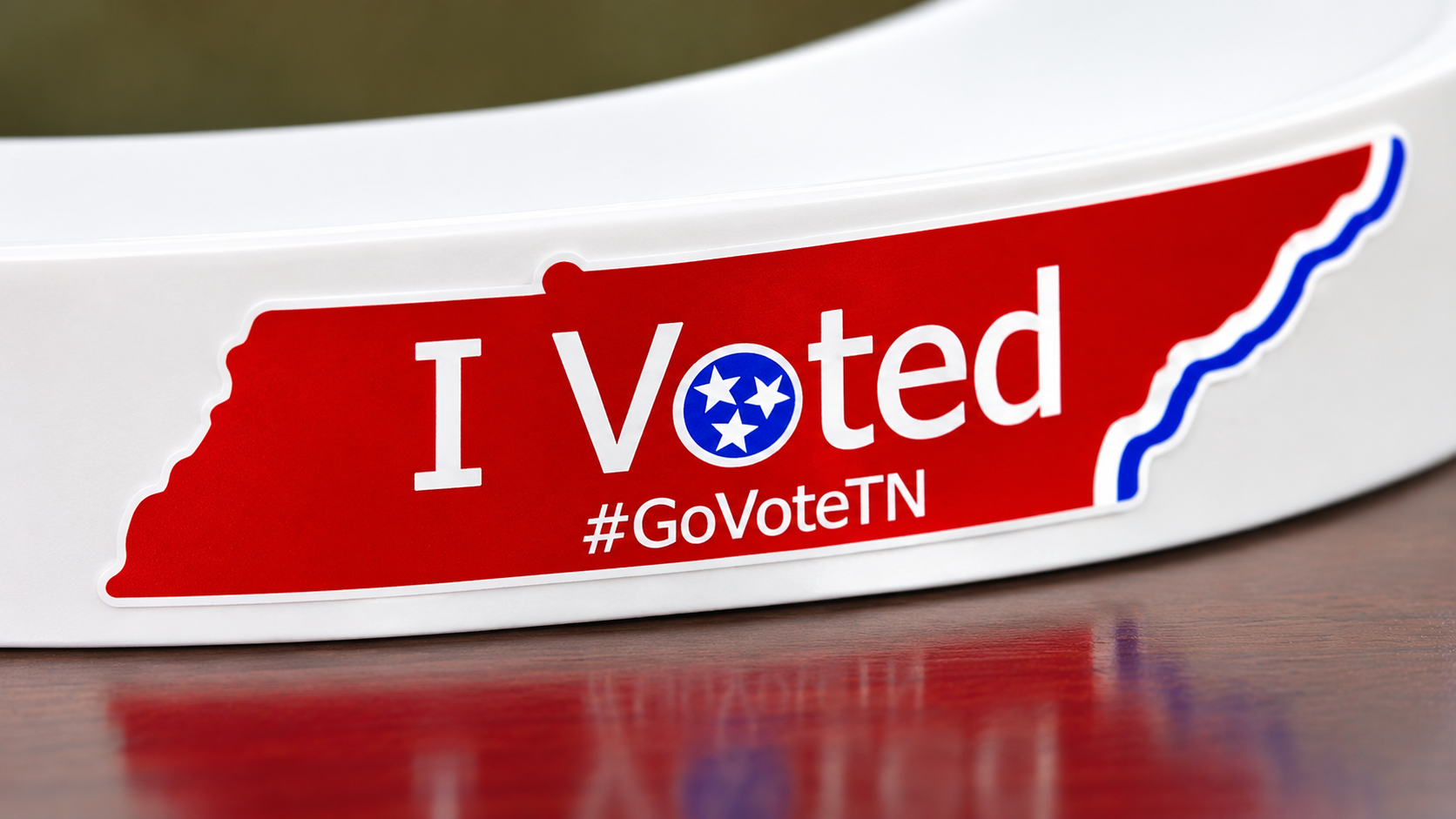
I went for a drive with my ten-year-old daughter, Georgia, and we both came home with a sticker.
Mine said “I Voted.”
Hers said “Future Voter.”
It might not sound particularly exciting, but after eight years living in America, I’d finally voted in my first American election.
What I hadn’t expected was to have an entire room of people cheering me on.
Or to discover that one of the most important decisions I’d make on my ballot would come down to an email. There was also the rather disappointing matter of the missing sausages, but we’ll get to that.
Apparently, being a first-time voter is a big deal
Early voting had begun here in Tennessee, and I decided to get in before the Election Day crowds.
I turned up with my American passport, ready to have my name checked, work out how the voting machine operated and head home.
There was just one thing I wanted to mention to the polling workers.
This was my first time voting in an American election.
Before I’d even finished explaining, someone called out, “FIRST TIME VOTER!”
Suddenly, people were cheering.
I loved it.

Although I did wonder what everyone made of this bloke with white hair, a ten-year-old daughter beside him, announcing he’d never voted before.
They probably thought I’d spent the past forty years trying to make up my mind.
The polling workers couldn’t have been more welcoming. They explained how everything worked, helped me understand the voting process and made Georgia feel included.
A few even joked that she’d come along to make sure Dad did everything properly.
Given that I was the one who’d never used an American voting machine, they might have had a point.
What struck me was how much everyone seemed to enjoy the occasion. Voting wasn’t being treated as some tedious administrative chore. At least in that room, it felt like something worth celebrating.
In Australia, voting is just something you do
I’ve been voting in Australian elections since I turned eighteen.
I couldn’t tell you anything about my first time, I don’t remember where I voted, who was working at the polling booth or whether anything particularly interesting happened.
I probably turned up, collected my ballot papers, marked my preferences and went home.

Voting is compulsory for eligible enrolled Australians, so it’s something you grow up expecting to do.
If you don’t vote and don’t have a valid reason, you can even find yourself paying a fine.
That doesn’t mean Australians don’t care about elections. We certainly do. Anyone who’s sat through an Australian election campaign knows we can argue about politics with the best of them.
But the act of voting itself feels fairly routine.
In America, voting is voluntary.
You make a conscious decision to participate, work out when and where to vote, and make the effort to turn up.
I wonder whether that difference helps explain some of the enthusiasm I encountered.
Maybe when participation is a choice, there’s something more meaningful about welcoming someone who’s making that choice for the first time.
Of course, that’s only my impression from one polling place in Tennessee. But it made an ordinary Tuesday feel like a bit of an occasion.
The ballot was longer than I expected
Before moving to the US, I’d spent years following American politics.
I knew the presidents, the major political figures and plenty of the arguments happening in Washington.
But following politics on television and actually voting in an American election are two very different things.
I started looking through my sample ballot and discovered quite a few people I’d never heard of.

There were candidates for Governor, the U.S. Senate, the House of Representatives and the Tennessee legislature.
Some were hoping to represent us in Washington. Others wanted to represent us in Nashville.
Then there were local positions and constitutional amendments.
I had some homework to do.
My experience of voting in Australia had always involved paper ballots. Someone hands you the papers, you mark your choices and put them into the ballot boxes.
Here in Tennessee, I was going to be using an electronic voting machine.
I also needed to work out what identification to take, where early voting was happening and exactly what would appear on the ballot.
Fortunately, Tennessee provides sample ballots online, which meant I could research the candidates before turning up.
That turned out to be important when I reached the constitutional amendments.
There’s nothing quite like standing in a voting booth, reading several paragraphs of legal language, and realising you’re being asked to make a decision about the state’s constitution.
In Australia, we call votes on proposed changes to the federal Constitution referendums.
The concept wasn’t unfamiliar, but the wording on the Tennessee ballot required some concentration. I was happy I’d done some reading beforehand.

The email that changed my vote
One of the more interesting things about preparing for this election was discovering that I wasn’t going to vote for the same political party in every race.
I’ve generally leaned more conservative than liberal, but I’ve never believed that means I have to agree with everything a particular party does.
I’ve spent enough time around politicians to know that party labels don’t tell you everything about the person.
When I lived in Canberra, Australia’s capital, I worked in banking and dealt with politicians regularly, even the current Prime Minister.
It taught me something useful.
What a politician promises and what they eventually deliver can be two very different things.
Some milestones deserve more than a photograph tucked away on your phone. Becoming an American citizen is one of them. If you’re celebrating your own naturalization, a citizenship certificate keepsake could be a lovely way to mark the occasion.
So rather than simply working my way down the ballot looking for a certain party, I wanted to understand what the candidates actually believed.
One of those decisions began with a question about Tennessee’s death penalty.
I’d been researching the state’s execution procedures, the methods being used and the costs involved.
Given everything that had occured here recently I had questions about whether the system needed reviewing, so I contacted several elected representatives.
Among them were my state senator, my state representative and U.S. Senator Marsha Blackburn.

I received replies from everyone except my state representative.
That bothered me.
I wasn’t expecting every politician to agree with me. In fact, I’d have been surprised if they did.
But I did expect an answer.
If someone is elected to represent a community, surely responding to reasonable questions from the people living there is part of the job.
So I decided to contact the Democratic candidate running for the Tennessee House of Representatives.
I asked him about two things.
The death penalty and the amount of development happening around where I live.
Not exactly the sort of conversation you’d have over a cup of coffee, but both issues mattered to me.
Sometimes a thoughtful answer makes all the difference
I love the area of Tennessee where we live.
There are trees, lakes, woodland and open spaces that give the place much of its character.
But development is happening everywhere.

Another subdivision appears. Another commercial development gets approved. More traffic arrives on roads that already seem to be struggling.
I’m not opposed to development. People need somewhere to live, businesses need somewhere to operate and communities inevitably change.
But I don’t believe every available piece of land needs to become another subdivision.
I wanted to know whether this candidate believed some of our green spaces should be protected.
He replied the same day.
Not with a generic message thanking me for my interest in important issues.
He actually answered the questions.
On development, he discussed the importance of protecting green spaces and preserving the character of our community.
He described the county as somewhere that should be tended and nourished rather than treated as a resource to be quickly harvested.
I liked that.
On capital punishment, his answer was equally interesting.
He supported the death penalty in certain circumstances but acknowledged that his religious faith sometimes conflicted with that position.
He also believed Tennessee’s execution system needed serious reform, potentially including a moratorium while its problems were investigated.
I didn’t agree with everything he said.
But I understood his reasoning.
That’s something I think we’ve lost sight of in political discussions.
You can disagree with someone without dismissing everything they believe.
You can also discover that a person from a political party you don’t usually support has given serious thought to an issue that matters to you.
His response wasn’t simply a collection of talking points. He explained where he stood and why.
Had the incumbent responded, I would have liked to consider her answers as well.
But she hadn’t.
So when I went to vote, I made my decision based on the information available to me.
He got my vote.
The Democrat.

One thing I wish I’d known before voting
Back at the polling place, Georgia and I were working our way through the ballot.
The voting machine was straightforward enough once the polling workers explained it.
But then I came across a race I hadn’t researched.
City Commissioner.
I didn’t recognise either candidate.
There were no party labels beside their names, and I knew nothing about what either person stood for.
So I turned to Georgia and asked her to pick a name she liked.
Not exactly the most sophisticated political research method.
I’ve since discovered that I could have left that contest blank.
In Tennessee, you don’t have to vote in every race for your other selections to count.
One thing I’ve learned is that becoming an American citizen doesn’t automatically mean understanding every part of American government. I’ve found that having a straightforward guide to the Constitution can be useful, particularly when you’re trying to make sense of what you’re voting on.
You can skip a contest if you don’t know enough about the candidates.
That would have been rather useful information about ten minutes earlier.
I guess there’s a lesson in that.
For all the attention we give presidential elections and the major races, local government matters too.
The people making decisions about roads, development, public facilities and local services can have a very direct influence on everyday life.
Yet those are sometimes the candidates we know the least about.
Next time, I’ll be going through the entire sample ballot before leaving the house.
As for Georgia, her career as my political adviser might be over before it’s properly begun.
There’s something missing from American elections
Now we come to the biggest disappointment of the day.
No sausages.
Not one.
For my American readers, allow me to explain one of Australia’s great electoral traditions.
The democracy sausage.

In Australia, polling places are often set up at schools, community centres and other public buildings.
Community groups sometimes use the occasion to raise money by running sausage sizzles.
You turn up to vote, and outside there’s a barbecue cooking sausages.
A sausage in a slice of bread, a bit of tomato sauce, maybe some onions.
Nothing fancy, just a good old-fashioned Aussie sausage sizzle.
If you’re lucky, there might be bacon and egg rolls for breakfast.
Sometimes there’s a cake stall as well.
It’s a decent arrangement when you think about it.
Thousands of people are turning up to vote so why wouldn’t you feed them?
It’s become such a familiar part of Australian election culture that people actively look for polling places selling them, there’s even an app so you know who has what.
Here in Tennessee, I found friendly campaign workers, helpful election officials and plenty of enthusiasm.
But no barbecue.
Not even a cupcake.
I had to explain this terrible oversight to Georgia, who was understandably disappointed to discover that American democracy doesn’t come with lunch.

We both got stickers, which was a nice touch.
But it’s difficult to put tomato sauce on a sticker.
Why I wanted Georgia there
One of the things I enjoyed most was watching how the polling workers interacted with Georgia.
She wasn’t treated as an inconvenience or someone who simply had to stand quietly while Dad got on with things.
People spoke to her, joked with her and made her feel welcome.
She received her own “Future Voter” sticker.
I thought that was a nice touch.
At ten years old, she’s still a long way from casting a ballot herself.
But she’s growing up in a country where politics is part of everyday conversation.
She hears adults discussing elections, sees campaign signs along the roads and watches the arguments that seem to accompany just about every political issue in America.
I wanted her to see something beyond all that.
That participating in democracy isn’t just about supporting your favourite politician or arguing with someone who disagrees with you.
It’s about taking the time to understand the issues, making decisions and accepting some responsibility for the place where you live.
It’s also about recognising that the person standing beside you might vote differently.
That doesn’t make them a bad person.
I hope that’s something she’ll remember as she gets older.
I don’t know whether Georgia will remember the details of this election.
She might not remember which candidates were running or what the constitutional amendments were about.
But maybe she’ll remember going with Dad to vote, seeing people cheer and getting her own sticker.
She’ll almost certainly remember that there weren’t any sausages.
Eight years later, America feels a little more like home
There’s something interesting about living in another country for a long time.
For the first few years, you spend a lot of time observing.
You notice the differences, question the customs and compare things with the way you grew up.
Even after you’ve settled in, there’s sometimes a small part of you that still feels like an outsider looking in.
I’ve lived in America for eight years now.
I’ve worked here, raised my family here and become an American citizen.
America has been home for quite some time.
But voting made that feel a little different.
For years, I’d watched American elections with great interest. I had opinions about the candidates, the policies and the direction the country was heading.
This time, I actually had a say.
Not a large say just one vote among millions.
But it was mine.
I could write to elected representatives, question candidates about issues affecting my community and make a decision about who I wanted representing us.
That feels quite different from simply watching the results on television.
I expected to walk into the polling place, cast my vote and come home.
Instead, I came away feeling genuinely proud.
Proud that I’d finally participated in an American election.
Grateful for the people who made my first experience so welcoming.
But most of all, glad that Georgia was there to share it with me.
I can’t remember the first time I voted in Australia.
I reckon I’ll remember my first time voting in America.
Even without the sausage.
If you enjoy these stories about Australian language, culture, and the little things that make us who we are, you can support From Down Under to Down South through Buy Me a Coffee . Every bit of support helps keep the stories coming.
This article contains affiliate links. If you purchase through them, I may earn a small commission at no additional cost to you.